Perimenopause Hot Flashes: Comparing Treatment Options
Hormone therapy is the most effective treatment for hot flashes, but your health history, cycle changes, and preferences help determine which option fits.
For bothersome hot flashes, compare systemic hormone therapy with evidence-supported nonhormonal options such as certain antidepressants, gabapentin, or fezolinetant. Hormone therapy is the most effective option overall, but its risks vary by formulation, route, timing, and personal health factors. During perimenopause, changing cycles and contraceptive needs can also shape the discussion, so a treatment that works for hot flashes may not address every concern. 3 4 5
Start with what you want treatment to change
Hot flashes that interrupt sleep or make work and daily life harder are a reasonable reason to consider treatment. The choice isn’t simply “hormones or nothing.” Hormone therapy is the most effective treatment for vasomotor symptoms, while several nonhormonal prescription and behavioral options also have evidence behind them. No single option is right for everyone. 3 4
It can help to name your main goal first. Is it fewer or less intense hot flashes? Better sleep? Relief from other menopause symptoms? Or help with irregular bleeding or contraception as well? These goals can point toward different conversations.
Hormone therapy: most effective, with personal tradeoffs
Systemic menopausal hormone therapy is the most effective treatment for hot flashes. Its benefit-risk balance depends on factors including the type of hormone, dose, duration, route, timing, and whether a progestogen is used. Guidance describes a more favorable balance for many women younger than 60 or within 10 years of menopause onset who have no contraindications, but those factors don’t replace an individual review of your medical history. 3
There’s a practical evidence wrinkle during perimenopause: a product-specific trial of estradiol plus progesterone enrolled naturally postmenopausal women, not women still having periods. Its results shouldn’t be treated as a direct estimate of what a particular perimenopausal woman will experience. Perimenopause itself is a varied transition, and contraceptive needs and changing bleeding patterns can affect which hormonal approach is considered. 1 5
Hormone therapy is not a single interchangeable product. Ask which formulation and route are being considered, what symptoms it is intended to address, and how your health history changes the balance of benefits and risks. A history of estrogen-dependent cancer or cardiovascular disease can make hormone therapy a poor fit for some people; personal preference is also a valid reason to discuss nonhormonal choices. 3 4
Nonhormonal options: several paths, different fits
The Menopause Society’s evidence review recommends certain SSRIs or SNRIs, gabapentin, and fezolinetant for hot flashes; it also supports cognitive behavioral therapy and clinical hypnosis. Oxybutynin is another medication option with evidence support. These choices differ in their possible side effects, other uses, and practical considerations, so it’s worth discussing what matters most to you rather than picking from a universal ranking. 4
Fezolinetant is a nonhormonal prescription tablet for moderate to severe vasomotor symptoms due to menopause. Its US prescribing information requires liver blood tests before treatment, monthly for the first three months, and at months six and nine. It also has specific restrictions related to liver and kidney problems and interactions with certain medicines, including CYP1A2 inhibitors. If it’s being considered, bring a complete list of your medicines and supplements to the conversation. 2
Behavioral options may suit you if you prefer not to take medication or want a tool alongside it. Cognitive behavioral therapy and clinical hypnosis are evidence-supported approaches for vasomotor symptoms. By contrast, the position statement does not recommend supplements or herbal remedies as a treatment for these symptoms; a “natural” label doesn’t establish that a product works. 4
Make the comparison specific to your life
A useful discussion is about fit, not just which treatment has the strongest average effect. You might ask:
- Which of my symptoms is this option expected to help, and which might it leave unchanged?
- How does my personal history affect the risks and likely benefits of hormone therapy?
- Does my cycle pattern or need for contraception change the options we should consider?
- What side effects, medicine interactions, or monitoring should I plan for?
- If this choice doesn’t help enough or doesn’t suit me, what would we consider next?
For example, someone who wants to avoid hormones might compare an evidence-supported prescription with cognitive behavioral therapy. Someone who wants help with hot flashes and changing cycles might ask how treatment choices relate to both symptoms and contraception. Those are starting points for a personal discussion, not treatment rules.
Revisit the choice as things change
Perimenopause is not a fixed snapshot: symptoms, bleeding patterns, and priorities can shift. It makes sense to revisit whether a treatment is helping and whether its tradeoffs still feel acceptable. If a treatment is started, agree on what improvement would look like and when to review that plan. Individualized treatment and periodic reassessment are central to menopause hormone therapy guidance. 3 5
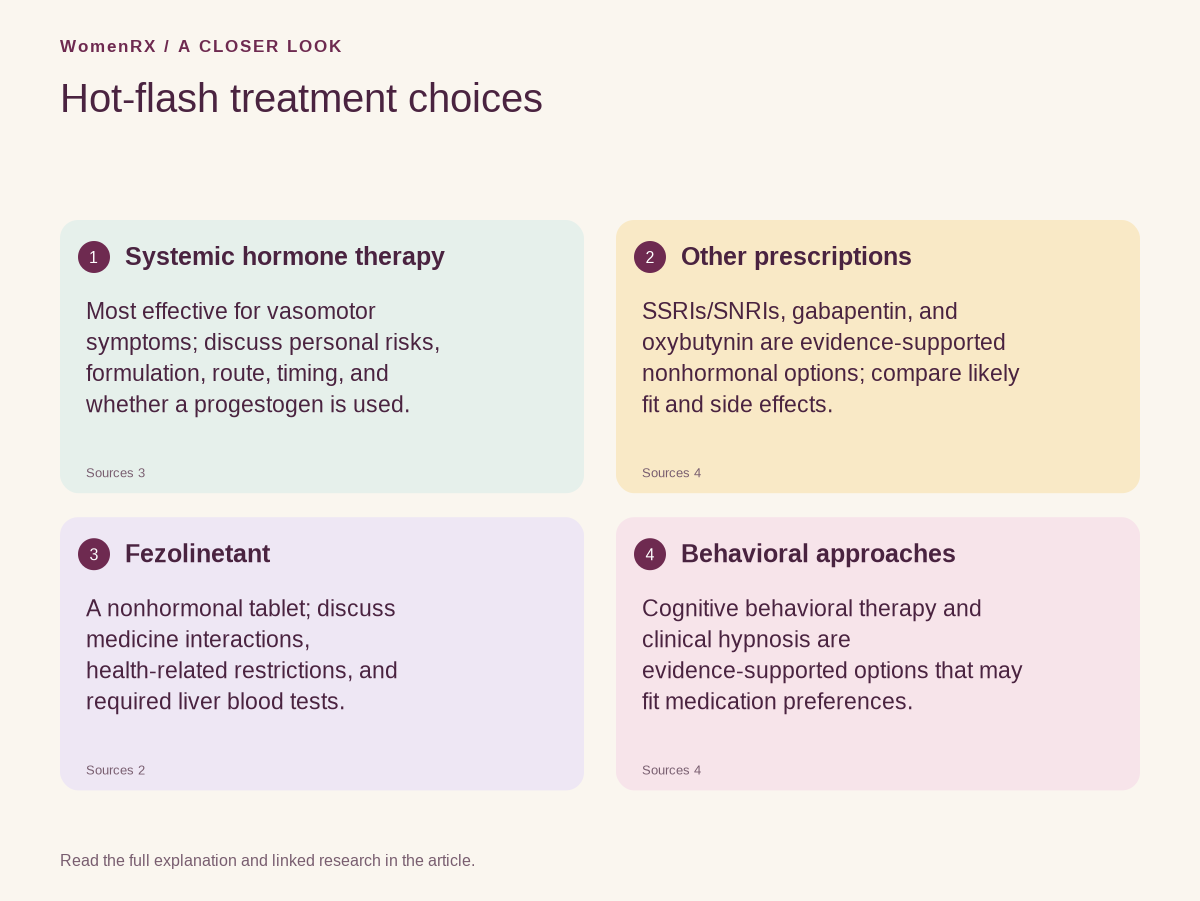
Hot-flash treatment choices
Systemic hormone therapy: Most effective for vasomotor symptoms; discuss personal risks, formulation, route, timing, and whether a progestogen is used.3
Other prescriptions: SSRIs/SNRIs, gabapentin, and oxybutynin are evidence-supported nonhormonal options; compare likely fit and side effects.4
Fezolinetant: A nonhormonal tablet; discuss medicine interactions, health-related restrictions, and required liver blood tests.2
Behavioral approaches: Cognitive behavioral therapy and clinical hypnosis are evidence-supported options that may fit medication preferences.4
Read the figure as text
These options differ in their evidence, practical considerations, and what to ask about during perimenopause.- Systemic hormone therapy: Most effective for vasomotor symptoms; discuss personal risks, formulation, route, timing, and whether a progestogen is used.3
- Other prescriptions: SSRIs/SNRIs, gabapentin, and oxybutynin are evidence-supported nonhormonal options; compare likely fit and side effects.4
- Fezolinetant: A nonhormonal tablet; discuss medicine interactions, health-related restrictions, and required liver blood tests.2
- Behavioral approaches: Cognitive behavioral therapy and clinical hypnosis are evidence-supported options that may fit medication preferences.4
More questions, answered
Are supplements a proven alternative for hot flashes?
The Menopause Society’s evidence review does not recommend supplements or herbal remedies for treating vasomotor symptoms. If you’re considering one, include it in your medicine and supplement list when discussing treatment options. 4
Does a nonhormonal option mean there’s no monitoring?
Not necessarily. Fezolinetant, for example, requires liver blood tests before starting and at specified points during treatment, and has medicine-interaction and health-related restrictions. Monitoring depends on the option being considered. 2
Sources you can check
- BIJUVA (ESTRADIOL AND PROGESTERONE) CAPSULE [MAYNE PHARMA] | US prescribing information and patient instructionsAccessed 2026-09-25Return to first citation
- VEOZAH (FEZOLINETANT) TABLET, FILM COATED [ASTELLAS PHARMA US, INC.] | US prescribing information and patient instructionsAccessed 2026-09-25Return to first citation
- The 2022 hormone therapy position statement of The North American Menopause Society.“The 2022 Hormone Therapy Position Statement of The North American Menopause Society” Advisory Panel. · Menopause (New York, N.Y.) · 2022Return to first citation
- The 2023 nonhormone therapy position statement of The North American Menopause Society.Menopause (New York, N.Y.) · 2023Return to first citation
- Hormonal Options for Perimenopause: A Clinician Toolkit.Piasta J, Zewail A. · Obstetrics and gynecology · 2026Return to first citation