Can Food Improve Vaginal Health? What Research Shows
Some studies link diet with vaginal microbiome patterns, but the human research described here doesn’t show that a particular food prevents infection or relieves vaginal symptoms.
Diet and the vaginal microbiome may be related, but pregnancy studies of diet and vaginal microbes don’t establish that eating a particular food prevents bacterial vaginosis, changes vaginal odor or pH, or treats symptoms. 34 One pregnancy trial found that a Mediterranean-style diet affected gut microbes but had a negligible association with vaginal microbiota. 3 Food shouldn’t replace assessment of a change in discharge or other symptoms. 12
The key distinction: association isn’t treatment
You may see foods or eating plans promoted as ways to “balance” vaginal bacteria. The pregnancy studies offer a more limited picture: diet can be associated with measurements of the vaginal microbiome, but that doesn’t show that a specific food changes how you feel or prevents an infection.
Researchers measure different things, including which bacteria are present, their relative abundance, and the overall structure of a microbial community. Those are not the same as measuring odor, discharge, vaginal pH, or whether someone develops bacterial vaginosis (BV). A change in a microbiome measure alone doesn’t establish a health benefit. 34
What human studies have actually measured
A study of 119 pregnant participants collected vaginal samples at 16 weeks and compared microbiome features with questionnaire-reported diet and other characteristics. Some dietary factors, including amino acids and macronutrients, were associated with differences in the measured vaginal microbiome. Because the study was observational, it cannot show that those foods caused the differences, and it did not test whether changing diet prevents infection or improves symptoms. 4
A separate randomized trial subanalysis looked at 351 pregnancies assigned to a Mediterranean-diet intervention, a stress-reduction program, or no intervention. The diet intervention affected the overall structure of participants’ gut microbiota, while the interventions had a negligible association with vaginal microbiota. The vaginal microbiome was an exploratory outcome, and these results don’t prove that diet has no effect in every person or at every life stage. They do show why a gut-microbiome result shouldn’t be presented as proof of a vaginal benefit. 3
Taken together, these findings are about microbial patterns in pregnancy, not evidence that a food treats a vaginal condition. They also don’t tell us that one person can eat a particular food and reliably produce a particular vaginal microbiome.
What about yogurt, probiotics, or a “vaginal health” diet?
The studies above don’t test a particular yogurt or food as treatment for vaginal symptoms, and they don’t establish that a specific eating plan prevents BV. So, based on this evidence, there isn’t a supported food prescription for changing vaginal odor, discharge, or infection risk.
That doesn’t mean you need to avoid foods you enjoy or give up a balanced eating pattern. It means the reason to choose a food should not be a promise that it will treat or prevent a vaginal infection. A dietary pattern can have other reasons to be appealing, but those are separate from demonstrating a vaginal health effect.
When symptoms deserve attention
Discharge normally varies, including around ovulation. A change in its smell, color, or texture can sometimes signal infection, and different conditions can cause different patterns. For example, BV can cause thin, grayish-white discharge with a fishy smell, but some people with BV have no symptoms. Symptoms alone can’t confirm the cause. 12
If your discharge changes and you’re concerned, or you have symptoms you think may be BV, seek assessment rather than trying to identify or treat the cause with food. BV may need antibiotic treatment, and other causes of discharge can need different care. BV can also return, so recurring symptoms are a reason to get advice about what’s causing them and what treatment may be appropriate. 12
The practical takeaway is simple: eat for your overall well-being, but don’t count on a specific food to prevent or treat vaginal symptoms. If something changes, getting the cause checked is more useful than trying to correct it with a diet change.
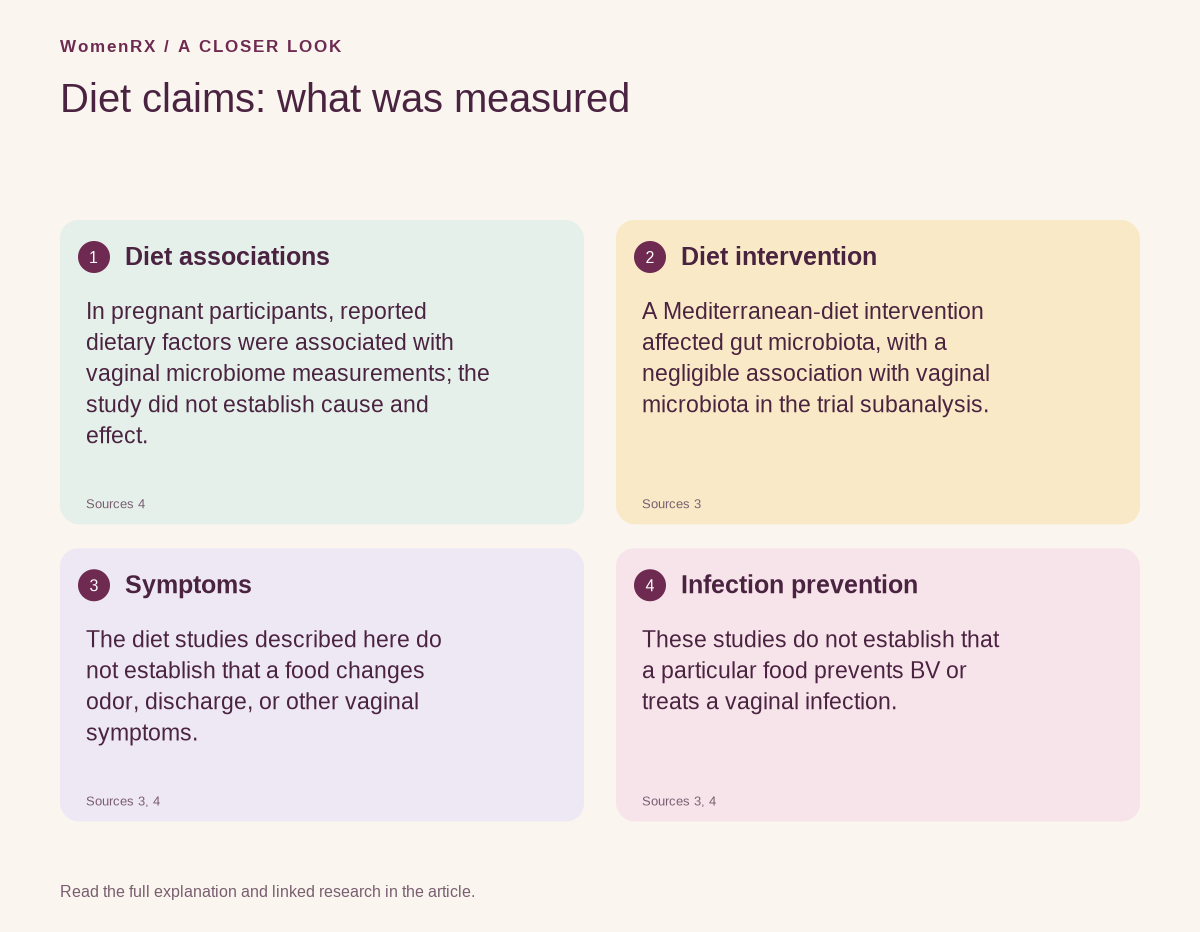
Diet claims: what was measured
Diet associations: In pregnant participants, reported dietary factors were associated with vaginal microbiome measurements; the study did not establish cause and effect.4
Diet intervention: A Mediterranean-diet intervention affected gut microbiota, with a negligible association with vaginal microbiota in the trial subanalysis.3
Symptoms: The diet studies described here do not establish that a food changes odor, discharge, or other vaginal symptoms.34
Infection prevention: These studies do not establish that a particular food prevents BV or treats a vaginal infection.34
Read the figure as text
The difference between observed microbiome patterns, an intervention result, and outcomes these studies did not establish.- Diet associations: In pregnant participants, reported dietary factors were associated with vaginal microbiome measurements; the study did not establish cause and effect.4
- Diet intervention: A Mediterranean-diet intervention affected gut microbiota, with a negligible association with vaginal microbiota in the trial subanalysis.3
- Symptoms: The diet studies described here do not establish that a food changes odor, discharge, or other vaginal symptoms.34
- Infection prevention: These studies do not establish that a particular food prevents BV or treats a vaginal infection.34
More questions, answered
Does eating yogurt prevent bacterial vaginosis?
Neither pregnancy study tests yogurt as a way to prevent BV, so they can’t support that claim. 34 If you notice a change in discharge or odor, food isn’t a substitute for finding out what’s causing it. 12
Can diet changes treat BV?
The human diet studies described here don’t establish diet as a BV treatment. NHS guidance says BV may need antibiotic treatment, so suspected or recurring symptoms are better assessed than managed with food alone. 134
Sources you can check
- Bacterial vaginosis - NHSAccessed 2026-09-25Return to first citation
- Vaginal discharge - NHSAccessed 2026-09-25Return to first citation
- Effects of Mediterranean diet or Mindfulness-Based Stress Reduction during pregnancy on maternal gut and vaginal microbiota: a subanalysis of the Improving Mothers for a better PrenAtal Care Trial BarCeloNa (IMPACT BCN) trial.Selma-Royo M, Crispi F, Castro-Barquero S, Casas I, Larroya M, Genero M, Paules C, Benitez L, Youssef L, Pascal R, Encabo N, Nakaki A, Martín-Asuero A, Oller-Guzmán MT, Arranz A, V... · The American journal of clinical nutrition · 2025Return to first citation
- Dietary amino acids, macronutrients, vaginal birth, and breastfeeding are associated with the vaginal microbiome in early pregnancy.Corbett GA, Moore R, Feehily C, Killeen SL, O'Brien E, Van Sinderen D, Matthews E, O'Flaherty R, Rudd PM, Saldova R, Walsh CJ, Lawton EM, MacIntyre DA, Corcoran S, Cotter PD, McAul... · Microbiology spectrum · 2024Return to first citation