Vaginal pH: When to Leave It Alone and When to Get Help
Vaginal pH can offer a clue about what’s going on, but it isn’t a wellness score you need to correct at home.
You generally don’t need to change your vaginal pH just to reach a particular number. A pH reading alone can’t diagnose bacterial vaginosis (BV). After menopause, lower estrogen can raise pH and cause dryness or irritation, which can complicate interpretation. New odor or discharge is a reason to seek evaluation rather than try an internal home remedy. 1 3
pH is a clue, not a target
Vaginal pH describes how acidic the vaginal fluid is. Lactobacilli, bacteria that commonly live in the vagina, help maintain an acidic environment. But a pH reading doesn’t tell you on its own whether you have an infection, what caused a change, or whether you need treatment. 3 4
That’s why trying to “balance” pH at home can miss the real question. Symptoms and clinical testing help distinguish BV from other causes of vaginal changes; a pH number alone cannot. 1 3
What odor or discharge may mean
BV is one possible cause of an unusual vaginal discharge. It can cause thin, watery, grayish-white discharge and a strong fishy odor, sometimes more noticeable after sex. BV often doesn’t cause much soreness or itching, and some people with BV have no symptoms. Other causes can also change discharge, so odor alone can’t confirm BV. 1
If you notice a new or persistent change in odor or discharge, getting evaluated is more useful than trying to adjust a pH number. A clinician can ask about your symptoms and may take a sample of vaginal discharge to check for BV and other infections. 1
Menopause changes how pH should be read
After menopause, falling estrogen can reduce vaginal lactobacilli and raise pH. It can also contribute to genitourinary syndrome of menopause (GSM), which may cause dryness and irritation. Those changes can overlap with BV findings, and traditional BV tests were developed in premenopausal women, so interpreting results after menopause can be more difficult. 3
If you’re postmenopausal and have dryness or irritation, an elevated pH doesn’t automatically mean you have BV. A review of postmenopausal BV recommends considering estrogen deficiency first in women with characteristic menopausal symptoms and elevated pH; symptoms still matter when deciding whether BV is likely. 3
Menopause isn’t the only useful context. If odor or discharge tends to recur around your period or after sex, mention that pattern when you seek care. Either can be a trigger for BV symptoms, but the pattern alone doesn’t establish the cause. 1
What’s reasonable to try at home
Keep care simple on the outside: the NHS recommends washing the genital area with water and plain soap. That’s different from trying to change the vaginal environment from the inside. 1
You don’t need to chase a universal pH target. Probiotics are sometimes promoted for vaginal health, but a review describes their effects on reproductive-tract health as controversial. They aren’t established as a reliable way to reset pH or treat symptoms. 4
One small randomized trial in 60 postmenopausal women with GSM found that a specific vaginal gel containing Pueraria mirifica improved some BV-related measures compared with placebo after 12 weeks, but it did not show a significant difference in symptom improvement between groups. That result is about one product in one study population, not proof that natural products generally balance pH or relieve symptoms. 2
Choose evaluation over a pH-fixing experiment
Consider an evaluation if you have a new or ongoing fishy odor, unusual discharge, or symptoms that are bothering you. This is especially useful if you’re postmenopausal, because dryness and irritation can have a different explanation from BV, and pH alone may not sort them out. If you’re pregnant and think you may have BV, seek care: BV in pregnancy can sometimes be associated with complications. 1 3
The practical takeaway: focus on what changed and how you feel, not on chasing an “ideal” pH. A pH result can contribute to an assessment, but it shouldn’t replace one.
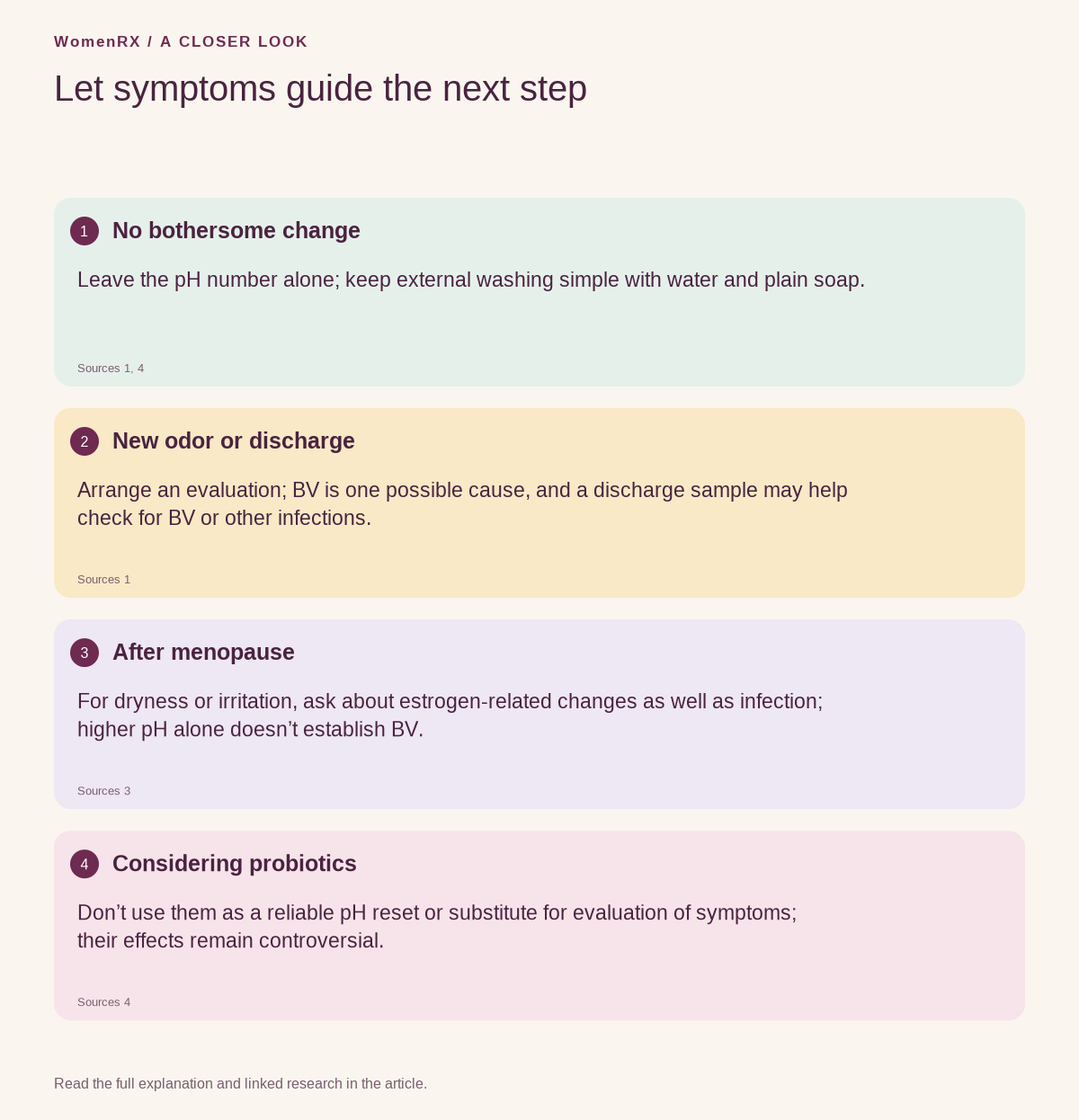
Let symptoms guide the next step
No bothersome change: Leave the pH number alone; keep external washing simple with water and plain soap.14
New odor or discharge: Arrange an evaluation; BV is one possible cause, and a discharge sample may help check for BV or other infections.1
After menopause: For dryness or irritation, ask about estrogen-related changes as well as infection; higher pH alone doesn’t establish BV.3
Considering probiotics: Don’t use them as a reliable pH reset or substitute for evaluation of symptoms; their effects remain controversial.4
Read the figure as text
Start with what you’ve noticed, then follow the matching path: a pH number alone can’t identify the cause. Keep washing external, and don’t rely on probiotics as a pH reset.- No bothersome change: Leave the pH number alone; keep external washing simple with water and plain soap.14
- New odor or discharge: Arrange an evaluation; BV is one possible cause, and a discharge sample may help check for BV or other infections.1
- After menopause: For dryness or irritation, ask about estrogen-related changes as well as infection; higher pH alone doesn’t establish BV.3
- Considering probiotics: Don’t use them as a reliable pH reset or substitute for evaluation of symptoms; their effects remain controversial.4
More questions, answered
Does a higher pH automatically mean I have BV?
No. Menopause can raise vaginal pH as estrogen and lactobacilli decrease, and traditional BV criteria can be harder to interpret after menopause. Symptoms and, when needed, testing help clarify the cause. 3
Can probiotics reliably balance vaginal pH?
They aren’t established as a reliable pH reset. A review describes the effects of probiotics on reproductive-tract health as controversial, so they shouldn’t replace evaluation for symptoms that could be BV or another condition. 4
Sources you can check
- Bacterial vaginosis - NHSAccessed 2026-09-25Return to first citation
- Comparison of the effects of Pueraria mirifica gel and of placebo gel on the vaginal microenvironment of postmenopausal women with Genitourinary Syndrome of Menopause (GSM).Sritonchai C, Manonai J, Sophonsritsuk A, Cherdshewasart W. · Maturitas · 2020Return to first citation
- Bacterial Vaginosis in Postmenopausal Women.Van Gerwen OT, Smith SE, Muzny CA. · Current infectious disease reports · 2023Return to first citation
- The role of probiotics in vaginal health.Mei Z, Li D. · Frontiers in cellular and infection microbiology · 2022Return to first citation