Vaginal pH Is a Clue, Not a Diagnosis
A home pH result can suggest a change in the vaginal environment, but it can’t tell you on its own what’s causing odor, discharge, or irritation.
Vaginal pH is one piece of a vaginitis assessment, not a way to diagnose the cause at home. A higher pH can occur with bacterial vaginosis or trichomoniasis, while yeast symptoms can occur with a normal or acidic pH. Menopause-related vaginal changes are another possible context for higher pH. Symptoms, exam findings, and sometimes a sample or other test help distinguish these causes. 3 5
What a pH result can tell you
Vaginal pH describes how acidic or less acidic the vaginal fluid is. It can help point an evaluation in a direction, but it doesn’t identify a specific infection or explain every symptom. In a common clinical approach for bacterial vaginosis (BV), pH above 4.5 is only one of four findings; three of the four are needed to meet the Amsel criteria. The other findings include the appearance of discharge, an odor test, and cells seen under a microscope. 3
That distinction matters if you’re using a home test. A higher reading may occur with BV, but it can also occur with trichomoniasis and with some menopause-related vaginal changes. Yeast symptoms, meanwhile, can occur with a normal or acidic pH. So neither a high nor a low result can confirm or rule out a particular cause by itself. 3 5
Similar symptoms don’t mean the same cause
Changes in discharge, odor, itching, burning, or soreness can overlap across conditions. BV often causes thin, grayish-white discharge and a fishy smell, and it usually doesn’t cause much itching or soreness. Yeast can cause thick white discharge and vulvar itching or burning. Trichomoniasis can cause yellow or green discharge, odor, soreness, or pain with sex or urination. These patterns may offer clues, but symptoms alone aren’t reliable enough to diagnose the cause. 1 2 3
Not every vaginal symptom is an infection. The pH review also describes irritation, allergic reactions, and atrophic or inflammatory vaginitis among possible noninfectious causes. That means a pH reading can’t tell you whether an infection is present or whether a noninfectious change is behind your symptoms. 3
Menopause can change the context
After menopause, vaginal tissue changes associated with genitourinary syndrome of menopause (GSM) can be part of the picture. In one clinical diagnostic study, vaginal atrophy was assessed using several findings, including vaginal dryness and tissue appearance, pH above 5, and microscopy. The pH value was one part of that assessment, not a stand-alone diagnosis. A higher reading shouldn’t automatically be attributed to menopause, especially when symptoms are new or changing. 5
A more useful path than treating the number
If you have a new or persistent change in discharge, odor, or irritation, use the pH result as context to share, not as a reason to choose a treatment on your own. A clinician may ask about your symptoms, examine the area, and test a sample to check for BV or other infections. Which tests make sense depends on the symptoms and the clinical assessment. 1 4
A useful way to think about the next step is:
- Symptoms with no pH test: Changes in discharge, odor, itching, or soreness can have overlapping causes. Describe what changed and when; don’t assume the cause from appearance alone. 2 3
- A higher pH: This may support further assessment for BV or another cause, but it doesn’t diagnose either one. 3
- A normal or acidic pH: This doesn’t rule out yeast when symptoms fit; pH is only one part of the picture. 3
- Symptoms with pelvic pain or bleeding: Seek medical evaluation rather than relying on a home reading. Discharge with pelvic pain or bleeding can be associated with infections such as chlamydia or gonorrhea. 2
For basic external washing, NHS guidance recommends gentle washing with warm water and mild, non-perfumed soap. 2 A pH result alone can’t identify the cause of symptoms or tell you which cause-specific treatment fits. 3
The practical takeaway: pH can help frame a conversation, but it can’t sort infection, menopause-related tissue changes, and irritation into separate answers. When symptoms are the reason you’re testing, finding the cause is more useful than trying to “balance” a number.
Where Symptoms and pH Lead Next
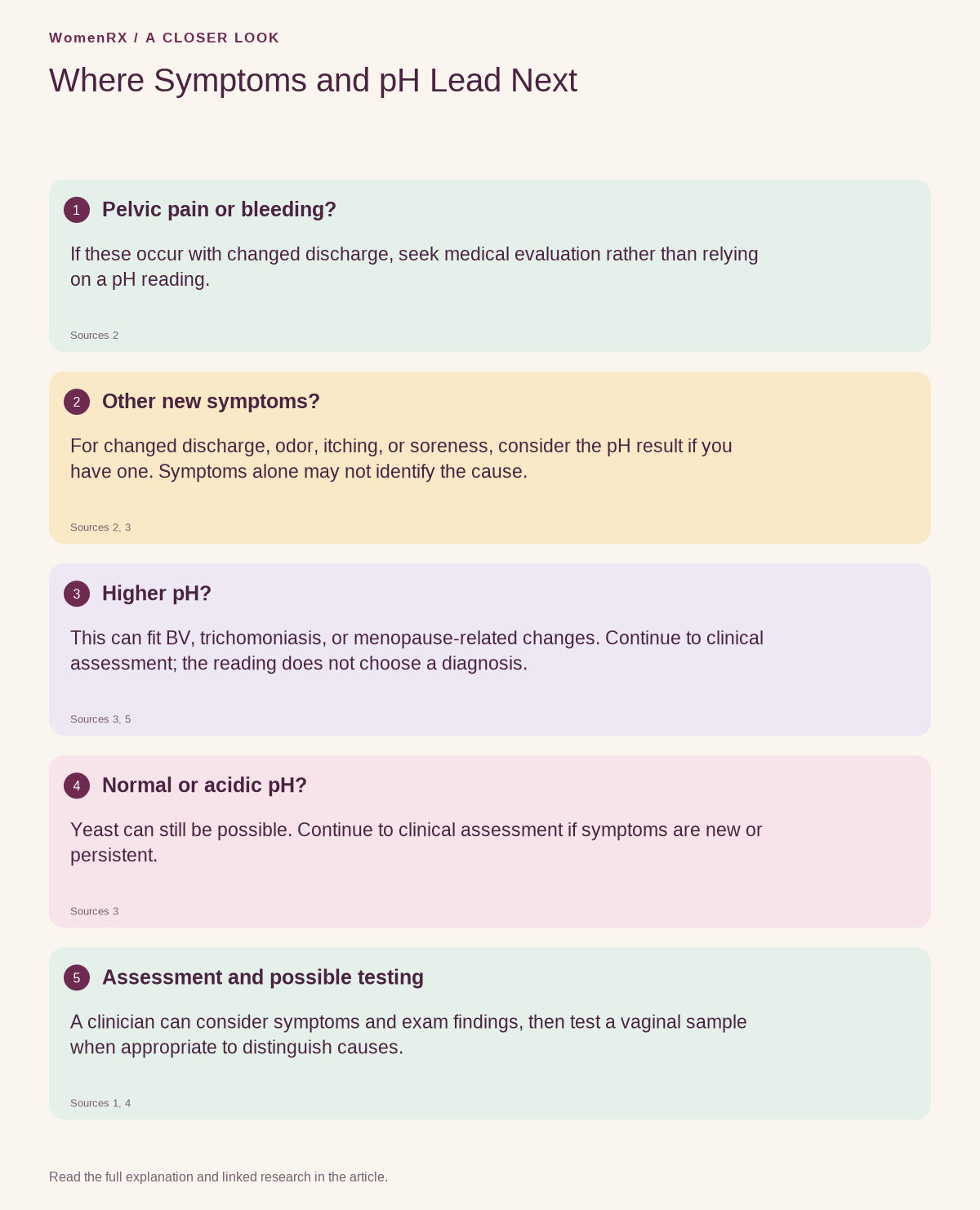
Pelvic pain or bleeding?: If these occur with changed discharge, seek medical evaluation rather than relying on a pH reading.2
Other new symptoms?: For changed discharge, odor, itching, or soreness, consider the pH result if you have one. Symptoms alone may not identify the cause.23
Higher pH?: This can fit BV, trichomoniasis, or menopause-related changes. Continue to clinical assessment; the reading does not choose a diagnosis.35
Normal or acidic pH?: Yeast can still be possible. Continue to clinical assessment if symptoms are new or persistent.3
Assessment and possible testing: A clinician can consider symptoms and exam findings, then test a vaginal sample when appropriate to distinguish causes.14
Read the figure as text
Start with the symptoms. A pH reading may add context, but different findings still lead to assessment rather than a pH-based remedy.- Pelvic pain or bleeding?: If these occur with changed discharge, seek medical evaluation rather than relying on a pH reading.2
- Other new symptoms?: For changed discharge, odor, itching, or soreness, consider the pH result if you have one. Symptoms alone may not identify the cause.23
- Higher pH?: This can fit BV, trichomoniasis, or menopause-related changes. Continue to clinical assessment; the reading does not choose a diagnosis.35
- Normal or acidic pH?: Yeast can still be possible. Continue to clinical assessment if symptoms are new or persistent.3
- Assessment and possible testing: A clinician can consider symptoms and exam findings, then test a vaginal sample when appropriate to distinguish causes.14
More questions, answered
Does a high vaginal pH mean I have BV?
No. A pH above 4.5 is one of four findings in the Amsel approach to BV diagnosis, and the criteria require three findings. Other conditions can also be associated with higher pH. 3
Can a normal pH rule out a yeast infection?
No. Yeast symptoms can occur with normal or acidic vaginal pH, so a pH result alone can’t confirm or exclude yeast. 3
Sources you can check
- Bacterial vaginosis - NHSAccessed 2026-09-25Return to first citation
- Vaginal discharge - NHSAccessed 2026-09-25Return to first citation
- Vaginal pH Value for Clinical Diagnosis and Treatment of Common Vaginitis.Lin YP, Chen WC, Cheng CM, Shen CJ. · Diagnostics (Basel, Switzerland) · 2021Return to first citation
- Comparing BD Affirm VPIII to Xpert Xpress MVP and BD MAX Vaginal Panel for the diagnosis of vaginal infections.Cosentino LA, Petrina M, Zamborsky T, Beamer M, Macio I, Meyn LA, Bunge KE, Hillier SL. · Microbiology spectrum · 2026Return to first citation
- Diagnostic performance of an automated microscopy and pH test for diagnosis of vaginitis.Lev-Sagie A, Strauss D, Ben Chetrit A. · NPJ digital medicine · 2023Return to first citation