Hashimoto’s: How Diagnosis and Treatment Decisions Work
A positive thyroid antibody test can point to Hashimoto’s, but thyroid-function tests help show whether your thyroid needs treatment now.
Clinicians assess Hashimoto’s by looking at thyroid function, usually starting with TSH and adding T4 tests as needed, and may use thyroid antibodies to identify an autoimmune cause. Antibodies alone don’t show whether your thyroid is making enough hormone. If thyroid function is normal, monitoring may be appropriate; when Hashimoto’s causes hypothyroidism, levothyroxine is a common treatment. 1 3
The tests answer different questions
A thyroid evaluation often starts with TSH, a blood test that measures thyroid-stimulating hormone. T4 tests measure thyroid hormone in the blood, while thyroid antibody tests can help identify an autoimmune thyroid condition. These tests work together: antibodies can point to the cause, while TSH and T4 help show how well the thyroid is functioning. 1
That distinction matters because Hashimoto’s can be present while the thyroid still makes enough hormone. A person may have thyroid antibodies and normal thyroid function, or may develop hypothyroidism if the gland can’t keep up. 3
Why symptoms aren’t enough
Weight or mood changes alone can’t establish Hashimoto’s or show whether thyroid hormone treatment is needed. Thyroid hormones affect many body systems, and blood tests are used to assess thyroid function and help diagnose thyroid disease. 1
A useful way to read the results is to separate two questions: “Is there evidence of an autoimmune cause?” and “Is my thyroid making enough hormone?” Antibody results mainly help with the first. TSH and T4 help answer the second. Your clinician interprets the results together rather than treating an antibody number as a measure of how much hormone you need. 1 3
When treatment enters the picture
If thyroid function is normal, a positive antibody test does not automatically mean you need medication. The evidence-based review describes periodic TSH measurement for people with normal thyroid function, to assess for progression to hypothyroidism. 3
When Hashimoto’s leads to hypothyroidism, thyroid hormone replacement with levothyroxine is a standard treatment. The decision rests on thyroid function and the clinical situation, not symptoms or antibodies in isolation. 3
If you take levothyroxine, some medicines can affect how much of it your body absorbs. For example, the US prescribing information identifies calcium carbonate and ferrous sulfate as agents that can bind levothyroxine and reduce absorption. If you take these or other medicines, ask your prescriber or pharmacist whether they affect your thyroid treatment. 2
If pregnancy is part of the picture
Planning a pregnancy: If you have a positive thyroid peroxidase antibody (TPOAb) result, bring it and any recent TSH and T4 results to your clinician. Ask whether your thyroid function needs checking now and what follow-up makes sense if it’s normal. A review reports an association between TPO antibodies and miscarriage and preterm birth in pregnant women, but that association doesn’t mean antibodies alone call for medication. 1 3
During pregnancy: Let your prenatal care team know if you have Hashimoto’s, positive antibodies, or take levothyroxine. Ask how they’ll assess your thyroid function and review treatment if hypothyroidism is present. The review identifies levothyroxine as the thyroid hormone treatment used during pregnancy when treatment is indicated; antibody results alone don’t answer whether you need it. 1 3
After birth: If you have Hashimoto’s or had thyroid-function changes during pregnancy, ask whether and when to recheck TSH, with T4 testing if needed to clarify thyroid function. Periodic TSH testing is used to watch for hypothyroidism when thyroid function is normal, but the pregnancy-outcome association doesn’t establish a postpartum testing interval. 1 3
A practical way to discuss your results
Ask which result reflects thyroid function and which suggests an autoimmune cause. Then ask whether your current thyroid function calls for treatment or follow-up testing. If pregnancy is relevant, include whether you’re planning, currently pregnant, or recently gave birth; those situations shouldn’t be treated as interchangeable. The key distinction is simple: antibodies can help explain why the thyroid may be affected, but thyroid-function tests help guide whether treatment is needed now. 1 3
From thyroid results to the next question
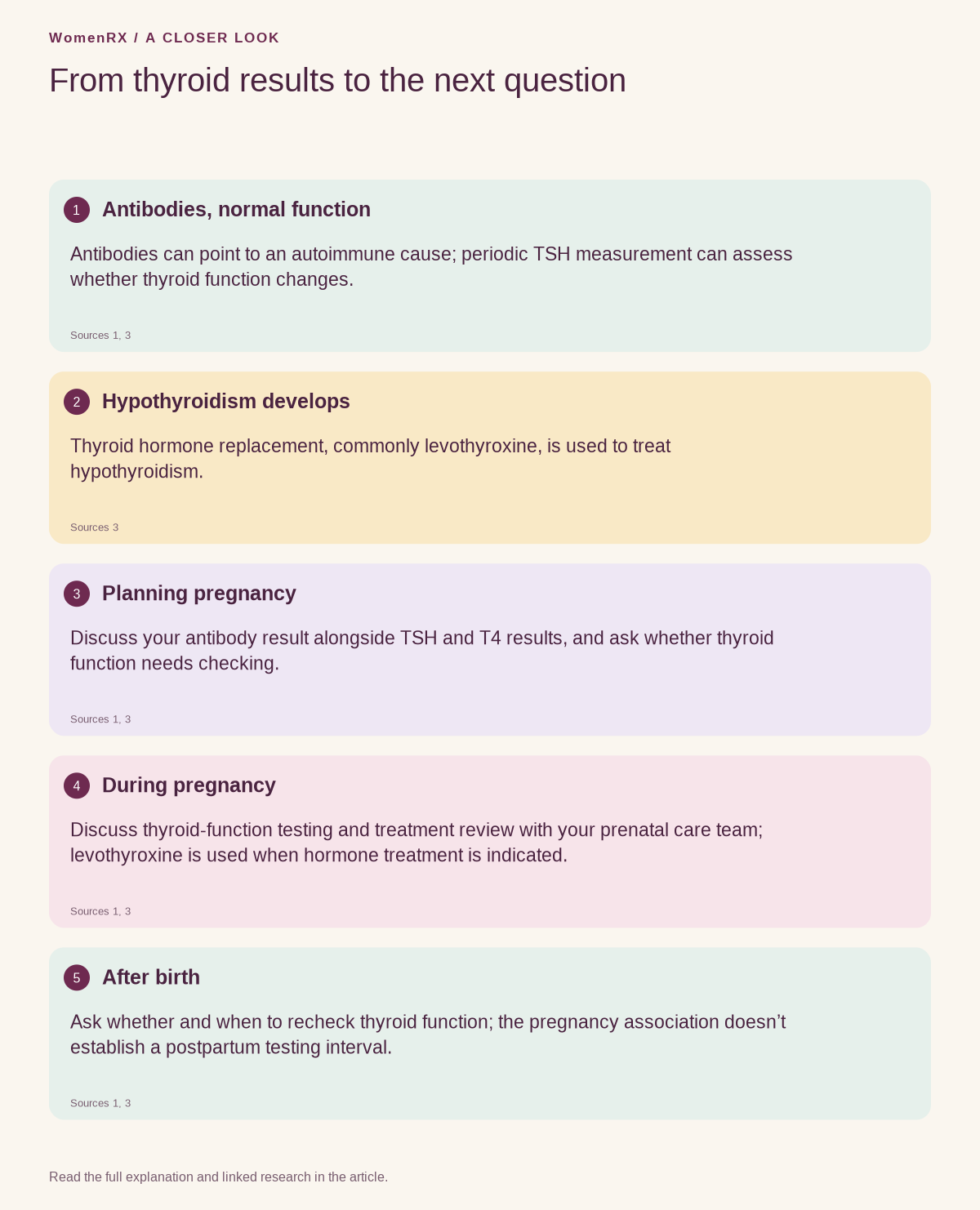
Antibodies, normal function: Antibodies can point to an autoimmune cause; periodic TSH measurement can assess whether thyroid function changes.13
Hypothyroidism develops: Thyroid hormone replacement, commonly levothyroxine, is used to treat hypothyroidism.3
Planning pregnancy: Discuss your antibody result alongside TSH and T4 results, and ask whether thyroid function needs checking.13
During pregnancy: Discuss thyroid-function testing and treatment review with your prenatal care team; levothyroxine is used when hormone treatment is indicated.13
After birth: Ask whether and when to recheck thyroid function; the pregnancy association doesn’t establish a postpartum testing interval.13
Read the figure as text
Follow the thyroid-function result first, then consider how pregnancy planning, pregnancy, or the period after birth changes the testing discussion.- Antibodies, normal function: Antibodies can point to an autoimmune cause; periodic TSH measurement can assess whether thyroid function changes.13
- Hypothyroidism develops: Thyroid hormone replacement, commonly levothyroxine, is used to treat hypothyroidism.3
- Planning pregnancy: Discuss your antibody result alongside TSH and T4 results, and ask whether thyroid function needs checking.13
- During pregnancy: Discuss thyroid-function testing and treatment review with your prenatal care team; levothyroxine is used when hormone treatment is indicated.13
- After birth: Ask whether and when to recheck thyroid function; the pregnancy association doesn’t establish a postpartum testing interval.13
More questions, answered
If my thyroid antibodies are positive, do I need levothyroxine?
Not necessarily. Antibodies can support an autoimmune cause, but they don’t show by themselves whether your thyroid is making enough hormone. Treatment decisions depend on thyroid function and your clinical situation. 1 3
Sources you can check
- Thyroid Tests: MedlinePlusAccessed 2026-09-25Return to first citation
- LEVOTHYROXINE SODIUM TABLET [CARDINAL HEALTH 107, LLC] | US prescribing information and patient instructionsAccessed 2026-09-25Return to first citation
- Hashimoto thyroiditis: an evidence-based guide to etiology, diagnosis and treatment.Klubo-Gwiezdzinska J, Wartofsky L. · Polish archives of internal medicine · 2022Return to first citation