Is “Adrenal PCOS” a Distinct Diagnosis?
Adrenal androgen levels can be part of PCOS, but they don’t define a separate PCOS diagnosis.
“Adrenal PCOS” is a descriptive phrase, not a separate feature in standard PCOS diagnostic criteria. PCOS is assessed through ovulatory dysfunction, signs or lab evidence of androgen excess, and ovarian appearance, while other possible causes are considered. An elevated DHEAS may point to adrenal androgen production, but one hormone result can’t establish PCOS or identify the whole cause of symptoms. 1 4
What the label can, and can’t, tell you
If someone uses “adrenal PCOS,” they may mean that adrenal androgens, such as DHEAS, are elevated or seem to contribute to androgen symptoms. That can be a useful description of a hormone finding. It isn’t a separate item in standard PCOS diagnostic criteria: those criteria look for at least two of three features, ovulatory dysfunction, clinical or biochemical androgen excess, and polycystic ovarian appearance, while considering other causes. The criteria don’t divide PCOS into ovarian and adrenal diagnoses. 1
That distinction matters because adrenal and ovarian hormone patterns can overlap. Some people with PCOS have elevated adrenal androgens; others don’t. In a retrospective study of 1,223 people with PCOS and 517 controls, age-adjusted DHEAS was elevated in 8.1% of the PCOS group and 4.3% of controls. Those figures come from one hospital population and its lab reference ranges, not a universal estimate. They do show why an elevated DHEAS result alone is not a PCOS test. 4
How an evaluation puts the pieces together
The assessment usually starts with the pattern: Are periods persistently irregular? Is there unwanted coarse hair growth, acne, or scalp hair thinning? Did these changes develop gradually or quickly? Age and life stage matter. In adolescence, cycle irregularity and acne can be part of normal development, which makes PCOS harder to assess; a clinician needs to interpret symptoms in relation to time since the first period. 1
Blood tests can help establish whether androgen levels are elevated and consider where they may be coming from. Testosterone is central to that assessment. DHEAS and other androgens may add context, but results depend on the test method and appropriate reference ranges. A review of steroid testing favors high-quality methods such as LC-MS/MS; older clinical guidance also emphasizes accurate measurement, including for free testosterone. If a result seems surprising, it’s reasonable to ask which hormone was measured, how it was measured, and which reference range was used. 1 2
The goal isn’t to label an ovary or adrenal gland from one number. A clinician combines symptoms, cycle history, examination, and selected lab results. Ovarian imaging may contribute to PCOS assessment in some situations, but the diagnostic criteria are based on a combination of features, not an ultrasound finding alone. 1
What else may need to be considered
Nonclassic congenital adrenal hyperplasia can resemble PCOS, with symptoms such as unwanted hair growth, acne, or irregular periods. A study of young women with PCOS and nonclassic congenital adrenal hyperplasia found that symptoms and several androgen measures overlapped, illustrating why the distinction may require targeted testing rather than appearance or a single androgen result. 17-hydroxyprogesterone is one test used in assessing for this condition. 1 3
Other possibilities include androgen-producing ovarian or adrenal tumors and Cushing syndrome. Thyroid and prolactin disorders can also be considered when cycle changes are part of the picture. These conditions aren’t equally likely, and testing depends on the person’s symptoms and findings. A rapid change in androgen-related symptoms, particularly with signs of virilization such as clitoral enlargement, calls for prompt evaluation rather than assuming a typical PCOS pattern. 1 3 5
A useful way to read the result
An elevated DHEAS can be a clue about adrenal androgen production. It does not, by itself, confirm “adrenal PCOS,” rule out PCOS, or exclude another cause. The practical question is whether the full pattern meets PCOS criteria and whether anything else needs to be checked. That keeps the focus on an explanation for your symptoms, rather than on a subtype label that a single test can’t establish.
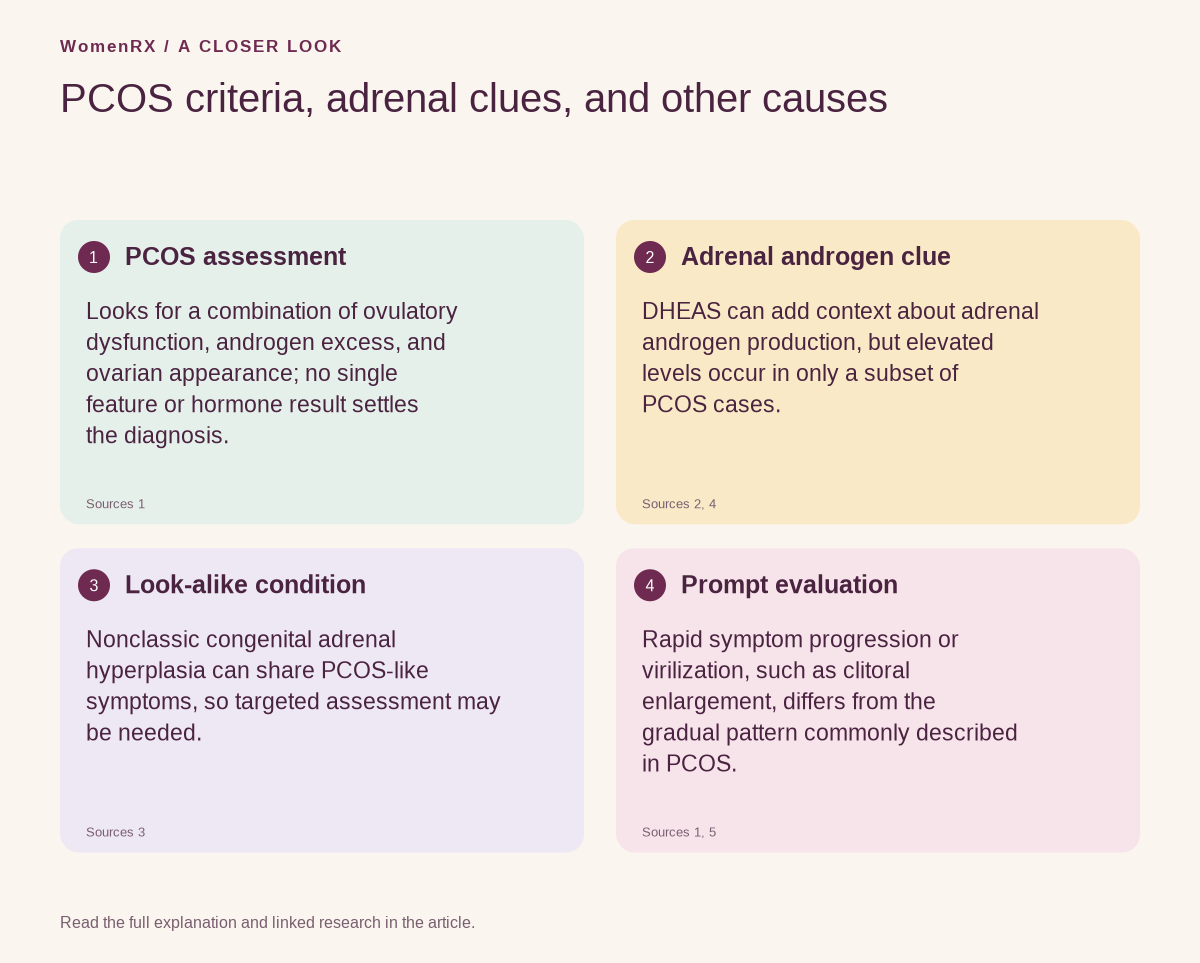
PCOS criteria, adrenal clues, and other causes
PCOS assessment: Looks for a combination of ovulatory dysfunction, androgen excess, and ovarian appearance; no single feature or hormone result settles the diagnosis.1
Adrenal androgen clue: DHEAS can add context about adrenal androgen production, but elevated levels occur in only a subset of PCOS cases.24
Look-alike condition: Nonclassic congenital adrenal hyperplasia can share PCOS-like symptoms, so targeted assessment may be needed.3
Prompt evaluation: Rapid symptom progression or virilization, such as clitoral enlargement, differs from the gradual pattern commonly described in PCOS.15
Read the figure as text
These findings answer different questions: whether PCOS criteria are met, whether adrenal androgens may contribute, and whether another condition needs consideration.- PCOS assessment: Looks for a combination of ovulatory dysfunction, androgen excess, and ovarian appearance; no single feature or hormone result settles the diagnosis.1
- Adrenal androgen clue: DHEAS can add context about adrenal androgen production, but elevated levels occur in only a subset of PCOS cases.24
- Look-alike condition: Nonclassic congenital adrenal hyperplasia can share PCOS-like symptoms, so targeted assessment may be needed.3
- Prompt evaluation: Rapid symptom progression or virilization, such as clitoral enlargement, differs from the gradual pattern commonly described in PCOS.15
More questions, answered
Does a normal DHEAS rule out PCOS?
No. DHEAS is elevated in only a subset of people with PCOS, and PCOS assessment uses the overall pattern of ovulatory function, androgen excess, and ovarian features. 1 4
Does an elevated DHEAS prove the excess is coming only from the adrenal glands?
No. It can suggest an adrenal contribution, but it doesn’t by itself explain all androgen activity or establish the cause of symptoms. 2 4
Sources you can check
- AMERICAN ASSOCIATION OF CLINICAL ENDOCRINOLOGISTS, AMERICAN COLLEGE OF ENDOCRINOLOGY, AND ANDROGEN EXCESS AND PCOS SOCIETY DISEASE STATE CLINICAL REVIEW: GUIDE TO THE BEST PRACTICES IN THE EVALUATION AND TREATMENT OF POLYCYSTIC OVARY SYNDROME--PART 1.Goodman NF, Cobin RH, Futterweit W, Glueck JS, Legro RS, Carmina E, American Association of Clinical Endocrinologists (AACE), American College of Endocrinology (ACE), Androgen Exce... · Endocrine practice : official journal of the American College of Endocrinology and the American Association of Clinical Endocrinologists · 2015Return to first citation
- Steroid Mass Spectrometry for the Diagnosis of PCOS.Keevil B. · Medical sciences (Basel, Switzerland) · 2019Return to first citation
- Correlation of biochemical markers and clinical signs of hyperandrogenism in women with polycystic ovary syndrome (PCOS) and women with non-classic congenital adrenal hyperplasia (NCAH).Chanukvadze D, Kristesashvili J, Kvashilava N. · Iranian journal of reproductive medicine · 2012Return to first citation
- Is it useful to measure DHEAS levels in PCOS?Boucher H, Robin G, Ribière L, Martin C, Espiard S, Catteau-Jonard S. · Annales d'endocrinologie · 2024Return to first citation
- Androgens in Cushing's Syndrome.Arnaldi G, Martino M. · Frontiers of hormone research · 2019Return to first citation