Could It Be PCOS? How Diagnosis Is Made
Irregular periods, acne, or unwanted hair can raise the question, but PCOS is diagnosed by looking at the pattern and checking for other explanations.
PCOS isn’t confirmed by acne, an ultrasound, or one hormone result alone. In adults, clinicians generally look for at least two of three features: irregular or absent ovulation, signs or blood-test evidence of higher androgens, and a polycystic pattern on ovarian imaging. They also consider other causes. In adolescents, puberty can resemble PCOS, so the assessment needs extra care. 1 7
A pattern matters more than one symptom
Irregular periods, acne, or unwanted facial or body hair can be reasons to ask about PCOS, but each can have other explanations. Acne by itself, for example, doesn’t establish a hormone disorder. The useful question is whether several features fit together, when they began, and whether another condition better explains them. 1 2 3
For adults, clinicians commonly assess three features: irregular or absent ovulation; signs of higher androgen levels, such as unwanted coarse hair, or blood-test evidence of higher androgens; and ovaries with a polycystic pattern on imaging. PCOS is generally considered when at least two are present and other causes have been considered. Not everyone with PCOS has all three. 1 5 8
“Polycystic” can be misleading. The finding on imaging refers to groups of small ovarian follicles, not necessarily ovarian cysts. That image is one part of the assessment, not a stand-alone answer. 1
What an evaluation may include
A clinician will usually ask about your cycle pattern and symptoms and examine you for relevant physical signs. Blood tests may help assess hormone levels. An ultrasound may be considered as part of the overall evaluation, but a scan or isolated lab result doesn’t replace the clinical picture. 1 2
The details help give those results meaning. For example, note when your periods became irregular, whether the pattern has changed, and when acne or unwanted hair began. If you exercise heavily or have been under significant stress, mention that too. These details can matter because functional hypothalamic amenorrhea, which can occur with stress or excessive physical exertion, can also cause absent or infrequent periods and may be difficult to distinguish from PCOS. The two conditions can sometimes overlap. 5 9
Why age changes the conversation
In adolescence, normal puberty can involve changing cycles and acne, so those signs may be harder to interpret than they are later. A review of adolescent PCOS diagnosis describes the overlap with normal puberty and notes continuing uncertainty in adolescent criteria. That overlap means the clinician needs to consider the whole pattern and developmental context rather than treating a familiar puberty symptom as proof of PCOS. 4 7
For a teenager, it’s reasonable to ask how age and time since the first period affect the interpretation, and whether follow-up would help if the picture isn’t clear now. 4 7
Other explanations worth considering
Irregular periods can have causes besides PCOS, including thyroid problems. A systematic review of the PCOS differential also discusses functional hypothalamic amenorrhea, elevated prolactin, congenital adrenal dysfunction, Cushing syndrome, androgen-producing tumors, and premature ovarian insufficiency as conditions that may need consideration depending on the symptoms and clinical picture. 4 5 A separate review discusses the nonclassic form of congenital adrenal hyperplasia as a possible alternative when androgen-related symptoms are present. 6 This doesn’t mean everyone needs testing for every condition; it means a good evaluation asks whether another explanation fits better.
For reproductive-age women with unwanted hair or other signs of higher androgens, a clinician may consider whether an adrenal condition such as nonclassic congenital adrenal hyperplasia needs to be ruled out. A review identifies blood testing for 17-hydroxyprogesterone as one tool used to distinguish it from PCOS in this group. Which tests make sense depends on your individual findings. 6
Make the appointment more useful
You don’t need a perfect record. If you can, bring or describe:
- Approximate dates of recent periods, including long gaps or missed periods.
- When acne or unwanted hair began and whether it has changed.
- Any major changes in exercise or stress around the time your periods changed.
- The questions you most want answered, such as: “What findings point toward PCOS in my case?” and “What other causes are you considering?”
A period app or simple calendar can help show a pattern, but it isn’t a diagnostic test. 4
A clear discussion should leave you understanding which features support PCOS, which alternatives were considered, and whether more evaluation or follow-up is needed. The goal isn’t to make one symptom or scan carry the whole answer.
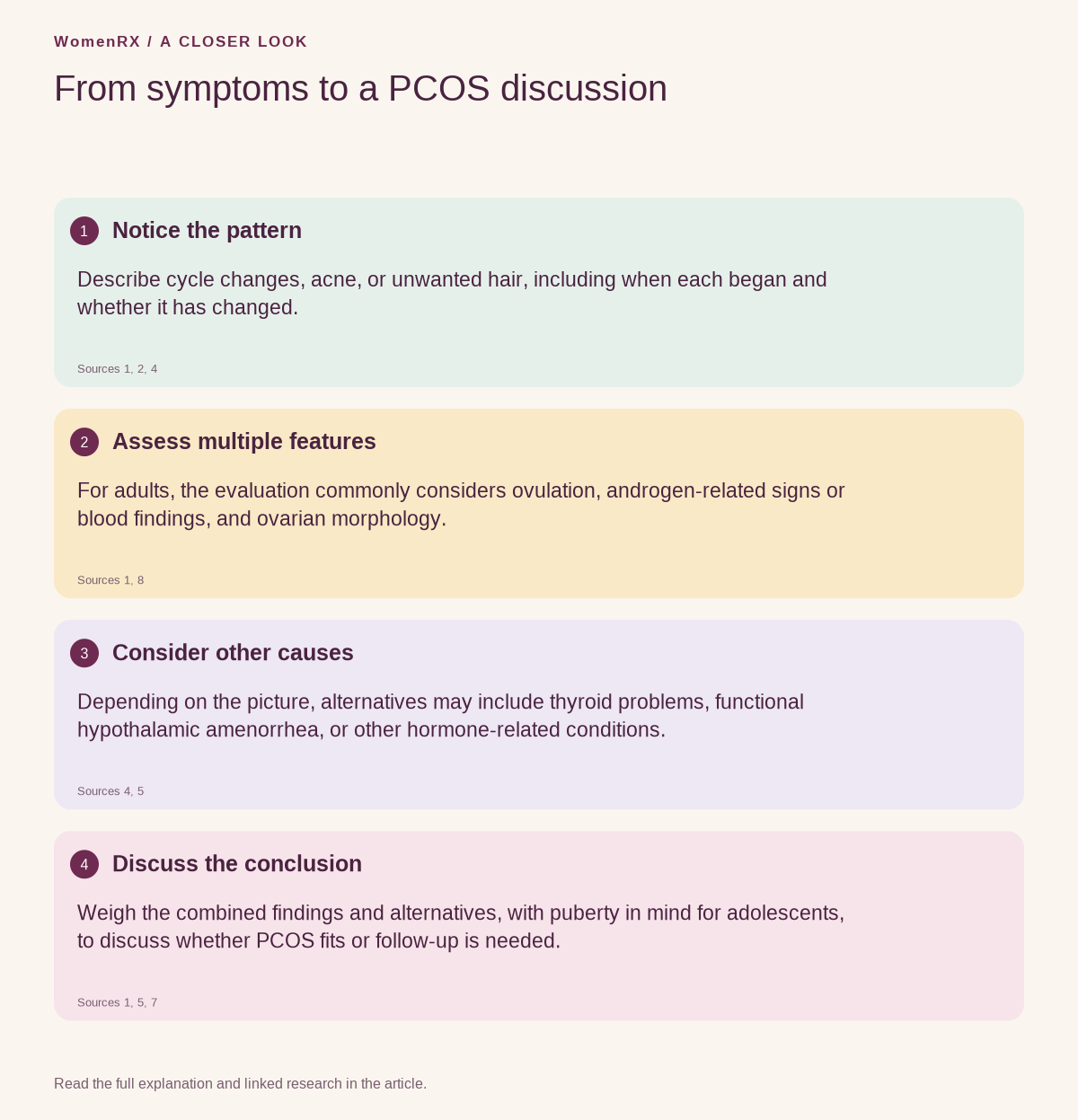
From symptoms to a PCOS discussion
Notice the pattern: Describe cycle changes, acne, or unwanted hair, including when each began and whether it has changed.124
Assess multiple features: For adults, the evaluation commonly considers ovulation, androgen-related signs or blood findings, and ovarian morphology.18
Consider other causes: Depending on the picture, alternatives may include thyroid problems, functional hypothalamic amenorrhea, or other hormone-related conditions.45
Discuss the conclusion: Weigh the combined findings and alternatives, with puberty in mind for adolescents, to discuss whether PCOS fits or follow-up is needed.157
Read the figure as text
The evaluation connects symptoms and cycle history, considers other explanations, and weighs multiple findings rather than relying on one test.- Notice the pattern: Describe cycle changes, acne, or unwanted hair, including when each began and whether it has changed.124
- Assess multiple features: For adults, the evaluation commonly considers ovulation, androgen-related signs or blood findings, and ovarian morphology.18
- Consider other causes: Depending on the picture, alternatives may include thyroid problems, functional hypothalamic amenorrhea, or other hormone-related conditions.45
- Discuss the conclusion: Weigh the combined findings and alternatives, with puberty in mind for adolescents, to discuss whether PCOS fits or follow-up is needed.157
More questions, answered
Can an ultrasound diagnose PCOS on its own?
No. Ovarian imaging can show one feature considered in PCOS, but diagnosis relies on the broader pattern and consideration of other causes. A scan isn’t the whole answer; in adolescents, normal puberty can also make symptoms harder to interpret. 1 2 7
Does acne alone mean I have PCOS?
No. Acne can occur with normal hormonal changes, including puberty, and it can have other causes. It may be more relevant to a PCOS evaluation when it appears alongside features such as irregular periods or unwanted coarse hair, but the combination still needs clinical assessment. 2 3
Sources you can check
- PCOS | Polycystic Ovary Syndrome | MedlinePlusAccessed 2026-09-25Return to first citation
- Acne - Diagnosis - NHSAccessed 2026-09-25Return to first citation
- Acne - Causes - NHSAccessed 2026-09-25Return to first citation
- Irregular periods - NHSAccessed 2026-09-25Return to first citation
- [Difficulties of differential diagnosis of functional hypothalamic amenorrhea and polycystic ovary syndrome: a systematic review].Absatarova YS, Evseeva YS, Andreeva EN, Sheremetyeva EV, Grigoryan OR, Mikheev RK. · Problemy endokrinologii · 2024Return to first citation
- Hyperandrogenism in polycystic ovary syndrome and adrenal hyperplasia: finding differences to make a specific diagnosis.Unfer V, Lepore E, Forte G, Hernández Marín I, Wdowiak A, Pkhaladze L. · Archives of gynecology and obstetrics · 2025Return to first citation
- Diagnostic features of polycystic ovary syndrome in adolescents (review).Beltadze K, Barbakadze L. · Georgian medical news · 2015Return to first citation
- Polycystic ovary syndrome: definitions, phenotypes and diagnostic approach.Livadas S, Diamanti-Kandarakis E. · Frontiers of hormone research · 2013Return to first citation
- Beyond ovarian Morphology: Integrative stress profiling for distinguishing polycystic ovary syndrome from functional hypothalamic amenorrhea.Costa Rodrigues da Silva AV, Soares SR, Oliveira Miguelote RF. · Comprehensive psychoneuroendocrinology · 2025Return to first citation