AHAs and BHAs: Which Acid Fits Your Skin?
Glycolic acid and salicylic acid work differently, but the full formula and what’s already in your routine matter just as much.
If you’re choosing between the two, glycolic acid is an AHA that loosens the connections between surface skin cells, while salicylic acid is a BHA used in products aimed at clogged pores and acne. Neither is automatically the gentler choice. Start with one acid product, pay attention to burning or peeling, and be especially careful about adding one if you already use tretinoin. 41

Choose by concern, not by the letters
An AHA and a BHA aren’t interchangeable labels for the same effect. Glycolic acid, an alpha hydroxy acid, acts on the outer skin layer by loosening the connections between cells. Salicylic acid, a beta hydroxy acid, is used in acne care for its effects on clogged pores and inflammation. That makes a salicylic-acid product a reasonable one to consider when clogged pores are your main concern. If surface roughness is what bothers you, a glycolic-acid product may be more relevant. Neither description predicts exactly how your skin will respond to a particular bottle. 4
The rest of the formula matters. In a study of adults with mild acne, a specially formulated 2% lactic-acid face-care system performed better on lesion counts than the 2% salicylic-acid product used for comparison. That’s a finding about those products, not proof that lactic acid always beats salicylic acid for acne. It’s a useful reminder not to choose by acid name alone. 2
Likewise, results from a professional-strength peel don’t tell you what an everyday exfoliating product will do. In a small trial involving people treated for flat facial warts, clinic-applied 35% glycolic-acid peels were associated with mild redness and peeling. That study tested a specific treatment for a specific condition, not a home routine for rough texture. 3
Make room for your skin to respond
If you’re introducing an exfoliating acid, the simplest cautious approach is to pick one product for one concern rather than starting an acid cleanser, toner, and serum together. Follow that product’s directions and leave the rest of your routine familiar while you see how your skin responds. This is a way to make irritation easier to recognize, not a tested schedule that suits every formula.
Pay attention to the difference between a product you can use comfortably and one that leaves your skin persistently stinging, red, or peeling. Don’t push ahead with a new exfoliant on skin that’s already irritated. For example, if your face is peeling from another treatment, let it settle before deciding whether an acid belongs in the routine at all.
If you use tretinoin, the calculation changes
Topical tretinoin can itself cause redness and peeling. Its product instructions specifically call for caution with salicylic acid, strongly drying cosmetics, medicated or abrasive cleansers, and other potentially irritating topical products. They also advise gentle washing and say that significant irritation may require a change to, or pause in, tretinoin treatment. Those are tretinoin-specific instructions, not a rule that everyone must avoid combining every acid with every retinoid. 1
There is a reason to avoid sweeping rules in either direction. In a small, 28-day study of 25 people with mild-to-moderate acne, researchers compared adapalene alone with adapalene mixed with a product containing glycolic acid, salicylic acid, and other ingredients. The combination side had slightly more burning, although most measured adverse effects were similar. That finding doesn’t establish that an acid and retinoid combination will be comfortable for you, or that you should recreate the study’s mixture at home. 4
If tretinoin is already leaving your skin dry or sore, adding an exfoliant is unlikely to make the routine easier to tolerate. Keep the focus on getting your current treatment comfortable first. If irritation is severe or persistent, the tretinoin instructions advise stopping it and speaking with its prescriber. 1
For sensitive skin, the best acid is not necessarily the one with the strongest reputation. It’s the product that addresses your actual concern without leaving you managing irritation.
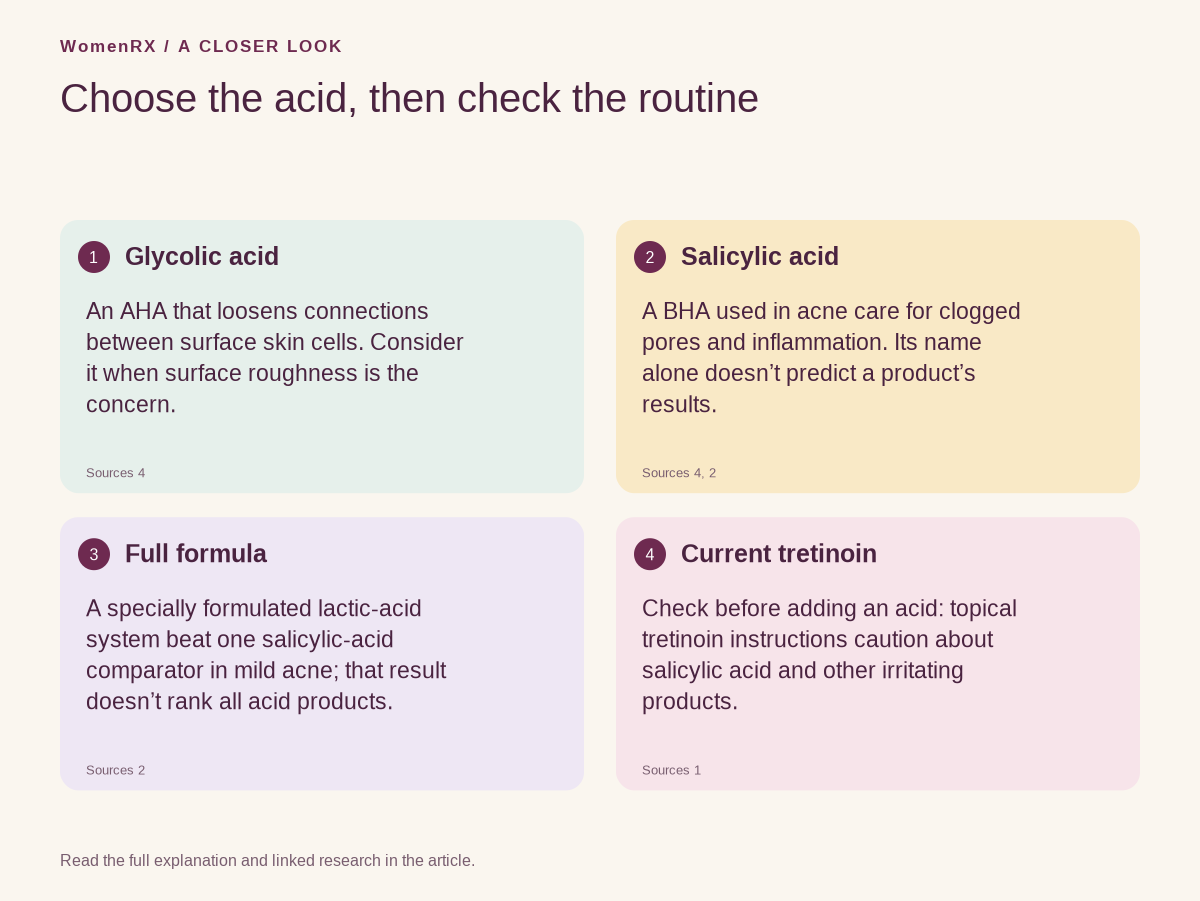
Choose the acid, then check the routine
Glycolic acid: An AHA that loosens connections between surface skin cells. Consider it when surface roughness is the concern.4
Salicylic acid: A BHA used in acne care for clogged pores and inflammation. Its name alone doesn’t predict a product’s results.42
Full formula: A specially formulated lactic-acid system beat one salicylic-acid comparator in mild acne; that result doesn’t rank all acid products.2
Current tretinoin: Check before adding an acid: topical tretinoin instructions caution about salicylic acid and other irritating products.1
Read the figure as text
The ingredient points you toward a concern; the full product and your current treatment affect how cautiously you introduce it.- Glycolic acid: An AHA that loosens connections between surface skin cells. Consider it when surface roughness is the concern.4
- Salicylic acid: A BHA used in acne care for clogged pores and inflammation. Its name alone doesn’t predict a product’s results.42
- Full formula: A specially formulated lactic-acid system beat one salicylic-acid comparator in mild acne; that result doesn’t rank all acid products.2
- Current tretinoin: Check before adding an acid: topical tretinoin instructions caution about salicylic acid and other irritating products.1
More questions, answered
Does a salicylic-acid product always work better for acne than an AHA product?
No. Salicylic acid has a role in acne care, but a study of adults with mild acne found that one specially formulated lactic-acid system outperformed the salicylic-acid comparator. You can’t apply that result to every product containing either ingredient. 42
Can I judge a home glycolic-acid product by results from a chemical peel?
Not reliably. A trial of clinic-applied 35% glycolic-acid peels studied treatment of flat facial warts and reported some redness and peeling. Its results don’t predict the benefit or tolerability of a different home product. 3
Sources you can check
- TRETINOIN CREAM [REDPHARM DRUG] | US prescribing information and patient instructionsAccessed 2026-09-25Return to first citation
- In vivo assessment of the efficacy of an innovative face care system in subjects with mild acne vulgaris.Scherdin U, Presto S, Rippke F, Nielsen J, Strassner M, Imadojemun A, Gärtner E, Herpens A, Korting HC, Bielfeldt S. · International journal of cosmetic science · 2004Return to first citation
- Chemical peeling with 35% glycolic acid for the treatment of disseminated facial verruca plana: A randomized, split-face, evaluator-blinded trial.Liu Z, Ai J, Zhu Z, Huang L, Yi Z, Wu L, Xu Y, Zhu D, Li H, Yan Y, Zhang L, Zhong X, Yang B. · Dermatologic therapy · 2022Return to first citation
- The efficacy of glycolic acid, salicylic acid, gluconolactone, and licochalcone A combined with 0.1% adapalene vs adapalene monotherapy in mild-to-moderate acne vulgaris: a double-blinded within-person comparative study.Kantikosum K, Chongpison Y, Chottawornsak N, Asawanonda P. · Clinical, cosmetic and investigational dermatology · 2019Return to first citation