Salicylic Acid for Acne: How to Use It Without Overdoing It
Salicylic acid can be one option for clogged pores and acne, but the product format and the other actives in your routine matter.
Salicylic acid helps loosen the buildup of dead skin cells associated with clogged pores. It comes in rinse-off cleansers and leave-on treatments, which aren’t interchangeable. A small adult study found improvement with a routine containing both a 1% cleanser and a 2% lotion, but couldn’t show what either product accomplished alone. Check your other acne products and watch for irritation as you add something new. 1 3
First, match the product to the question
Salicylic acid is used in topical acne products, including cleansers and leave-on products. It’s called keratolytic, meaning it helps loosen dead skin cells that can build up around a pore. That makes it a reasonable ingredient to consider when clogged pores are part of your acne. It isn’t a stand-alone cure, and acne can have several contributing factors, including hormonal changes that affect oil production and block hair follicles. 1 3
A product’s format matters when you’re comparing options. A cleanser is rinsed off; a lotion or other leave-on product stays on the skin. In one 12-week randomized study, adults with mild to moderate facial acne used a routine that included a 1% salicylic acid cleanser and a 2% salicylic acid lotion. The study reported improvement and good tolerability for that full routine. It doesn’t tell us whether the cleanser or lotion was responsible, or whether the result applies to every product with salicylic acid. 3
The study authors also note that local irritation is possible with higher, prescription doses of salicylic acid above 2%. That finding doesn’t establish a universal risk threshold or predict how any one person will respond. 3
Evidence for acne cleansers more broadly is limited: a systematic review found 14 prospective studies of different washing and cleanser approaches, and concluded that the small number of well-performed studies made reliable recommendations difficult. So don’t assume that a cleanser and a leave-on treatment are interchangeable, or that a higher concentration will suit your skin better. 4
Check what else is in your routine
Before adding a salicylic acid product, scan your current products for other acne actives, such as benzoyl peroxide, retinoids, or another exfoliating acid. Benzoyl peroxide and topical retinoids can each cause irritation; that doesn’t establish that combining either one with salicylic acid causes a particular reaction. 2 Checking for overlap is a practical way to make sense of your routine.
A cautious way to assess a product is to add just one new active at a time and keep the rest of your routine familiar. That’s a troubleshooting suggestion, not a tested rule for preventing irritation. Avoid using more than the product label directs. If you notice persistent tightness, dryness, or irritation, consider whether the new product is bothering your skin and ask a pharmacist for advice about it. Dryness and tightness were among the tolerability concerns assessed in an adult acne comparison, though that study does not establish how every person will respond to salicylic acid. 3
Pregnancy calls for a product-specific answer
The reported results of the adult acne study don’t answer whether topical salicylic acid is suitable during pregnancy. Being mostly women isn’t the same as studying pregnancy, and the results can’t compare a rinse-off cleanser with a leave-on product or small-area use with wider application in pregnancy. 3 If you’re pregnant or planning a pregnancy, take the actual product details to your prenatal care clinician or pharmacist: its ingredients and concentration, whether you rinse it off, how much you expect to use, and where you’ll apply it. Check the whole ingredient list rather than salicylic acid alone. For example, topical retinoids are not considered suitable during pregnancy. 2
When a different acne plan may be needed
Salicylic acid may not be enough if acne is moderate or severe, if you develop nodules or cysts, or if acne is leaving scars. Those situations deserve medical attention because nodules and cysts can scar, and acne treatments may need to be combined or changed. Acne can also affect how you feel, which is a valid reason to seek more help even when the spots themselves seem mild. 1 2
The useful question isn’t simply whether salicylic acid is “good” or “bad” for your skin. It’s whether the specific product fits your acne, whether your routine already has other potentially irritating actives, and whether your skin is tolerating the combination.
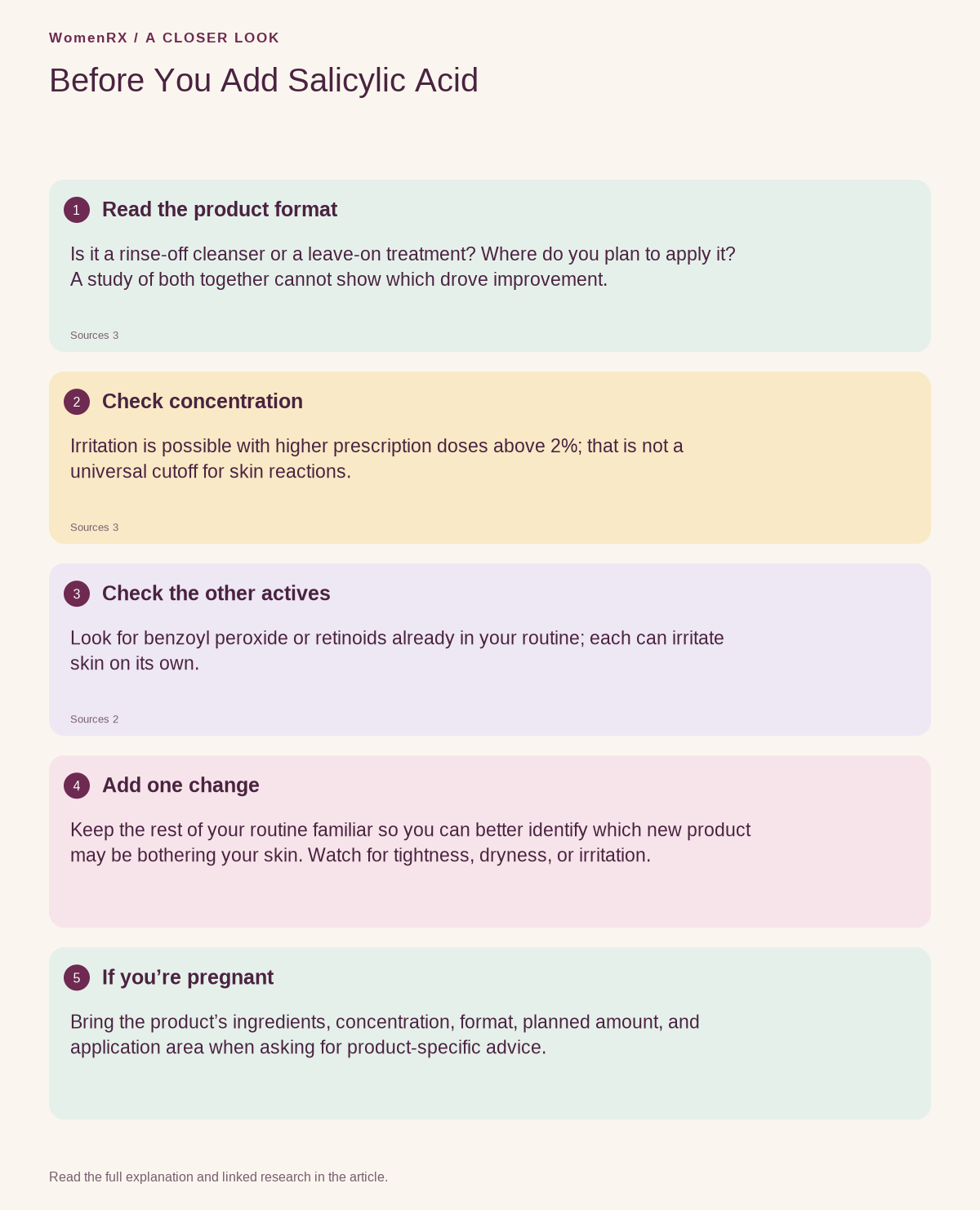
Before You Add Salicylic Acid
Read the product format: Is it a rinse-off cleanser or a leave-on treatment? Where do you plan to apply it? A study of both together cannot show which drove improvement.3
Check concentration: Irritation is possible with higher prescription doses above 2%; that is not a universal cutoff for skin reactions.3
Check the other actives: Look for benzoyl peroxide or retinoids already in your routine; each can irritate skin on its own.2
Add one change: Keep the rest of your routine familiar so you can better identify which new product may be bothering your skin. Watch for tightness, dryness, or irritation.
If you’re pregnant: Bring the product’s ingredients, concentration, format, planned amount, and application area when asking for product-specific advice.
Read the figure as text
Use these checks to compare the product with your current routine and the way you plan to use it.- Read the product format: Is it a rinse-off cleanser or a leave-on treatment? Where do you plan to apply it? A study of both together cannot show which drove improvement.3
- Check concentration: Irritation is possible with higher prescription doses above 2%; that is not a universal cutoff for skin reactions.3
- Check the other actives: Look for benzoyl peroxide or retinoids already in your routine; each can irritate skin on its own.2
- Add one change: Keep the rest of your routine familiar so you can better identify which new product may be bothering your skin. Watch for tightness, dryness, or irritation.
- If you’re pregnant: Bring the product’s ingredients, concentration, format, planned amount, and application area when asking for product-specific advice.
More questions, answered
Can I use salicylic acid with other acne ingredients?
There isn’t a blanket answer for every combination. Benzoyl peroxide and topical retinoids can each cause irritation, but that alone doesn’t show a harmful interaction with salicylic acid. 2 If you’re changing your routine, introducing one new product at a time is a practical way to tell which product may be bothering your skin.
Sources you can check
- Acne - NHSAccessed 2026-09-25Return to first citation
- Acne - Treatment - NHSAccessed 2026-09-25Return to first citation
- Efficacy and Tolerability of a Novel Cosmetic and Over-the-Counter Facial Acne Regimen Versus a Prescription Treatment.Huang P, Supan O, Pak CL, Mehta RC, Makino ET. · Journal of cosmetic dermatology · 2025Return to first citation
- Clinical evidence for washing and cleansers in acne vulgaris: a systematic review.Stringer T, Nagler A, Orlow SJ, Oza VS. · The Journal of dermatological treatment · 2018Return to first citation