Can You Use These Skin-Care Actives Together?
Start with what each product adds to your routine, then weigh that benefit against the chance of irritation.
Some actives can belong in the same routine, but application order isn’t a universal compatibility test. Prescription tretinoin cream calls for particular caution with salicylic acid and caution with other topical treatments or strongly drying products. If you’re considering an acid alongside a retinoid, ask what the second product adds before taking on more potential irritation. 1
First, decide what the second active is doing
Say you already use a retinoid and are thinking about adding an acid. Is the acid meant to address a concern your current product isn’t addressing, or are you adding it because you’ve heard the combination works faster? That distinction matters more than whether a serum goes before or after a cream. A combination might have a purpose, but more products also make a reaction harder to sort out.
Look at the exact ingredients, too. A cleanser or serum may contain an acid even if the front of the package emphasizes something else. In small studies of women, researchers evaluated regimens containing retinoid-and-acid formulations for acne or photodamaged skin. Those findings show why someone might consider the combination, but they don’t give a rule for layering any two products from your shelf. 3 4
Where common pairings differ
Tretinoin cream and salicylic acid: This is the clearest product-specific caution. Tretinoin cream information calls for particular caution with preparations containing salicylic acid. It also cautions about other topical medications, abrasive cleansers, and products that strongly dry the skin. If you use prescription tretinoin, check whether salicylic acid is already in a cleanser, toner, or acne treatment before adding another product. Putting it on at a different time doesn’t remove the label’s caution. 1
A retinoid and an alpha hydroxy acid (AHA), such as glycolic acid: The pairing can have a purpose: retinoids and AHAs act differently, and retinoid-and-acid regimens have been studied for blemishes and photodamage. But the studies involved particular formulations and routines, including products designed to deliver the ingredients together. They don’t show that a separate glycolic acid product layered with your retinol or tretinoin will have the same results or tolerability. If your skin is already dry or peeling, an extra exfoliating product is a poor place to start experimenting. 2 3 4 5
A retinoid and benzoyl peroxide: If benzoyl peroxide is another acne treatment in your routine, treat it as an additional topical medication when assessing irritation, especially alongside prescription tretinoin. Tretinoin cream information advises caution with other topical medications, but it doesn’t establish a rule for every benzoyl peroxide and retinoid formulation. Don’t assume either that the pair is automatically unsuitable or that changing their order settles the question. 1
Make irritation the deciding signal
Before adding another active, consider how your skin feels with the current routine. Tretinoin can cause redness and peeling, and its product information advises gentle cleansing rather than harsh scrubbing or frequent washing. Keeping the non-active parts of your routine gentle gives you a clearer view of whether the products you’re using are tolerable. Sun protection matters with tretinoin, too. 1
Introducing one new product at a time is a practical way to tell what changed if your skin reacts. Separating application times avoids putting the products on together, but it doesn’t remove the product-specific caution in tretinoin cream information about salicylic acid. If you’ve been given a specific treatment plan, check before changing how you use it. 1
Mild dryness is different from skin that’s becoming very red, swollen, blistered, or crusted. Tretinoin cream information says a significant reaction may require stopping the medication until the skin recovers or adjusting treatment. If those stronger symptoms appear, don’t keep adding actives to try to push through them; contact the tretinoin prescriber about what to do next. 1
If you’re pregnant or breastfeeding
Check the specific active and product rather than setting aside all active skin care. For topical tretinoin, the cream information says reports of birth defects have not established a causal link, and their significance is unknown. It also says it’s unknown whether topical tretinoin passes into human milk. If you’re pregnant, planning pregnancy, or breastfeeding, ask about that product before using it. These statements are about topical cream, not oral tretinoin. 1
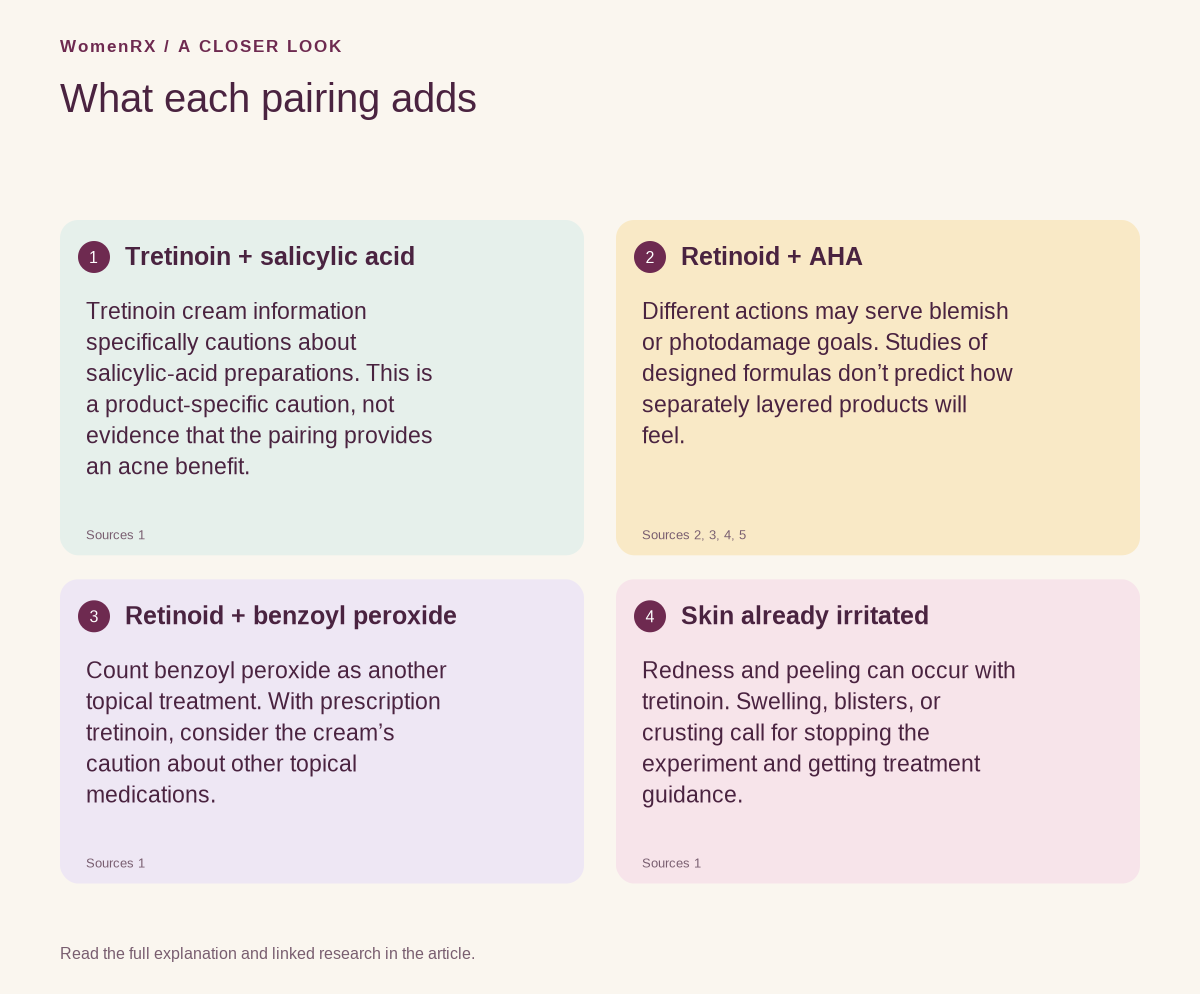
What each pairing adds
Tretinoin + salicylic acid: Tretinoin cream information specifically cautions about salicylic-acid preparations. This is a product-specific caution, not evidence that the pairing provides an acne benefit.1
Retinoid + AHA: Different actions may serve blemish or photodamage goals. Studies of designed formulas don’t predict how separately layered products will feel.2345
Retinoid + benzoyl peroxide: Count benzoyl peroxide as another topical treatment. With prescription tretinoin, consider the cream’s caution about other topical medications.1
Skin already irritated: Redness and peeling can occur with tretinoin. Swelling, blisters, or crusting call for stopping the experiment and getting treatment guidance.1
Read the figure as text
Compare the reason to combine products with the caution that changes your next move.- Tretinoin + salicylic acid: Tretinoin cream information specifically cautions about salicylic-acid preparations. This is a product-specific caution, not evidence that the pairing provides an acne benefit.1
- Retinoid + AHA: Different actions may serve blemish or photodamage goals. Studies of designed formulas don’t predict how separately layered products will feel.2345
- Retinoid + benzoyl peroxide: Count benzoyl peroxide as another topical treatment. With prescription tretinoin, consider the cream’s caution about other topical medications.1
- Skin already irritated: Redness and peeling can occur with tretinoin. Swelling, blisters, or crusting call for stopping the experiment and getting treatment guidance.1
More questions, answered
Does a combined retinoid-and-acid cream mean I can layer separate versions?
No. Small studies evaluated particular formulas or multi-product regimens. Their results don’t predict how a separate retinoid and acid will feel on your skin. 2 3 4
Sources you can check
- TRETINOIN CREAM [REDPHARM DRUG] | US prescribing information and patient instructionsAccessed 2026-09-25Return to first citation
- Efficacy and Tolerability of a Double-Conjugated Retinoid and Alpha Hydroxy Acid Cream in Subjects With Mild to Moderate Blemish-Prone Skin.Robinson D, Friedmann D, Gordon J, Wortzman M, Nelson D. · Journal of drugs in dermatology : JDD · 2022Return to first citation
- Novel retinoid ester in combination with salicylic acid for the treatment of acne.Draelos Z, Lewis J, McHugh L, Pellegrino A, Popescu L. · Journal of cosmetic dermatology · 2016Return to first citation
- Evaluation of an advanced antioxidant and double-conjugated retinoid/AHA cream in participants with FST IV-V.Grimes PE, Nelson DB. · Journal of cosmetic dermatology · 2024Return to first citation
- The Tolerability and Efficacy of a Three-product Anti-aging Treatment Regimen in Subjects with Moderate-to-severe Photodamage.Katz BE, Lewis J, McHugh L, Pellegrino A, Popescu L. · The Journal of clinical and aesthetic dermatology · 2015Return to first citation