A Gentler Cleanser Routine While Using Tretinoin
A mild, nonmedicated cleanser can reduce irritation from washing, but it can’t prevent every reaction to tretinoin.
Choose a mild, nonmedicated cleanser and wash gently. Abrasive or medicated cleansers, strongly drying products, frequent washing, and scrubbing can add irritation while you use topical tretinoin. If redness, peeling, or discomfort is severe or persistent, changing cleanser may not be enough; review the tretinoin plan with its prescriber. 1
Choose a cleanser that does less
Look for a mild, nonmedicated cleanser that doesn’t leave your face feeling tight or uncomfortable. The instructions for one topical tretinoin cream advise against medicated or abrasive cleansers and products with a strong drying effect. They also call for caution with alcohol or astringents, and with products containing sulfur, resorcinol, or salicylic acid. While your skin is irritated, adding another acne-active or exfoliating cleanser can make it harder to tell what’s contributing to the discomfort. 1
The aim isn’t to find a cleanser that cancels out tretinoin. Supportive skincare may complement acne treatment, but a review of skincare approaches doesn’t establish that a particular cleanser prevents tretinoin irritation. 2
Keep washing gentle and simple
Wash without scrubbing, and don’t wash more often than you need to. Tretinoin cream instructions warn that frequent washing and rough scrubbing can worsen irritation. Pat your face dry rather than rubbing it with a towel. 1
If you apply tretinoin after washing, follow the directions for your own prescription. The cream instructions say to apply it to completely dry skin to help minimize irritation, and describe waiting 20 to 30 minutes after washing. That timing comes from those specific instructions, so don’t assume it applies to every formulation. 1
When the cleanser may not be the main issue
Stinging or tightness that shows up around washing may mean your cleanser or washing habits are adding to the discomfort, especially if you recently introduced a medicated, abrasive, or strongly drying product. That clue isn’t a reliable way to identify the cause on its own: tretinoin itself can cause redness and peeling, too. 1
If irritation persists after you switch to gentler washing, don’t keep searching for a cleanser that will make you tolerate it. The cream instructions say that significant local irritation may call for using tretinoin less frequently, pausing it temporarily, or stopping it. Ask the person who prescribed it what change, if any, is appropriate for your treatment. 1
Marked redness or swelling, blistering, or crusting deserves a prompt treatment review rather than more experimentation with cleansers. The instructions describe these reactions and advise stopping treatment until the skin recovers or adjusting it to a tolerable level; they also advise contacting the prescriber for severe or persistent irritation. 1
Keep pregnancy questions separate
If pregnancy is relevant to you, raise tretinoin as part of a separate medication review with your prescriber. A cleanser change can’t answer whether a medication is appropriate in that situation. The cleanser guidance here is about skin tolerance, not pregnancy safety.
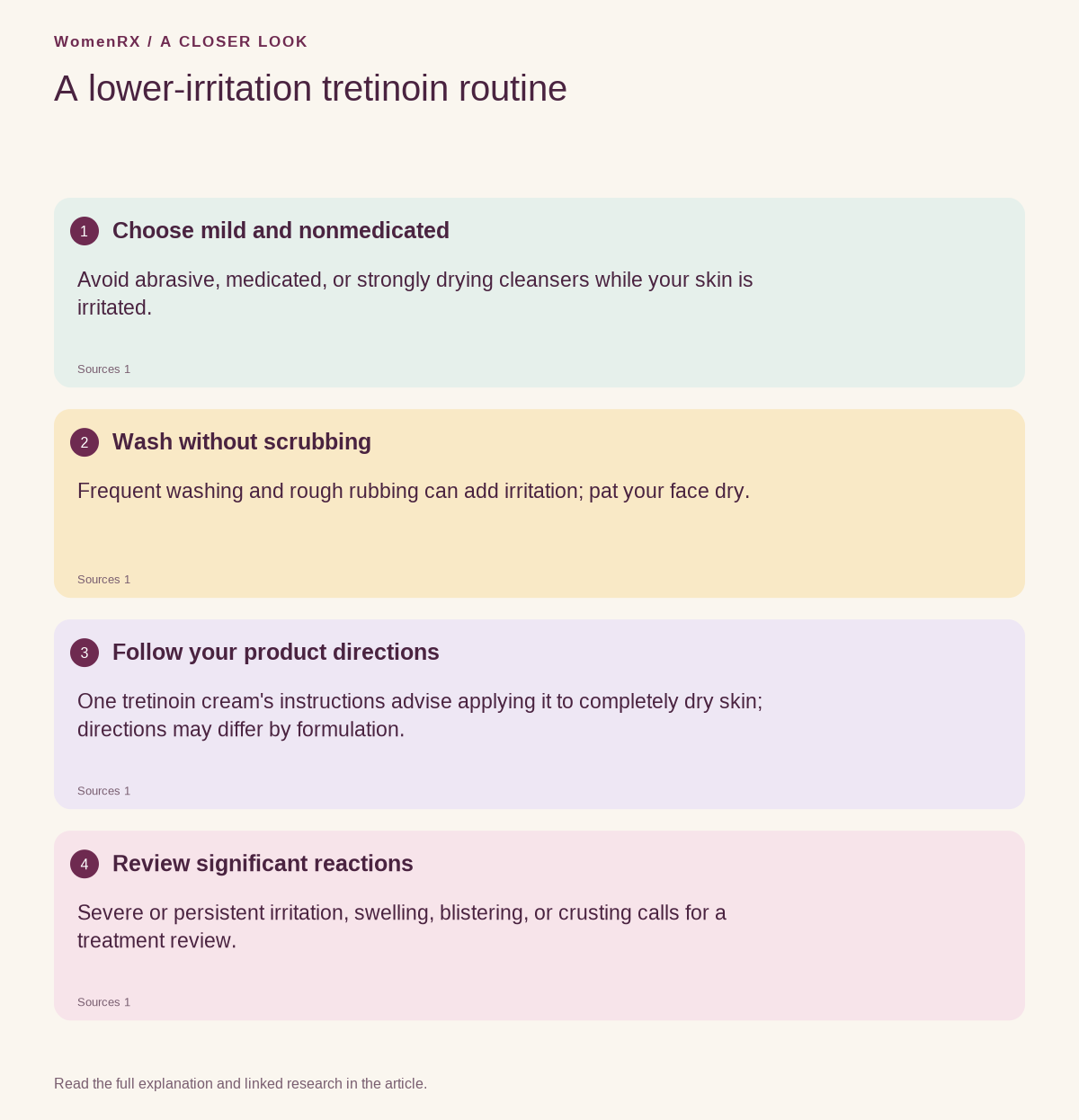
A lower-irritation tretinoin routine
Choose mild and nonmedicated: Avoid abrasive, medicated, or strongly drying cleansers while your skin is irritated.1
Wash without scrubbing: Frequent washing and rough rubbing can add irritation; pat your face dry.1
Follow your product directions: One tretinoin cream's instructions advise applying it to completely dry skin; directions may differ by formulation.1
Review significant reactions: Severe or persistent irritation, swelling, blistering, or crusting calls for a treatment review.1
Read the figure as text
Use this checklist to reduce irritation from cleansing and recognize when changing cleanser may not be enough.- Choose mild and nonmedicated: Avoid abrasive, medicated, or strongly drying cleansers while your skin is irritated.1
- Wash without scrubbing: Frequent washing and rough rubbing can add irritation; pat your face dry.1
- Follow your product directions: One tretinoin cream's instructions advise applying it to completely dry skin; directions may differ by formulation.1
- Review significant reactions: Severe or persistent irritation, swelling, blistering, or crusting calls for a treatment review.1
More questions, answered
Should I add an exfoliating cleanser to clear acne faster?
Not automatically. The topical tretinoin cream instructions advise caution with abrasive or medicated cleansers and specifically mention salicylic acid, sulfur, and resorcinol. If you’re considering another acne treatment, check how it fits with your prescribed routine rather than adding it while your skin is already irritated. 1
Can I tell from stinging whether my cleanser is the cause?
Not for certain. Washing habits or a cleanser can add irritation, but topical tretinoin can cause redness and peeling too. If symptoms continue with gentle cleansing, review the treatment plan rather than assuming the cleanser is the only cause. 1
Sources you can check
- TRETINOIN CREAM [REDPHARM DRUG] | US prescribing information and patient instructionsAccessed 2026-09-25Return to first citation
- One Acne™: A holistic management approach to improve overall skin quality and treatment outcomes in acne with or without sensitive skin.Kircik L, Tan J, Lain ET, Beleznay K, Chavda R, Lachmann N, Brinkhuizen T, Baldwin H, Layton AM. · International journal of dermatology · 2025Return to first citation