A Simple Skincare Routine for Menopause-Related Dryness
Start with a mild cleanser and moisturizer; persistent or irritated skin may need more than a routine change.
For dry skin, keep the routine simple: use a mild cleanser and moisturizer morning and evening. A small trial found improvement with this basic approach in adults with dry skin, but it did not study menopause specifically or establish a best formula for menopausal facial skin. 3 If a product stings or leaves your skin increasingly red or flaky, consider pausing it.
Start with the fewest steps that help
Dryness around perimenopause or after menopause can be frustrating, but it isn’t automatically caused by menopause. Aging, environmental conditions, health conditions, skin disorders, and medications can also contribute to dry skin. Research on dry skin describes changes in hydration, skin oils, and barrier function, but does not establish one cause for every person. 5
A reasonable starting routine is deliberately plain:
- Morning: Wash gently with a mild cleanser, or use water if cleansing seems to leave your skin tight. Apply a moisturizer that feels comfortable.
- Evening: Cleanse gently and moisturize again.
In a randomized trial of 52 people with moderate to severe dry skin, those using a mild cleanser and moisturizer twice daily for two weeks had greater improvement in dryness measures than those using cleanser without moisturizer. The study was not menopause-specific, and it does not prove that every person needs the same products or schedule. 3
Choose by feel, not by a menopause label
You don’t need a product marketed for menopause to try a basic moisturizer. If you’re comparing ingredient lists, glycerin is a humectant, which helps attract and hold water in the skin; petrolatum and dimethicone are occlusives that help retain moisture. Ceramides are skin lipids used in some moisturizers. These ingredient roles do not mean that one label or formula is proven best for menopausal skin. 4
There is some evidence for moisturizers in other dry-skin groups, but it doesn’t answer the menopause-specific question. For example, a four-week study of a ceramide- and oil-based body lotion measured improvement in dryness on participants’ legs, not menopausal facial skin. 2 A trial of a ceramide-dominant cleanser and cream in adults with eczema found improvements in hydration and water loss, while eczema severity did not differ significantly between groups at the end of the study. That’s a useful reminder that ingredient claims and symptom outcomes aren’t interchangeable. 4
If your skin feels comfortable and less dry, there may be no need to add a serum, exfoliant, or retinoid. If you want to try another product, add one at a time so you can tell whether it helps or irritates. More steps can make it harder to identify the source of a reaction.
If your skin starts stinging or flaking
First, simplify. Pause recently added products that sting or leave the skin more irritated, and return to gentle cleansing and moisturizer.
If you use prescription tretinoin cream, irritation, redness, peeling, and increased sun sensitivity are recognized concerns. Its product information also cautions about combining it with drying cleansers, abrasive products, and preparations such as salicylic acid. Ask the prescriber how to handle irritation rather than trying to push through it. 1
If irritation is severe or persistent, or if dryness comes with a lasting rash, cracking, or a new skin change, seek an assessment rather than assuming it is menopause. Dryness can have several contributing causes, and a routine alone may not address them. 5
What changes between perimenopause and postmenopause?
These studies do not compare skincare routines by menopause stage. So there isn’t a supported reason in this evidence to prescribe one routine for perimenopause and another for postmenopause. Let your current symptoms guide the first step: try a simple moisturizing routine for dryness, but get persistent or unexplained changes assessed instead of attributing them to a particular stage.
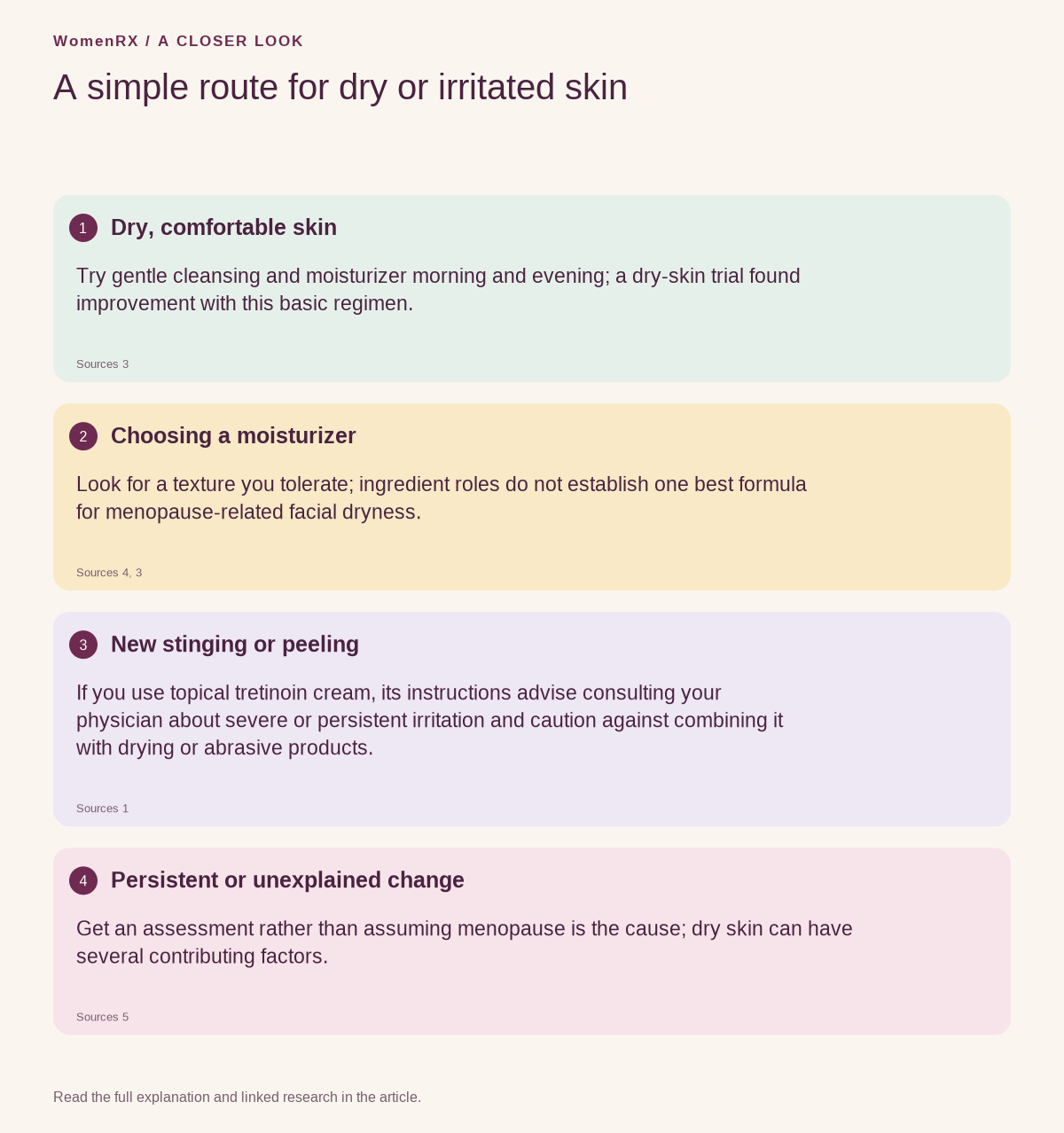
A simple route for dry or irritated skin
Dry, comfortable skin: Try gentle cleansing and moisturizer morning and evening; a dry-skin trial found improvement with this basic regimen.3
Choosing a moisturizer: Look for a texture you tolerate; ingredient roles do not establish one best formula for menopause-related facial dryness.43
New stinging or peeling: If you use topical tretinoin cream, its instructions advise consulting your physician about severe or persistent irritation and caution against combining it with drying or abrasive products.1
Persistent or unexplained change: Get an assessment rather than assuming menopause is the cause; dry skin can have several contributing factors.5
Read the figure as text
Use the main concern to choose a modest next step, and distinguish routine dryness from changes that need assessment.- Dry, comfortable skin: Try gentle cleansing and moisturizer morning and evening; a dry-skin trial found improvement with this basic regimen.3
- Choosing a moisturizer: Look for a texture you tolerate; ingredient roles do not establish one best formula for menopause-related facial dryness.43
- New stinging or peeling: If you use topical tretinoin cream, its instructions advise consulting your physician about severe or persistent irritation and caution against combining it with drying or abrasive products.1
- Persistent or unexplained change: Get an assessment rather than assuming menopause is the cause; dry skin can have several contributing factors.5
More questions, answered
Do ceramides or glycerin have to be in my moisturizer?
No. They are ingredients with plausible moisturizing roles, but the cited research does not establish that either is necessary or superior for menopause-related facial dryness. Choose a moisturizer you tolerate; a small randomized study supports regular moisturizer use for dry skin without identifying a universal best formula. 34
Sources you can check
- TRETINOIN CREAM [REDPHARM DRUG] | US prescribing information and patient instructionsAccessed 2026-09-25Return to first citation
- Comprehensive Evaluation of Body Lotion in Alleviating Xerosis: A Multi-Omics Approach to Lipid Metabolism and Microbial Community Modulation.Wang J, Cheng L, Zhang J, Qin Y, Fu Q, Bai X, Qi F, Wu F, Yang J, Pan Y. · Journal of cosmetic dermatology · 2026Return to first citation
- A consistent skin care regimen leads to objective and subjective improvements in dry human skin: investigator-blinded randomized clinical trial.Kim S, Ly BK, Ha JH, Carson KA, Hawkins S, Kang S, Chien AL. · The Journal of dermatological treatment · 2022Return to first citation
- A daily regimen of a ceramide-dominant moisturizing cream and cleanser restores the skin permeability barrier in adults with moderate eczema: A randomized trial.Spada F, Harrison IP, Barnes TM, Greive KA, Daniels D, Townley JP, Mostafa N, Fong AT, Tong PL, Shumack S. · Dermatologic therapy · 2021Return to first citation
- Molecular characterization of xerosis cutis: A systematic review.Amin R, Lechner A, Vogt A, Blume-Peytavi U, Kottner J. · PloS one · 2021Return to first citation