A Comfortable Skincare Routine for Your 50s
If your skin feels drier or more sensitive, start with how it feels now, not your age or a longer list of products.
A simple routine can begin with a moisturizer that feels comfortable. 2 Keep daytime sun protection in the picture, too. 1 Menopause may contribute to changes in skin moisture for some women, but it doesn’t explain every change or affect everyone the same way. 4 If dryness is your main concern, a retinoid is optional, not a required first step.
Start with what your skin is telling you
Dryness, tightness, flaking, and sensitivity can be reasons to simplify your routine rather than add more products. Menopause may be part of the picture: a review of research links lower estrogen with changes in skin moisture and other skin qualities. But skin also changes with age and other factors, and the relationship doesn’t mean menopause is the cause of every new concern. 4
Notice what bothers you most. Is your skin tight after washing, flaky in particular areas, or uncomfortable with products you used to tolerate? Those details can help you decide whether your first adjustment should be a more comfortable moisturizer, a simpler routine, or a closer look at a persistent skin problem. You don’t need to change products just because you’ve reached a certain decade.
Build around comfort and consistency
For dry skin, moisturizer is a useful starting point. Emollients help rehydrate skin and support its barrier, and a review describes them as a mainstay of basic care for dry skin. Studies use varied products and ways of measuring results, though, so the evidence doesn’t identify one best formula for every person. Choose a texture you’re willing to use and judge it by whether your skin feels more comfortable. 2
A practical option is to use a gentle-feeling wash and follow with moisturizer. If washing leaves your face feeling tight, you could try changing the cleanser or washing routine before adding an active ingredient. That’s a simple way to test what feels better, not a proven menopause-specific protocol. If a product seems to cause discomfort, set it aside and avoid changing several things at once; that can make it easier to tell what your skin tolerates.
For rough, scaly areas on the body, urea is one ingredient with a history of use in dry-skin conditions. A review found that mild irritation was its most common reported side effect. That doesn’t establish that it suits every area or every person, so it’s an option rather than a required step. 3
Keep daytime sun protection practical
If you spend time outdoors during the day, sunscreen can be part of your routine. A clinical study evaluated one multifunctional sunscreen formulation for UV-A and UV-B protection, hydration, and other outcomes. It doesn’t show that every sunscreen has the same added skincare effects, or that you need a complex formula. 1
You can keep the rest of the routine simple. Moisturizer and sun protection address different needs: one helps with dry-skin comfort, while sunscreen is intended to protect against ultraviolet radiation.
Treat active ingredients as optional
An active ingredient isn’t a basic requirement for a routine focused on dryness. Retinoids are optional, not a necessary first step. If you want to try an active, make one change at a time and pay attention to how your skin responds. If it causes ongoing discomfort, stop using it rather than pushing through.
A useful routine is one you can keep using without making your skin feel worse. Start with the concern you actually have, make a small adjustment, and give yourself room to decide that a product isn’t right for you.
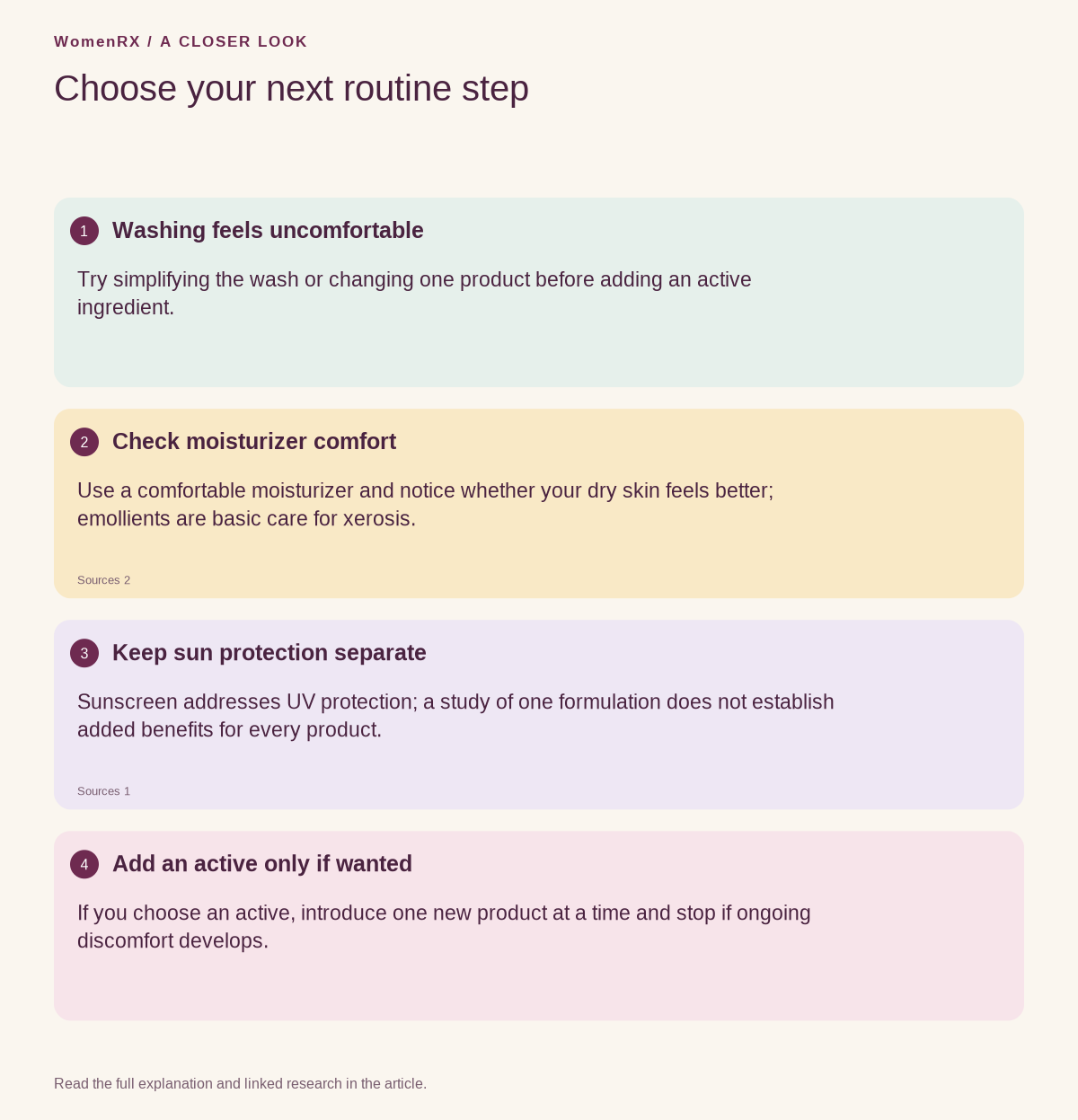
Choose your next routine step
Washing feels uncomfortable: Try simplifying the wash or changing one product before adding an active ingredient.
Check moisturizer comfort: Use a comfortable moisturizer and notice whether your dry skin feels better; emollients are basic care for xerosis.2
Keep sun protection separate: Sunscreen addresses UV protection; a study of one formulation does not establish added benefits for every product.1
Add an active only if wanted: If you choose an active, introduce one new product at a time and stop if ongoing discomfort develops.
Read the figure as text
Move through these decisions in order: address uncomfortable washing, see whether moisturizer helps, keep sun protection distinct, and add an active only if you want one.- Washing feels uncomfortable: Try simplifying the wash or changing one product before adding an active ingredient.
- Check moisturizer comfort: Use a comfortable moisturizer and notice whether your dry skin feels better; emollients are basic care for xerosis.2
- Keep sun protection separate: Sunscreen addresses UV protection; a study of one formulation does not establish added benefits for every product.1
- Add an active only if wanted: If you choose an active, introduce one new product at a time and stop if ongoing discomfort develops.
More questions, answered
Does menopause cause dry skin?
It may contribute for some women. A review links lower estrogen with skin moisture changes, but menopause is not a guaranteed or sole explanation for dryness. 4
Do I need a retinoid in my routine?
No. If dryness is your main concern, a retinoid is optional, not a basic first step. You can begin by seeing whether moisturizer helps your skin feel more comfortable.
Sources you can check
- Benefits of a Multifunctional Sunscreen Formulation Containing Nanoencapsulated Antioxidants in the Skin Protection Against UV Radiation and Blue Light: Clinical and Preclinical Studies.Fonseca AP, Ribon R, Cascais L, Facchini G, Pinheiro ALTA, Eberlin S, Maia Campos PMBG. · Journal of cosmetic dermatology · 2025Return to first citation
- Clinical Benefits of Basic Emollient Therapy for the Management of Patients With Xerosis Cutis.Vestergaard C, Torrelo A, Christen-Zaech S. · International journal of dermatology · 2025Return to first citation
- Urea: a comprehensive review of the clinical literature.Pan M, Heinecke G, Bernardo S, Tsui C, Levitt J. · Dermatology online journal · 2013Return to first citation
- Managing Menopausal Skin Changes: A Narrative Review of Skin Quality Changes, Their Aesthetic Impact, and the Actual Role of Hormone Replacement Therapy in Improvement.Viscomi B, Muniz M, Sattler S. · Journal of cosmetic dermatology · 2025Return to first citation