Crepey-Looking Skin: What May Help and What Won’t
Fine wrinkles and loose-looking skin can reflect different changes, so the useful first step is to separate surface dryness from skin laxity.
“Crepey” describes an appearance, not a diagnosis. Sun-related skin changes, loss of support after substantial weight loss, and, on the abdomen, stretched skin can contribute in different ways. Moisturizer may help dry or itchy skin feel better, while retinoids have evidence for photoaged skin. Neither should be expected to remove substantial loose skin. 6428

Start with what’s actually changing
Crepey-looking skin can mean fine lines, a thin-looking texture, or skin that doesn’t spring back as you’d like. Those aren’t necessarily the same problem. The backs of your hands may show years of sun exposure; skin on your abdomen may look different after pregnancy or a major change in weight. Where you see the change, and whether it’s mainly texture or excess skin, matters more than finding one product labeled for “crepey skin.”
Repeated ultraviolet (UV) exposure damages the skin’s supporting dermal matrix. A review of how topical retinoids work in human skin describes sun-related collagen changes and evidence that tretinoin can partly improve collagen deficiency in photoaged skin. That makes photoaging one plausible contributor to fine wrinkles, particularly on exposed areas, but it doesn’t explain every patch of loose-looking skin. 6
Substantial weight loss can change the picture in another way. A systematic review of facial changes after major weight loss found an association with loss of facial volume and greater skin laxity, especially around the mid-cheek and central neck. A topical product aimed at fine surface texture isn’t addressing that lost volume or excess skin. 4
On the abdomen, skin laxity and a change in the abdominal wall are distinct. A review of post-pregnancy and post-weight-loss abdominal changes describes loose skin as a change in the skin and underlying tissue, while rectus diastasis involves widening of the midline connective tissue and may show up as bulging. If the concern is a belly that protrudes as well as skin that looks loose, it’s worth describing both rather than assuming a cream can address them as one problem. 2
Match skincare to a realistic job
If the area is dry or itchy, a fragrance-free moisturizer and gentler washing may make it more comfortable. That’s useful care, even though relief of dryness is not the same as tightening excess skin. Guidance for itchy skin recommends regular unperfumed moisturizer and cool or lukewarm rather than prolonged hot baths or showers. 8
Retinoids are a different category: they’re used for sun-related skin changes, not simply to add moisture. Evidence on topical tretinoin in human photoaged skin describes effects on collagen production and UV-related matrix damage. The cited evidence concerns topical tretinoin and a separately studied multi-ingredient retinol formula. A result for one product does not establish what another will do. 65 In one eight-week study of 30 adults, including 21 women, a formulation containing retinol plus a synthetic retinoid ester, pea peptide, and antioxidants improved measured hydration and elasticity compared with participants’ own baseline. Because the ingredients were combined and there was no separate comparison group described, the study cannot tell you how much of the change came from retinol or predict that the formula will tighten loose skin. Retinol can also cause dryness, redness, or itching. 5
UV exposure contributes to photoaging. A clinical study reported improvements in early signs of photoaging with a regimen containing sunscreen, acetyl dipeptide-31 amide, and bakuchiol. Because the products were used together, the study cannot isolate sunscreen’s cosmetic effect. 67
When the concern is loose skin, ask a different question
Cosmetic procedures are sometimes offered for laxity, but “procedure” covers different approaches and levels of evidence. A systematic review of nine studies involving 278 participants reported improvements in several skin measures after a particular injectable hyaluronic acid treatment. The included studies examined different body sites and outcomes, so that result is not a promise that injections will correct the skin you’re noticing. Reported reactions included bruising and swelling. 1
Evidence for XERF, a specific radiofrequency device, is narrower: a retrospective study followed 16 women after one facial XERF treatment and reported improvements in laxity and skin-quality measures over three months. With no untreated comparison group and such a small sample, it cannot establish how reliably XERF works or how results hold up longer term. 3
If you’re considering a procedure, make the discussion specific to the site and the change you want treated. Is the target fine lines, surface texture, or actual excess skin? What improvement has been studied on that body area, for how long, and what unwanted effects are possible? Those questions are more useful than a general promise to “rebuild collagen.” 13
When it’s more than a texture concern
A new itchy area isn’t automatically another sign of aging. Dryness and irritation can itch, but so can rashes and other skin conditions. Arrange an assessment if itching is severe, widespread, keeps returning, doesn’t improve with self-care, or comes with a new rash, lump, or swelling that worries you. Itching during pregnancy also deserves a check because, although it’s common, it can sometimes have a liver-related cause. These are thresholds for itching, not a way to judge every new or changing mark on the skin. 8
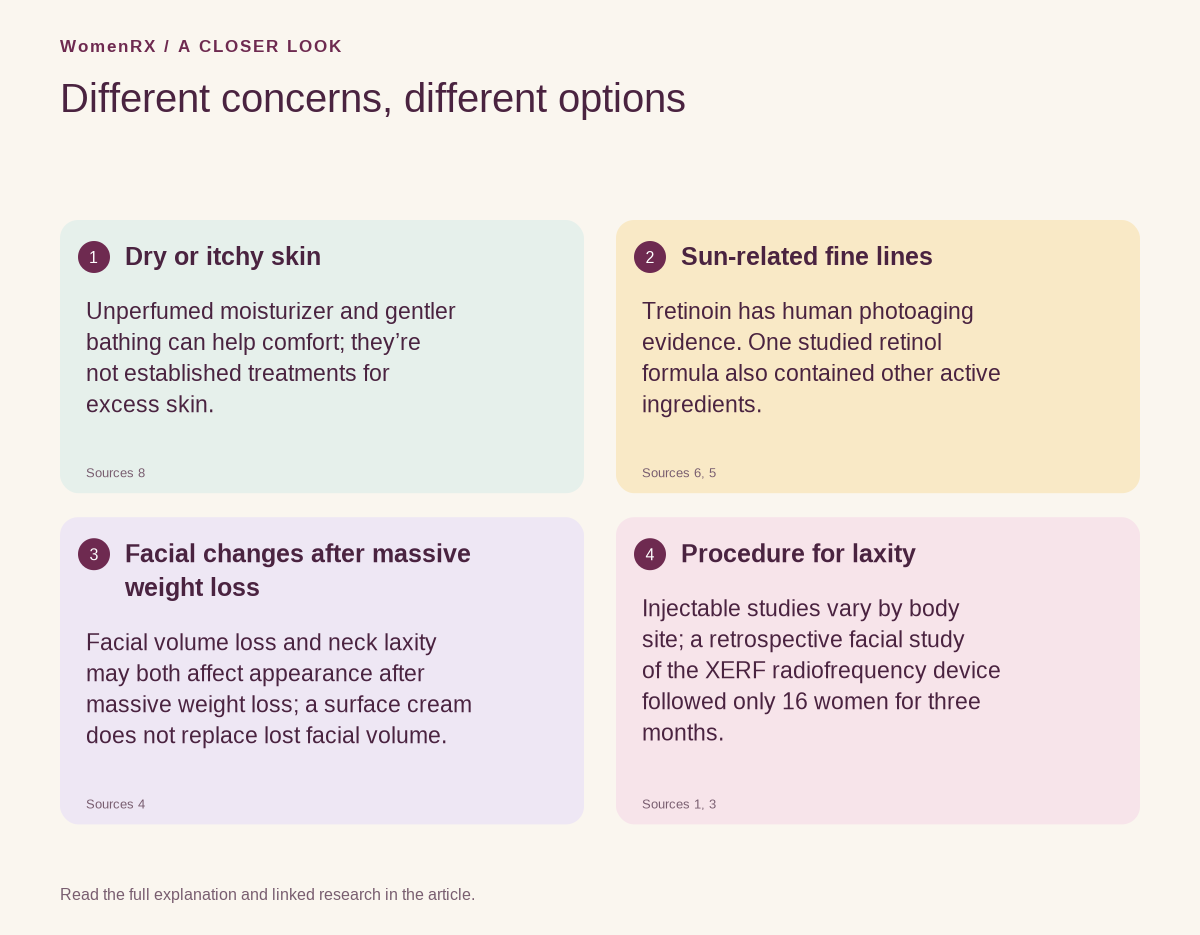
Different concerns, different options
Dry or itchy skin: Unperfumed moisturizer and gentler bathing can help comfort; they’re not established treatments for excess skin.8
Sun-related fine lines: Tretinoin has human photoaging evidence. One studied retinol formula also contained other active ingredients.65
Facial changes after massive weight loss: Facial volume loss and neck laxity may both affect appearance after massive weight loss; a surface cream does not replace lost facial volume.4
Procedure for laxity: Injectable studies vary by body site; a retrospective facial study of the XERF radiofrequency device followed only 16 women for three months.13
Read the figure as text
A quick way to distinguish comfort care, treatment of photoaged texture, and approaches studied for laxity.- Dry or itchy skin: Unperfumed moisturizer and gentler bathing can help comfort; they’re not established treatments for excess skin.8
- Sun-related fine lines: Tretinoin has human photoaging evidence. One studied retinol formula also contained other active ingredients.65
- Facial changes after massive weight loss: Facial volume loss and neck laxity may both affect appearance after massive weight loss; a surface cream does not replace lost facial volume.4
- Procedure for laxity: Injectable studies vary by body site; a retrospective facial study of the XERF radiofrequency device followed only 16 women for three months.13
More questions, answered
Does crepey-looking skin after pregnancy mean I have rectus diastasis?
No. Loose abdominal skin affects the skin and underlying tissue; rectus diastasis is a change in the abdominal midline that may cause bulging. They can occur together, but one does not establish the other. 2
Sources you can check
- A Systematic Review of the Efficacy and Safety of Profhilo® and Profhilo® Body.Sparavigna A, Cigni C, Tanzini L, Lualdi R, Grimolizzi F. · Plastic and aesthetic nursing · 2026Return to first citation
- Superficial Abdominal Skin Laxity Versus Rectus Diastasis: Distinct Pathophysiological Entities With Different Functional and Reconstructive Implications in Modern Abdominoplasty.Victor Baldin A, Bautista Perez IJ, Padilla Sierra MG, Briceño-Suárez M. · Cureus · 2026Return to first citation
- Objective and subjective retrospective evaluation of XERF, a novel single-shot dual-frequency non-invasive monopolar radiofrequency.Erlich G, Dahan E, Wolf Y. · Lasers in medical science · 2026Return to first citation
- Soft Tissue Facial Changes Following Massive Weight Loss Secondary to Medical and Surgical Bariatric Interventions: A Systematic Review.Jafar AB, Jacob J, Kao WK, Ho T. · Aesthetic surgery journal. Open forum · 2024Return to first citation
- Effects of Retinol, Natural Pea Peptide and Antioxidant Blend in a Topical Formulation: In Vitro and Clinical Evidence.Cook B, Riggs M, Holley KC, Knaggs H, Diwakar G, Lephart ED. · Dermatology and therapy · 2025Return to first citation
- The mechanism of action of topical retinoids.Kang S. · Cutis · 2005Return to first citation
- INDIVIDUAL ARTICLE: A Scientific Approach to Defining, Evaluating, and Treating Pre-Aging With a Cosmetic Regimen Containing a Novel Cosmetic Peptide, Acetyl Dipeptide-31 Amide (AP31).Farris P, Frey C, Parsa R, Miller D, Shyr T, Li WH. · Journal of drugs in dermatology : JDD · 2025Return to first citation
- Itchy skin - NHSAccessed 2026-09-25Return to first citation