Perimenopause and Skin Changes: What May Help
Dryness and rougher texture can begin during perimenopause, but a new skin concern isn’t automatically caused by hormones.
Dryness, rougher texture, thinning, and fragility may appear during perimenopause, though timing alone can’t identify the cause. 2 For dry or rough-feeling skin, try a gentle cleanser and moisturizer and see how your skin responds. Reduce rubbing if skin seems easily injured. For itch, a cold compress may help; seek assessment if it’s severe, unexplained, or lasts a few weeks. 1

What may change, and what that can feel like
During the transition to menopause, some women notice drier or rougher skin, changes in texture, or skin that seems more fragile. A review of menopause-related skin research describes changes such as thinning, reduced elasticity, and rougher texture, and says these may begin in perimenopause. It discusses declining estrogen as one possible contributor to changes in skin structure. That’s a plausible connection, not proof that hormones explain every new spot, rash, or change in how your skin feels. 2
Ageing and sun exposure can also affect skin structure, so noticing a change during this life stage doesn’t identify its cause by itself. 2
Match your next step to the symptom
Dryness or rough texture without significant itch: If your skin feels dry or rough, try a simple routine with a gentle cleanser and moisturizer, then see whether it feels more comfortable. If you’re noticing texture changes, limiting sun exposure also addresses another factor that can affect skin structure, though it won’t tell you whether hormones played a part. 2 In a study involving perimenopausal and postmenopausal women, participants used a cleanser and moisturizer alongside sunscreen and a study serum; the study cannot show what either basic product did on its own. 3
Fragility or sensitivity without itch: Thinning and fragility are described in menopause research. The review also discusses how structural changes may leave skin more vulnerable to injury from rubbing or shearing. If your skin seems easily injured, reduce unnecessary rubbing. 2 If “sensitive” means a particular product feels uncomfortable, set it aside and see whether the discomfort settles.
Itch or sensitivity that includes itch: Itching can occur with dry skin, but it can also come from allergies, medicines, irritating cosmetics or other substances, or conditions such as eczema and psoriasis. A cold compress may ease itch. Try not to scratch, and reduce exposure to high heat, irritating fabrics, and products you suspect are bothering your skin. 1
Itch that is severe, unexplained, or not settling: MedlinePlus advises contacting a health care provider if itching is severe, has no apparent cause, or doesn’t go away after a few weeks. Itching may occur with a rash or hives, and assessment can help identify whether a skin condition, reaction, or another cause needs treatment. 1
Keep hormones in perspective
A possible link between estrogen changes and skin structure doesn’t mean hormone therapy is a cosmetic skin treatment. The menopause skin review discusses research on hormonal effects, but it doesn’t establish that hormone therapy should be started solely to change skin appearance. 2 If you’re weighing hormone therapy for other menopause symptoms, discuss that decision separately with a clinician.
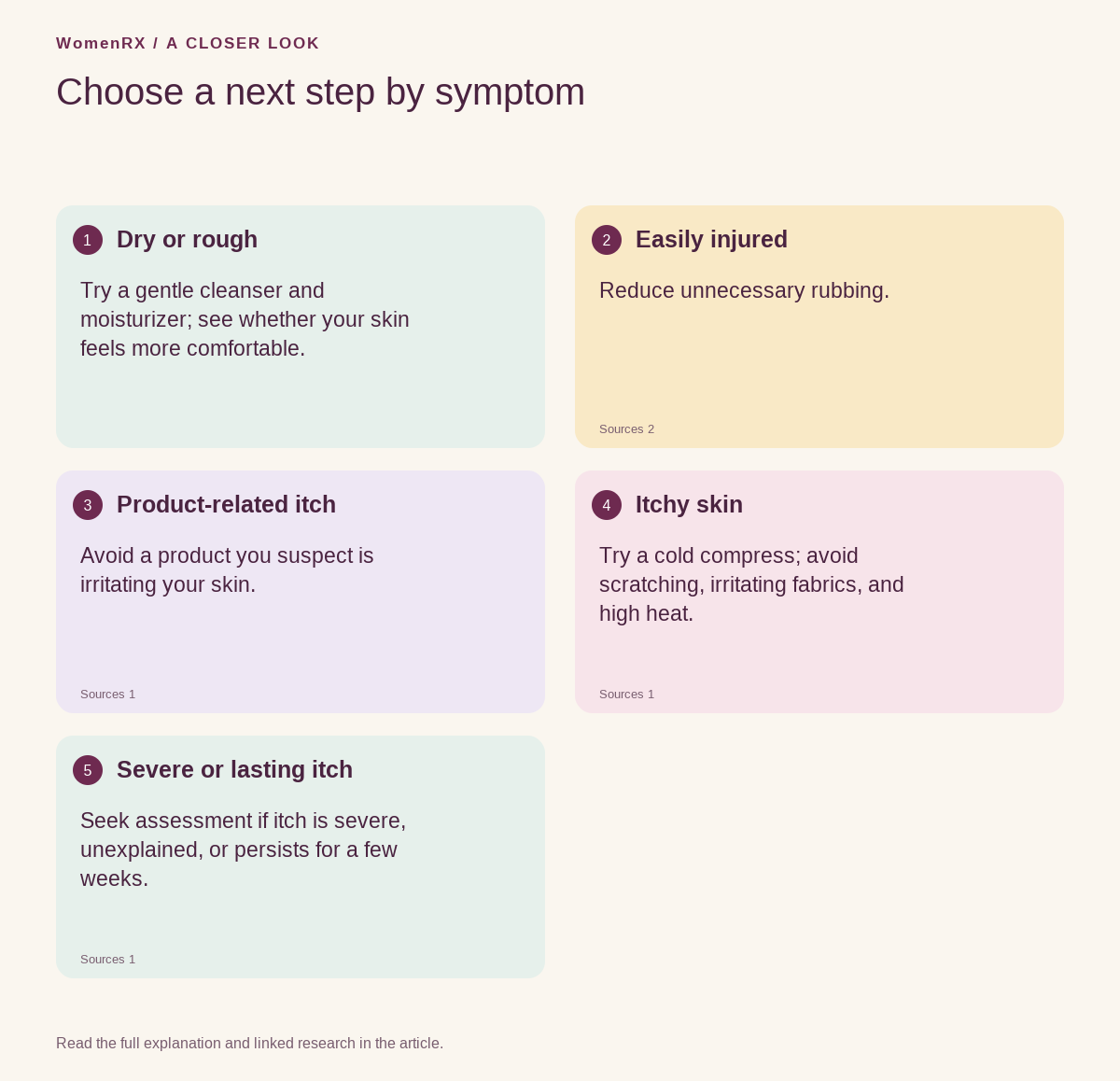
Choose a next step by symptom
Dry or rough: Try a gentle cleanser and moisturizer; see whether your skin feels more comfortable.
Easily injured: Reduce unnecessary rubbing.2
Product-related itch: Avoid a product you suspect is irritating your skin.1
Itchy skin: Try a cold compress; avoid scratching, irritating fabrics, and high heat.1
Severe or lasting itch: Seek assessment if itch is severe, unexplained, or persists for a few weeks.1
Read the figure as text
Start with what your skin is doing, rather than assuming the timing tells you why.- Dry or rough: Try a gentle cleanser and moisturizer; see whether your skin feels more comfortable.
- Easily injured: Reduce unnecessary rubbing.2
- Product-related itch: Avoid a product you suspect is irritating your skin.1
- Itchy skin: Try a cold compress; avoid scratching, irritating fabrics, and high heat.1
- Severe or lasting itch: Seek assessment if itch is severe, unexplained, or persists for a few weeks.1
More questions, answered
Does skin sensitivity mean perimenopause is the cause?
Not necessarily. Sensitivity alone doesn’t identify a cause. If what you’re noticing is itching, possible causes include dry skin, allergies, medicines, irritating cosmetics, and skin conditions. 1
Sources you can check
- Itching | Pruritus | Itchy skin | MedlinePlusAccessed 2026-09-25Return to first citation
- Menopause and Dermal White Adipose Tissue Depletion: Mechanistic Links, Adipogenesis, and Regenerative Therapeutic Replacement.Widgerow AD, Ziegler ME, Shafiq F. · Journal of cosmetic dermatology · 2026Return to first citation
- A Multicenter Trial of an Enhanced Serum Comprised of 13 Plant-Based Adaptogens Targeting Skin Quality in Females Impacted by Hormonal Decline.Draelos ZD, Moradi A, Smathers A. · Journal of cosmetic dermatology · 2026Return to first citation