Crepey-Looking Skin: What Evidence Supports, and What It Doesn't
Sun protection, retinoids, and skin-tightening procedures address different concerns, so the best place to start is with what you want to change.
Crepey-looking skin doesn’t have one fix. Sun protection can limit further UV-related photoaging, and topical retinoids have evidence for some facial fine wrinkles. Those findings don’t establish whether either approach tightens loose skin on the body. A small study of ultrasound treatment for upper arms found improvement at 90 days, but that result doesn’t promise similar effects elsewhere. 2 3 5

First, separate fine lines from loose skin
“Crepey” can describe several things: fine wrinkles, a dry-looking surface, or skin that looks loose when it moves. Those differences matter more than the label on a jar. A treatment studied for fine facial wrinkles doesn’t automatically tell you what to expect for loose skin on an upper arm.
Years of UV exposure can contribute to fine lines, uneven pigmentation, and reduced skin elasticity. Age-related changes can matter too, but these studies don’t establish how menopause affects a crepey appearance or whether treatment results differ after menopause. 2
Keep sun protection and surface care in their lane
Sunscreen and protective clothing help limit further UV exposure. They’re a foundation for skin affected by sun, not a way to reverse photoaging that’s already there. The cited photoaging research doesn’t establish whether sun protection tightens loose skin on the body. 2
As a general surface-care choice, you might use moisturizer if dryness is the feature you notice most. Judge it by whether your skin feels and looks less dry, not by a promise to rebuild firmness. That distinction can save you from paying for a “tightening” cream when what you want is either everyday comfort or a change in skin laxity.
Retinoids can help some photoaging signs
Topical retinoids have been studied for photoaging, particularly on the face. A network meta-analysis of randomized trials found improvements in fine wrinkles with retinol and tretinoin, among other treatments. Its results varied by the feature measured, such as fine wrinkles, roughness, or pigmentation. The authors also noted inconsistent assessment methods and limits in the diversity of study participants. These facial fine-line findings don’t establish that a cream will tighten loose skin on the arms or abdomen. 2
A systematic review of 25 comparative studies found that results varied: some alternatives to tretinoin performed better, many performed similarly, and others performed less well. Most alternatives were less irritating and better tolerated. But much of the comparison research was poor quality or potentially biased, so a simple “strongest product wins” ranking is less useful than it sounds. 3
Topical tretinoin can cause redness and peeling, sometimes enough to interrupt use. Its product information also advises protecting treated skin from sun exposure. If you’re considering it, those tradeoffs deserve as much attention as a before-and-after photo. 1
Procedures need an area-specific reality check
Devices aimed at laxity ask a different question from creams aimed at fine lines. In one randomized, split-body study, 14 women completed a comparison of two ultrasound treatments for upper-arm laxity and crepiness. After a single treatment, investigators and participants rated improvement at 90 days. Because both arms received an active treatment, the study compared devices rather than showing how either performed against no treatment. It was also small and followed participants only through that short-term assessment. 5
Radiofrequency is another procedure you may see advertised. One study compared two radiofrequency approaches in 84 patients, but it reviewed past treatment records rather than randomly assigning patients or including an untreated group. Its findings aren’t a sound basis for promising that one approach is best for your skin. 6
Before considering a procedure, match the advertised result to your actual concern: Was the same body area studied? Was the measured change fine wrinkles, surface texture, or laxity? What was the comparison, and how long did the result last? An improvement in facial wrinkles or upper-arm appearance is useful information, but neither proves lasting tightening everywhere.
If the concern is mainly brown sun spots, that’s another target altogether. Research on treating solar lentigines, or sun spots, measures changes in those spots. A successful spot treatment isn’t evidence that loose skin has tightened. 4
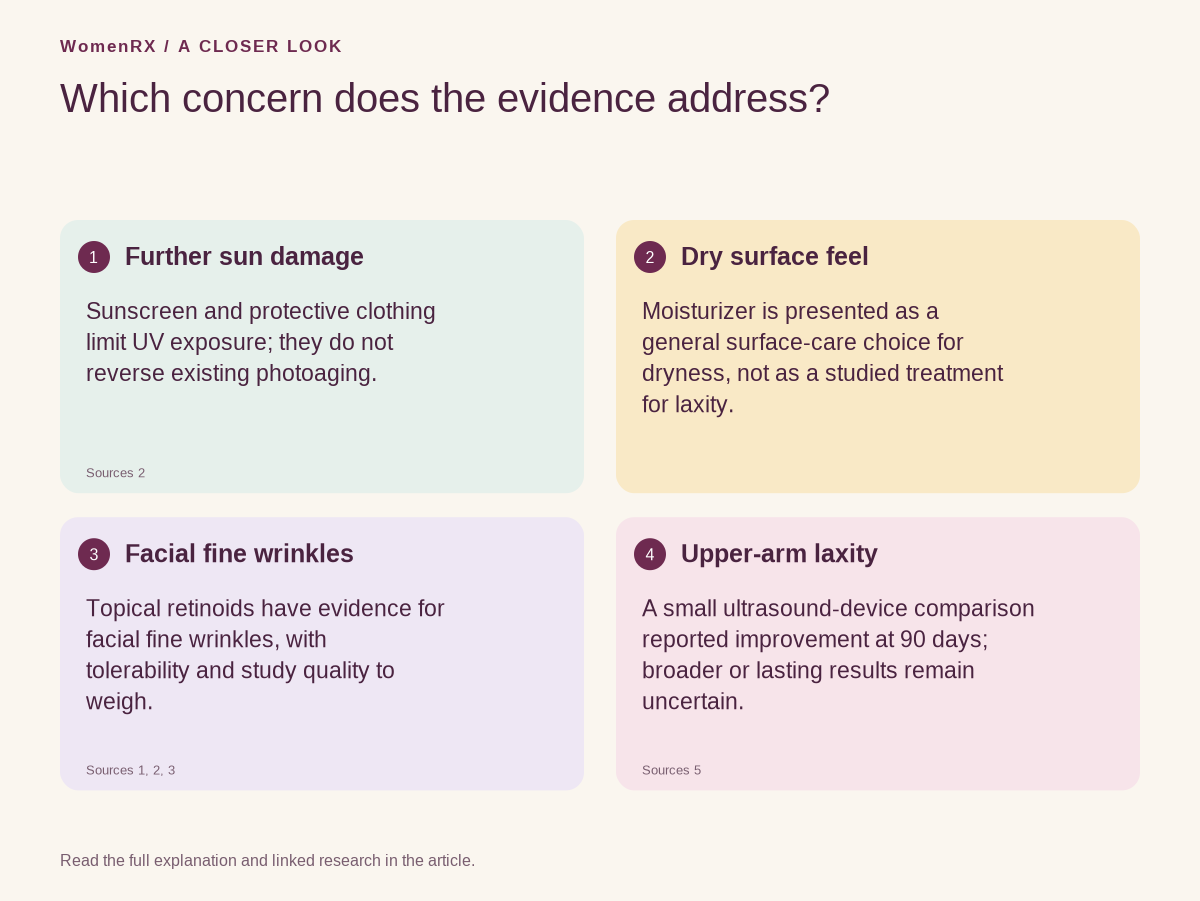
Which concern does the evidence address?
Further sun damage: Sunscreen and protective clothing limit UV exposure; they do not reverse existing photoaging.2
Dry surface feel: Moisturizer is presented as a general surface-care choice for dryness, not as a studied treatment for laxity.
Facial fine wrinkles: Topical retinoids have evidence for facial fine wrinkles, with tolerability and study quality to weigh.123
Upper-arm laxity: A small ultrasound-device comparison reported improvement at 90 days; broader or lasting results remain uncertain.5
Read the figure as text
A quick way to separate supportive care from treatments studied for a specific skin change.- Further sun damage: Sunscreen and protective clothing limit UV exposure; they do not reverse existing photoaging.2
- Dry surface feel: Moisturizer is presented as a general surface-care choice for dryness, not as a studied treatment for laxity.
- Facial fine wrinkles: Topical retinoids have evidence for facial fine wrinkles, with tolerability and study quality to weigh.123
- Upper-arm laxity: A small ultrasound-device comparison reported improvement at 90 days; broader or lasting results remain uncertain.5
More questions, answered
Is retinol the same as tretinoin for crepey skin?
No. They’re different topical retinoids, and evidence on photoaging doesn’t establish that they’ll produce the same result for every person or body area. Both have evidence relevant to facial fine wrinkles; the cited facial photoaging studies don’t establish whether either tightens loose body skin. 2 3
Sources you can check
- TRETINOIN CREAM [REDPHARM DRUG] | US prescribing information and patient instructionsAccessed 2026-09-25Return to first citation
- Comparative efficacy of topical interventions for facial photoaging: a network meta-analysis.Lin L, Chen X, Liu C, Wang Q, Lian W, Xu X, Guo Y, Zhong H, Zhong J, Zhao N, Cheng W, Shu P, Xu Z. · Scientific reports · 2025Return to first citation
- Comparing Tretinoin to Other Topical Therapies in the Treatment of Skin Photoaging: A Systematic Review.Siddiqui Z, Zufall A, Nash M, Rao D, Hirani R, Russo M. · American journal of clinical dermatology · 2024Return to first citation
- Treatment of Solar Lentigines: A Systematic Review of Clinical Trials.Mardani G, Nasiri MJ, Namazi N, Farshchian M, Abdollahimajd F. · Journal of cosmetic dermatology · 2025Return to first citation
- A Single-Center, Blinded, Split-Body, Randomized Clinical Trial of High-Intensity, Parallel Ultrasound Beams Versus Microfocused Ultrasound With Visualization for the Treatment of Upper Inner Arm Skin Laxity.Loyal J, Hartman N, Goldman MP. · Dermatologic surgery : official publication for American Society for Dermatologic Surgery [et al.] · 2026Return to first citation
- Radiofrequency technology as an anti-aging intervention: clinical efficacy in reversing senescence-driven skin laxity and age-related dermal degeneration.Wang M, Fu M, Zhang J. · Frontiers in cell and developmental biology · 2026Return to first citation