Tretinoin for Sun-Damaged Skin: What Studies Show
Tretinoin has clinical-trial evidence for photoaging, but studies measure changes in visible features, not wrinkle removal.
Topical tretinoin may improve some visible signs of photoaging, but the evidence does not promise wrinkle removal or predict what one person will see. Small studies assessed changes over 12 or 24 weeks, mostly against other active products rather than no treatment. Sun protection still matters: tretinoin is not a shield from UV exposure, and product information advises limiting sun exposure during use. 1 2 3 4
What tretinoin may change
Photoaging refers to visible skin changes associated with long-term sun exposure, including wrinkles and uneven pigmentation. A review describes topical retinoids, including tretinoin, as having evidence from randomized trials for photoaging. That supports the possibility of improvement, not a promise that every feature will change or that wrinkles will disappear. 4
The studies assess visible outcomes such as fine lines, wrinkles, discoloration, skin tone, or an overall photoaging score. These are clinical or image-based measures of appearance. They’re different from laboratory findings, such as changes in gene activity in a skin sample, which can help researchers explore a possible mechanism but aren’t themselves proof of visible improvement. 2 3
What the comparisons can tell you
In a 24-week randomized trial, researchers compared tretinoin 0.02% with one specific formulation containing retinol and related ingredients in people with moderate to severe facial photodamage. The analysis included 20 White women: 11 assigned to tretinoin and 9 to the other formulation. At week 24, median photoaging scores were 5 with tretinoin and 4 with the other formulation. The difference was not statistically significant, so this small study didn’t establish that one worked better. It also didn’t show that the treatments were identical or that neither had an effect. 2
The same trial reported erythema, or redness, less often with the retinol-based formulation than with tretinoin: 11% versus 64%. That’s a tolerability finding from a small study, not a guarantee about how your skin will react. Topical tretinoin product information also describes local redness and peeling, and notes that temporary increases or decreases in skin pigment have been reported. 1 2
A separate 12-week split-face study included women aged 30 to 65 with mild to severe photodamage. Forty-seven women completed the study across two comparison groups. In the group comparing products with tretinoin, 24 participants were assigned to use the tested double-conjugated retinoid cream on one side of the face and tretinoin on the other; the other group compared that cream with retinol. The study assessed fine lines and wrinkles, among other visible features. Its abstract reported that the double-conjugated product was noninferior to tretinoin on several measures, but that result applies to the particular products and study design, not to all retinoid creams. 3
Together, these studies offer checkpoints, not a personal timetable. They assessed outcomes at 12 or 24 weeks, and don’t establish a guaranteed week when you’ll notice a change, how much you’ll see, or whether changes persist after treatment ends. The comparisons were against other active products, so they don’t provide a straightforward estimate of tretinoin’s effect versus no treatment. 2 3
Sun protection is part of the plan
Tretinoin doesn’t prevent UV exposure or replace sun protection. Product information advises minimizing sunlight and artificial UV exposure while using the cream, and recommends sunscreen and protective clothing when exposure can’t be avoided. It also cautions that skin may be more susceptible to sunburn during treatment. 1
Irritation is another practical consideration. Product information describes possible redness, peeling, and, for some people, more severe reactions. If irritation is severe or persistent, the product information advises stopping use and seeking guidance about the reaction. Temporary pigment changes have also been reported, but the available trial summaries don’t establish how often these occur across different skin tones. 1
Who was studied, and what remains unclear
The 24-week trial analyzed 20 White women. The 12-week study included women aged 30 to 65, but its abstract doesn’t report their skin tones or ethnicity. Neither study summary establishes how well results apply across a broad range of skin tones, and the summaries don’t describe results by menopausal status. That’s a limit on how specifically you can apply these findings, not evidence that tretinoin works differently by skin tone or age. 2 3
The realistic takeaway is that tretinoin has clinical-trial support for improving some signs of photoaging, but the studies are small and test selected outcomes over weeks to months. Think of possible visible improvement, not wrinkle erasure, and keep sun protection in the picture.
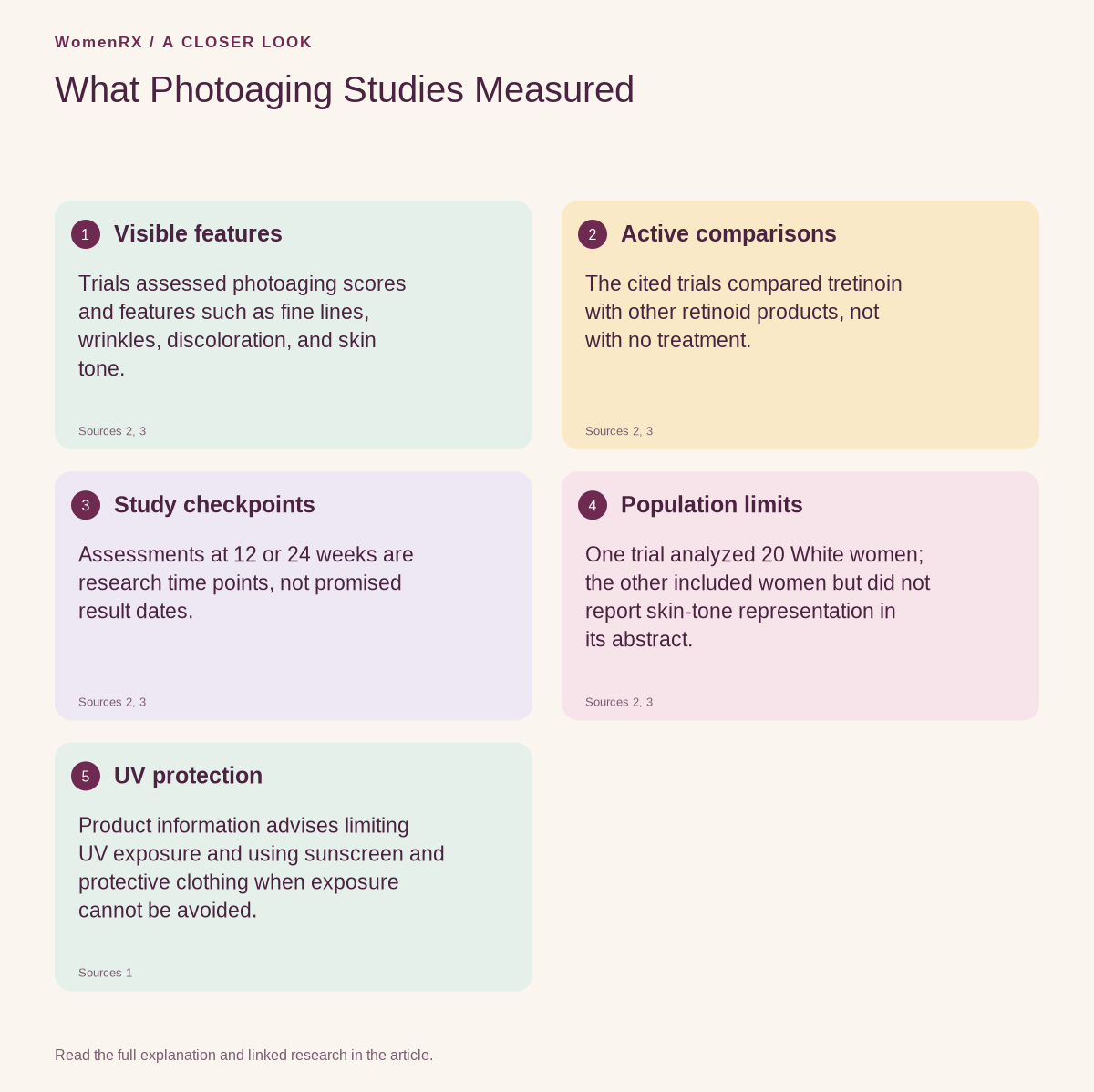
What Photoaging Studies Measured
Visible features: Trials assessed photoaging scores and features such as fine lines, wrinkles, discoloration, and skin tone.23
Active comparisons: The cited trials compared tretinoin with other retinoid products, not with no treatment.23
Study checkpoints: Assessments at 12 or 24 weeks are research time points, not promised result dates.23
Population limits: One trial analyzed 20 White women; the other included women but did not report skin-tone representation in its abstract.23
UV protection: Product information advises limiting UV exposure and using sunscreen and protective clothing when exposure cannot be avoided.1
Read the figure as text
A compact evidence map of the outcomes, comparisons, and population limits in tretinoin photoaging research.- Visible features: Trials assessed photoaging scores and features such as fine lines, wrinkles, discoloration, and skin tone.23
- Active comparisons: The cited trials compared tretinoin with other retinoid products, not with no treatment.23
- Study checkpoints: Assessments at 12 or 24 weeks are research time points, not promised result dates.23
- Population limits: One trial analyzed 20 White women; the other included women but did not report skin-tone representation in its abstract.23
- UV protection: Product information advises limiting UV exposure and using sunscreen and protective clothing when exposure cannot be avoided.1
More questions, answered
Do these studies show how long results last after treatment?
The trial summaries report assessments during 12 or 24 weeks of treatment, but don’t report whether improvements persisted after treatment ended. They can’t establish how long any change lasts. 2 3
Sources you can check
- TRETINOIN CREAM [REDPHARM DRUG] | US prescribing information and patient instructionsAccessed 2026-09-25Return to first citation
- Biomarkers of Tretinoin Precursors and Tretinoin Efficacy in Patients With Moderate to Severe Facial Photodamage: A Randomized Clinical Trial.Chien AL, Kim DJ, Cheng N, Shin J, Leung SG, Nelson AM, Zang J, Suh H, Rainer B, Wallis L, Okoye GA, Loss M, Kang S. · JAMA dermatology · 2022Return to first citation
- Efficacy and tolerability of a double-conjugated retinoid cream vs 1.0% retinol cream or 0.025% tretinoin cream in subjects with mild to severe photoaging.McDaniel DH, Mazur C, Wortzman MS, Nelson DB. · Journal of cosmetic dermatology · 2017Return to first citation
- The use of retinoids in the treatment of photoaging.Singh M, Griffiths CE. · Dermatologic therapy · 2006Return to first citation