A Simple Routine for Sun Damage, Dryness, and Texture
Start with sun protection and comfortable skin, then consider one optional treatment for texture or fine lines.
Keep the routine small: use a moisturizer if your skin feels dry, and choose a broad-spectrum SPF 30 or higher sunscreen for daytime sun protection. Sunlight contributes to skin aging, while moisturizer can ease dryness. If texture or fine lines still bother you, a topical retinoid is an optional next step, not a requirement. 563

Make sun protection the morning priority
Sunlight is a major contributor to visible skin aging. Protecting your skin now won't erase years of sun exposure or stop normal aging, but it gives a routine for sun damage a sensible foundation. Choose a sunscreen labeled broad spectrum and SPF 30 or higher. Broad spectrum means protection against both UVA and UVB rays. If you'll be swimming or sweating, look for a water-resistant product and follow its label for reapplication. Shade and protective clothing help too. 56
You don't need a separate daytime treatment just because a bottle promises a brighter or younger-looking complexion. If dryness is noticeable, add a moisturizer that feels comfortable under your sunscreen. If not, there's no need to build a long morning lineup.
Keep the evening routine comfortable
At night, a simple wash and moisturizer may be enough. Dryness and a less smooth appearance can come with age, and treatments that soothe dry skin can help it feel and look better without claiming to change the underlying aging process. 5 If your skin feels dry, you can use a moisturizer for comfort. Prescription topical retinoids commonly cause dryness, peeling, redness, or stinging. 3
Pay attention to how your skin feels rather than how many steps you're completing. For example, if washing leaves your face feeling tight, adding a scrub and an active treatment at the same time is unlikely to make the routine easier to tolerate. The prescribing information for tretinoin cream specifically cautions about abrasive cleansers and products with strong drying effects when used alongside it. 1
Choose an optional active for texture or fine lines
If your basic routine feels good but you want to address rough texture, uneven tone, or fine lines, a topical retinoid is the optional category with the clearest support here. A review of photoaging treatments reports improvements in wrinkles, texture, and skin tone with topical retinoids, while also finding that clinical evidence for many over-the-counter cosmetic products is limited. Prescription retinoids have been studied more than typical cosmetic products, but irritation can limit their appeal. 3
That tradeoff matters more than collecting multiple actives. Try to judge whether one new product agrees with your skin before adding another; otherwise, if redness or peeling develops, it's hard to tell what's responsible. This is a practical way to keep the routine understandable, not a proven schedule for introducing products. If you're using prescription tretinoin and develop substantial irritation, its product information says use may need to be reduced, paused, or stopped according to the severity of the reaction. It also recommends protecting treated skin from sun exposure. 1
Keep expectations modest. In a small randomized, vehicle-controlled study of a tretinoin lotion on the chest, both the tretinoin and vehicle groups improved on some photoaging measures over 180 days; the tretinoin group had more redness at day 90. Those results don't tell us what a facial product will do for you, but they do show why a pleasant formula and tolerability deserve attention alongside the active ingredient. 4
Let your skin needs and life stage change the plan
If dryness is the concern that affects you most, including later in life, you can stop at sunscreen and moisturizer. Skin commonly becomes drier and thinner with age; a retinoid isn't needed to make a routine worthwhile. 5
Pregnancy changes the optional-active decision. A review of acne treatment during pregnancy and lactation recommends avoiding both oral and topical retinoids during those periods. That review addresses acne treatment, not cosmetic photoaging, but it is a reason not to treat a retinoid as an essential skin-care step while pregnant or breastfeeding. 2 You can keep the goal simple: protect your skin from the sun and care for dryness, then revisit optional treatments when they're appropriate for you.
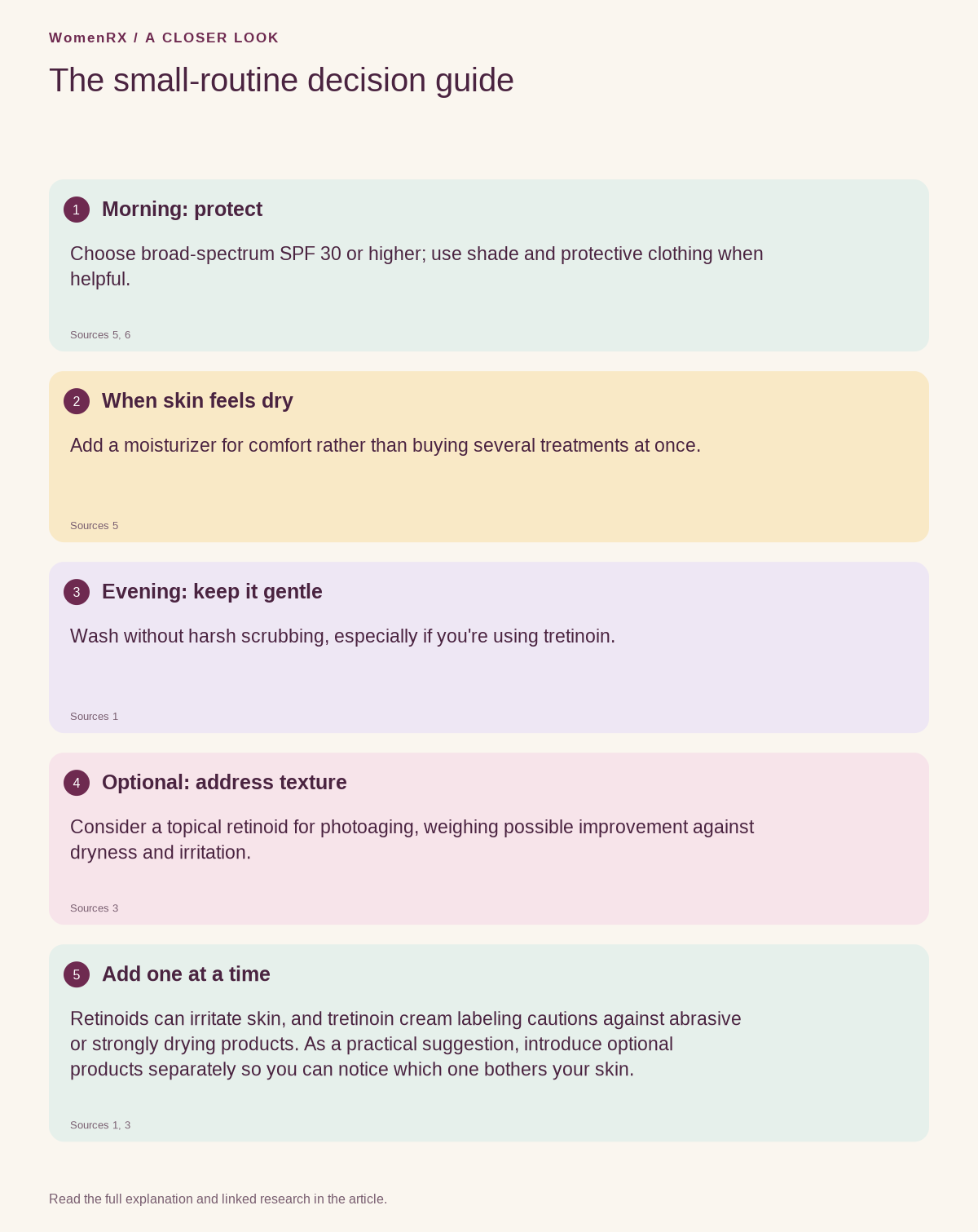
The small-routine decision guide
Morning: protect: Choose broad-spectrum SPF 30 or higher; use shade and protective clothing when helpful.56
When skin feels dry: Add a moisturizer for comfort rather than buying several treatments at once.5
Evening: keep it gentle: Wash without harsh scrubbing, especially if you're using tretinoin.1
Optional: address texture: Consider a topical retinoid for photoaging, weighing possible improvement against dryness and irritation.3
Add one at a time: Retinoids can irritate skin, and tretinoin cream labeling cautions against abrasive or strongly drying products. As a practical suggestion, introduce optional products separately so you can notice which one bothers your skin.13
Read the figure as text
Start with the steps that meet your current needs; the active treatment is optional.- Morning: protect: Choose broad-spectrum SPF 30 or higher; use shade and protective clothing when helpful.56
- When skin feels dry: Add a moisturizer for comfort rather than buying several treatments at once.5
- Evening: keep it gentle: Wash without harsh scrubbing, especially if you're using tretinoin.1
- Optional: address texture: Consider a topical retinoid for photoaging, weighing possible improvement against dryness and irritation.3
- Add one at a time: Retinoids can irritate skin, and tretinoin cream labeling cautions against abrasive or strongly drying products. As a practical suggestion, introduce optional products separately so you can notice which one bothers your skin.13
More questions, answered
Do over-the-counter cosmetic products have the same evidence as prescription topical retinoids?
No. A review identifies prescription topical retinoids as the most studied treatments for photoaging and says clinical data supporting over-the-counter cosmetic products are generally lacking. That does not mean every over-the-counter product is ineffective. 3
Do I need a water-resistant sunscreen every day?
Water resistance is especially useful when you'll be swimming or sweating. The everyday label priorities for choosing sunscreen are broad-spectrum protection and SPF 30 or higher; water-resistant products still need reapplication according to their labels. 6
Sources you can check
- TRETINOIN CREAM [REDPHARM DRUG] | US prescribing information and patient instructionsAccessed 2026-09-25Return to first citation
- Treatment of acne vulgaris during pregnancy and lactation.Kong YL, Tey HL. · Drugs · 2013Return to first citation
- Topical Treatments for Photoaged Skin.Sadick N, Pannu S, Abidi Z, Arruda S. · Journal of drugs in dermatology : JDD · 2023Return to first citation
- A Prospective, Randomized, Double-Blind, Vehicle-Controlled Study Evaluating the Efficacy, Safety, and Patient Satisfaction of Tretinoin 0.05% Lotion for Chest Rejuvenation.Wood E, Almukhtar R, Gonzalez A, Angra K, Lipp M, Fabi S. · Journal of drugs in dermatology : JDD · 2022Return to first citation
- Aging Skin | Sunlight | MedlinePlusAccessed 2026-09-25Return to first citation
- How to select a sunscreenAccessed 2026-09-25Return to first citation