How to Choose and Apply Everyday Sunscreen
A useful daily sunscreen routine starts with a clear label, enough product to cover exposed skin, and a plan to reapply when you’re outdoors.
Choose a broad-spectrum sunscreen with SPF 30 or higher. If you’ll be swimming or sweating, look for water resistance, too. Apply it before going outside, cover all skin your clothes leave exposed, and use enough: most adults need about one ounce for all skin not covered by clothing, including the face. At least one teaspoon is the face-specific reference point, not an amount to add to the ounce. Reapply every two hours while outdoors and immediately after swimming or sweating. 45
Start with the protection label, not the skincare pitch
A moisturizer, makeup product, or dedicated sunscreen can look appealing for all sorts of reasons. For sun protection, start with what the label actually says: broad spectrum and SPF 30 or higher. Broad spectrum means protection against both UVA and UVB rays. The American Academy of Dermatology recommends those two features and water resistance, which is especially useful if you’ll swim or sweat. 4
If your day includes a swim, a workout, or time outside when you’ll sweat, check for water resistant as well. The label will specify either 40 or 80 minutes of water resistance. That describes how long the sunscreen remains effective on wet or sweaty skin under testing conditions. It doesn’t mean you can skip reapplication after getting out of the water. 45
The best-looking label can’t make up for a patchy layer. SPF is tested at an application thickness of 2 milligrams per square centimeter of skin. In a study of 26 volunteers applying an SPF 50+ sunscreen to their faces, a single unguided application averaged 1.04 milligrams per square centimeter. When they followed an application guide, they used more sunscreen and spread it more evenly, though the average amount still fell short of the testing thickness. A separate study found that measured SPF declined as less sunscreen was applied. These studies don’t tell you the exact protection you’ll get at home, but they explain why using a tiny amount of a high-SPF product isn’t a reliable shortcut. 23
Make the first application count
Put sunscreen on before you head outdoors. The American Academy of Dermatology recommends allowing about 15 minutes before sun exposure. Then look beyond the center of your face: cover your neck, ears, and any arms, legs, or tops of feet your clothes leave exposed. If your hair is thinning, protect the exposed scalp with sunscreen or a wide-brimmed hat; use an SPF 30 or higher lip balm for your lips. 5
For amount, the Academy gives two useful reference points. Most adults need about one ounce, roughly a shot glass full, to cover all skin not covered by clothing, including the face; your body size and how much skin is exposed can change what you need. For the face, its separate reference point is at least one teaspoon, about the amount that would cover the length of your index and middle fingers. That teaspoon is part of the full-coverage amount, not an addition to it. Rub it in thoroughly rather than treating the number as a reason to leave thick patches in some places and bare skin in others. 5
Think about what’s exposed on this outing. For example, a walk in short sleeves calls for coverage on your arms as well as your face and neck. A hat or clothing can cover some areas, but sunscreen still belongs on the skin they leave uncovered. Clouds and winter weather don’t eliminate UV exposure when you go outside. 5
Reapply for the time you’re actually outside
If you remain outdoors, reapply sunscreen every two hours. Reapply immediately after swimming or sweating, even if you chose a water-resistant product. Those are different cues: the two-hour rule is for continued outdoor exposure; swimming or sweating calls for a fresh application sooner. 5
For example, if you apply sunscreen before an afternoon outdoors, set a reminder for two hours later and bring enough to cover the exposed areas again. If you swim before that reminder goes off, reapply when you get out rather than waiting for it. Water resistance helps you choose a product for that setting; it doesn’t replace the routine. 45
If dark patches are your concern, consider visible light too
Melasma changes one part of the product decision. Broad-spectrum SPF describes UV protection, while visible light can also contribute to pigment changes, particularly in darker skin. The American Academy of Dermatology recommends considering a tinted sunscreen with iron oxide when you want better protection against dark spots from visible light. 15
There’s a useful limit to the evidence: in an eight-week randomized trial involving people with melasma under intense sun exposure, a sunscreen that also protected against visible light produced greater improvement than a UV-only sunscreen. Both groups also used hydroquinone, so the trial tested sunscreen types alongside that treatment, not tinted sunscreen as a stand-alone cure. Tinted sunscreen is an option worth considering for melasma, not a requirement for every person or a promise that any particular formula will suit your skin. 1
For everyday use, the routine remains straightforward: pick a label that meets the UV basics, choose water resistance when your plans call for it, and make sure you can apply a full, even layer to the skin you’re exposing. 45
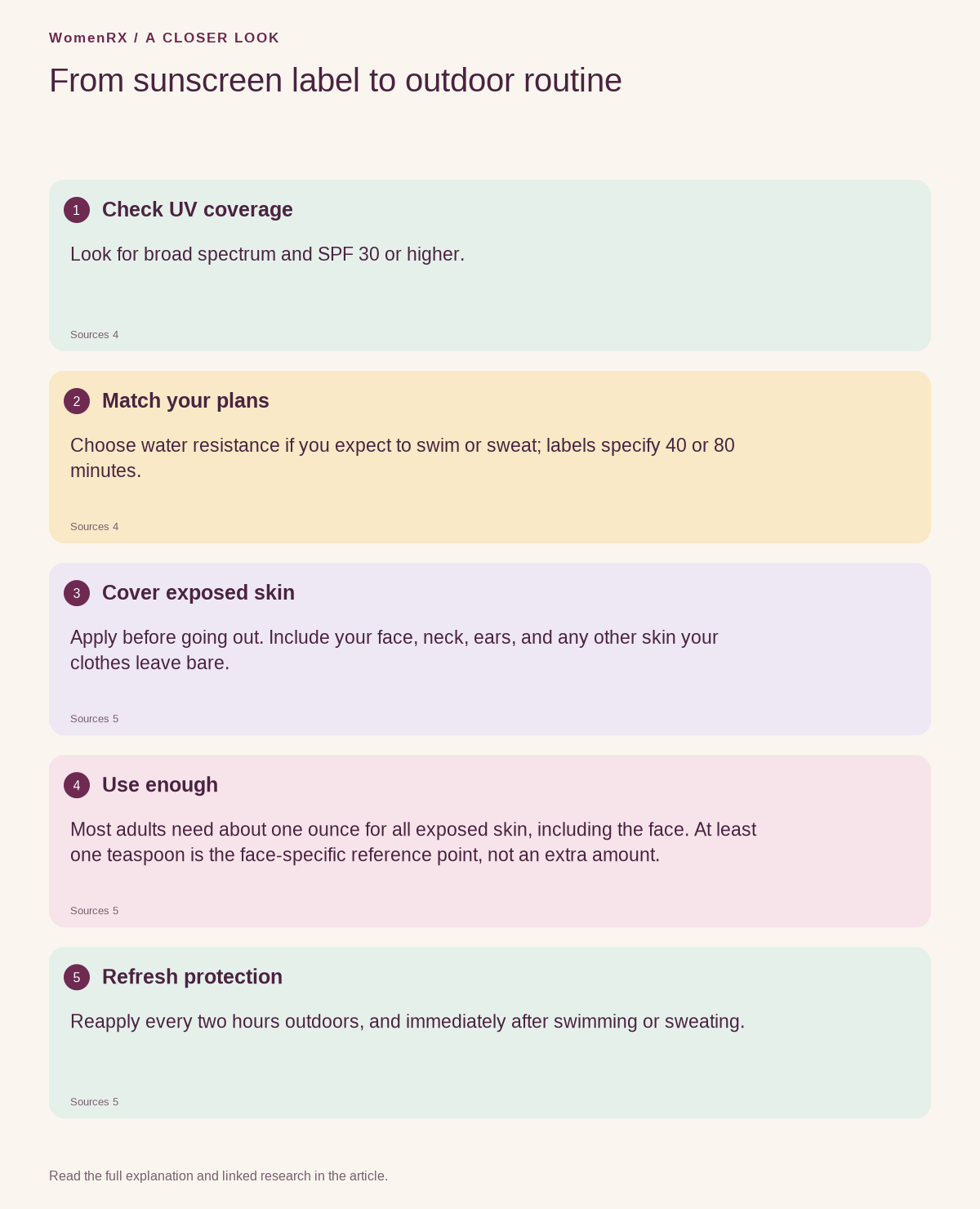
From sunscreen label to outdoor routine
Check UV coverage: Look for broad spectrum and SPF 30 or higher.4
Match your plans: Choose water resistance if you expect to swim or sweat; labels specify 40 or 80 minutes.4
Cover exposed skin: Apply before going out. Include your face, neck, ears, and any other skin your clothes leave bare.5
Use enough: Most adults need about one ounce for all exposed skin, including the face. At least one teaspoon is the face-specific reference point, not an extra amount.5
Refresh protection: Reapply every two hours outdoors, and immediately after swimming or sweating.5
Read the figure as text
Use these checks in order, from choosing a product to keeping exposed skin covered during your outing.- Check UV coverage: Look for broad spectrum and SPF 30 or higher.4
- Match your plans: Choose water resistance if you expect to swim or sweat; labels specify 40 or 80 minutes.4
- Cover exposed skin: Apply before going out. Include your face, neck, ears, and any other skin your clothes leave bare.5
- Use enough: Most adults need about one ounce for all exposed skin, including the face. At least one teaspoon is the face-specific reference point, not an extra amount.5
- Refresh protection: Reapply every two hours outdoors, and immediately after swimming or sweating.5
Sources you can check
- Near-visible light and UV photoprotection in the treatment of melasma: a double-blind randomized trial.Castanedo-Cazares JP, Hernandez-Blanco D, Carlos-Ortega B, Fuentes-Ahumada C, Torres-Álvarez B. · Photodermatology, photoimmunology & photomedicine · 2014Return to first citation
- In vivo evaluation of sunscreen application by multispectral imaging: A new tool for educating sunscreen users.Le Digabel J, Questel E, Lauze C, Carballido F, Josse G. · Skin research and technology : official journal of International Society for Bioengineering and the Skin (ISBS) [and] International Society for Digital Imaging of Skin (ISDIS) [and] International Society for Skin Imaging (ISSI) · 2023Return to first citation
- The effect of on-site application density on the UV protection efficacy of sunscreens.Fujiwara R, Muta K, Izutsu Y, Hatao M. · Photodermatology, photoimmunology & photomedicine · 2022Return to first citation
- How to select a sunscreenAccessed 2026-09-25Return to first citation
- How to apply sunscreenAccessed 2026-09-25Return to first citation