Sunscreen, Tanning, and Vitamin D: What Matters
A tan signals UV-related skin damage, while sunscreen’s effect on vitamin D depends on how protection is used.
A tan isn’t a healthy layer of protection. It’s a response to UV exposure and a sign of skin damage. Sunscreen can reduce the UVB that helps your skin make vitamin D, but everyday use doesn’t block it completely. In a year-long Australian trial, routine SPF 50+ users had a smaller rise in vitamin D than discretionary users. 1 2 3
A tan and vitamin D come from the same exposure, but mean different things
UVB helps your skin make vitamin D and can cause sunburn. UVA prompts skin to produce more melanin, creating a tan. That darker color is a response to UV exposure, not evidence that the exposure was good for your skin. Tanning beds expose skin to UV rays, too, and a “base tan” won’t prevent sunburn outdoors. 1 2
You don’t need to pursue a tan to get vitamin D. Fortified foods provide much of the vitamin D in American diets, and supplements are another source. How much vitamin D a person makes from sunlight varies with factors including season, cloud cover, skin melanin, and the skin exposed. That makes a single sun-exposure target unreliable. 2
Does sunscreen lower vitamin D?
There’s a difference between what sunscreen can do and what happens when people wear it. Sunscreen reduces UV reaching the skin when applied correctly. In practice, people may leave skin uncovered, apply too little, or not reapply, so their skin may still make some vitamin D. 2 5
A randomized Australian trial tested a more consistent routine. Adults who weren’t already routine sunscreen users or taking vitamin D supplements were assigned either to apply SPF 50+ sunscreen on days when the forecast UV index was at least 3 or to use sunscreen at their discretion. After about a year, the adjusted rise in blood vitamin D was 5.2 nmol/L smaller in the routine-use group among the 628 participants analyzed. 3
At the final measurement, 139 of 304 routine-use participants and 115 of 312 discretionary-use participants had a vitamin D level below the study’s deficiency threshold of 50 nmol/L. That comparison matters, but it doesn’t mean sunscreen inevitably causes deficiency. It compares two sunscreen habits in one setting, not sunscreen with no sunscreen. The trial included 415 participants who identified as female, but its published abstract gives no separate treatment estimate for women. 3
Skin tone changes vitamin D production, not what a tan means
Melanin affects how much vitamin D skin makes from sunlight; NIH notes that people with dark skin are less able to produce it this way. That’s one reason the same time outdoors won’t have the same vitamin D effect for everyone. It isn’t a reason to use tanning as a vitamin D plan. UV exposure can damage skin, while food and supplements provide ways to obtain vitamin D without seeking more UV. 1 2
What does sunscreen safety evidence show?
A review of sunscreen research concluded that sunscreen is safe to use overall and reduces skin-cancer risk when applied correctly. It also emphasized that the amount and way people apply it affect the protection they receive. That supports a practical approach: use broad-spectrum sunscreen for UVA and UVB protection, and pair it with shade and protective clothing rather than expecting a product to make prolonged sun exposure harmless. 1 5
An overall safety finding isn’t an ingredient-by-ingredient comparison. Research about how certain UV filters are absorbed or act in laboratory settings does not, by itself, demonstrate harm to women with PCOS. A PCOS-focused review describes direct studies of PCOS outcomes as sparse. 4 5
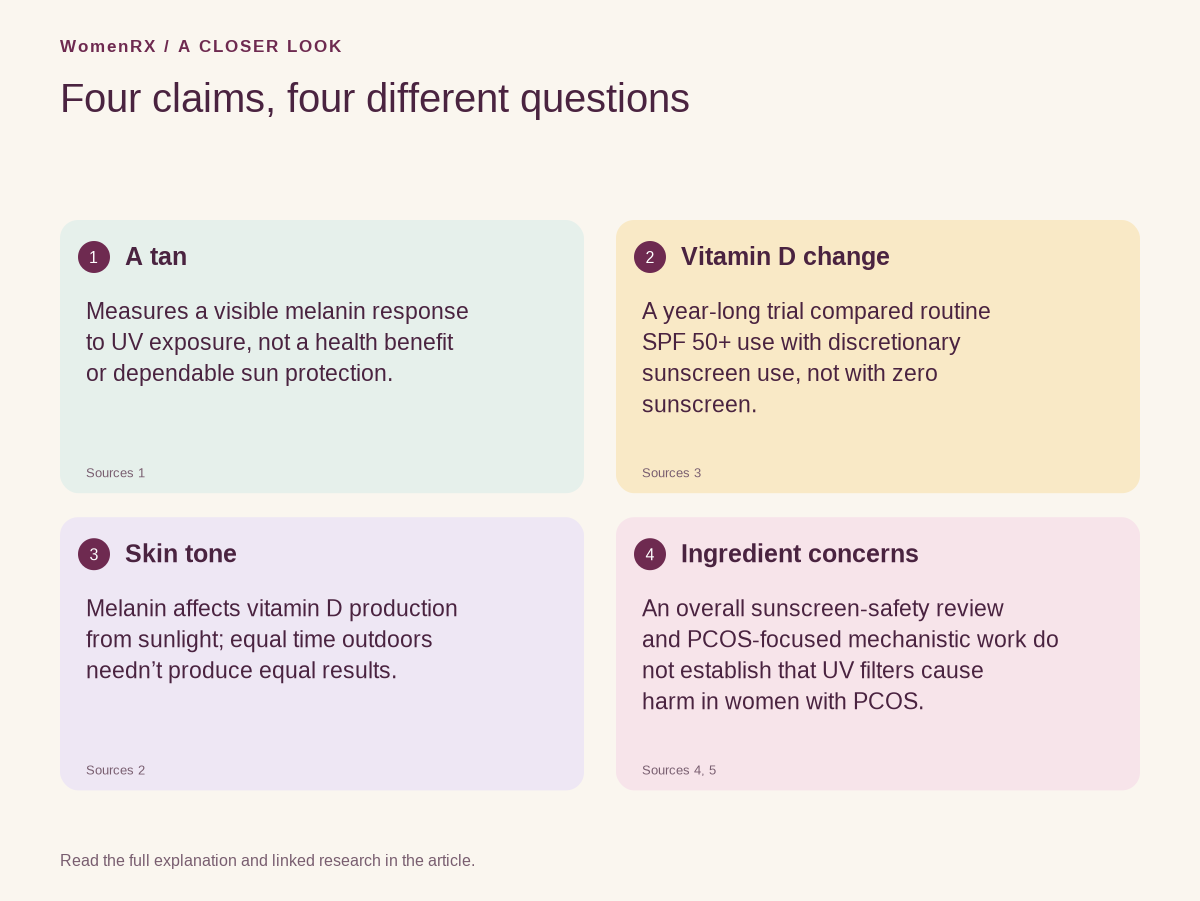
Four claims, four different questions
A tan: Measures a visible melanin response to UV exposure, not a health benefit or dependable sun protection.1
Vitamin D change: A year-long trial compared routine SPF 50+ use with discretionary sunscreen use, not with zero sunscreen.3
Skin tone: Melanin affects vitamin D production from sunlight; equal time outdoors needn’t produce equal results.2
Ingredient concerns: An overall sunscreen-safety review and PCOS-focused mechanistic work do not establish that UV filters cause harm in women with PCOS.45
Read the figure as text
A quick map of what each sunscreen-related claim describes and what it cannot settle.- A tan: Measures a visible melanin response to UV exposure, not a health benefit or dependable sun protection.1
- Vitamin D change: A year-long trial compared routine SPF 50+ use with discretionary sunscreen use, not with zero sunscreen.3
- Skin tone: Melanin affects vitamin D production from sunlight; equal time outdoors needn’t produce equal results.2
- Ingredient concerns: An overall sunscreen-safety review and PCOS-focused mechanistic work do not establish that UV filters cause harm in women with PCOS.45
Sources you can check
- Tanning: MedlinePlusAccessed 2026-09-25Return to first citation
- Vitamin D - Health Professional Fact SheetAccessed 2026-09-25Return to first citation
- Effect of daily sunscreen application on vitamin D: findings from the open-label randomized controlled Sun-D Trial.Tran V, Duarte Romero BL, Andersen H, Clarke M, Collins LG, Dawson T, Hartel G, Lefevre JG, Lucas RM, McLeod DSA, Milne RL, Sinclair C, Whiteman DC, Waterhouse M, Neale RE. · The British journal of dermatology · 2025Return to first citation
- Polycystic Ovary Syndrome (PCOS)-Specific Risk Appraisal of the Sunscreen Ultraviolet (UV) Filters (Oxybenzone/Octinoxate).Dutta S, Sengupta P, Chhikara BS, Formicki G, Rosas IM, Roychoudhury S. · Toxics · 2025Return to first citation
- Effectiveness, compliance and application of sunscreen for solar ultraviolet radiation protection in Australia.Henderson SI, King KL, Karipidis KK, Tinker RA, Green AC. · Public health research & practice · 2022Return to first citation