Magnesium Citrate vs. Oxide: Choose by Purpose, Not Hype
Citrate appears to be absorbed more readily than oxide, but that doesn’t prove it works better for every reason you might take magnesium.
If you’re comparing the two as supplements, citrate has the edge on absorption: NIH guidance and small human studies find it more bioavailable than oxide. But absorption measures don’t establish better symptom relief or other health outcomes. Check the Supplement Facts panel for elemental magnesium, and choose based on the product’s intended use and how your body responds, not the form name alone. 12
Magnesium citrate and magnesium oxide aren’t interchangeable just because both contain magnesium. Citrate generally dissolves better and appears to be absorbed more readily. That can matter if your goal is to increase magnesium intake. It doesn’t make citrate automatically better for bowel relief, a particular symptom, or long-term health.
What the absorption evidence can tell you
The NIH Office of Dietary Supplements says magnesium citrate tends to have higher bioavailability than magnesium oxide. A small randomized study compared the forms in 14 healthy men. After five days of magnesium supplementation to saturate magnesium pools, the study assessed a single dose of each form. Citrate increased urinary magnesium excretion, while the increase after oxide wasn’t significant; some blood-magnesium measurements also rose more with citrate. 12
These findings support a difference in absorption measures, not proof that citrate produces better clinical results. The study was small, involved men only, and looked at short-term measurements. A review of randomized studies in healthy adults also found that citrate was generally bioavailable and oxide less so, but those studies assessed absorption-related measures rather than showing one form improves health outcomes more than the other. 24
So if you’re choosing a supplement mainly to add magnesium, citrate may be a reasonable tie-breaker. It isn’t a guarantee that you’ll feel a difference, and the evidence doesn’t establish a special advantage for women. Another human comparison included healthy women and men, but the reported findings don’t provide a women-only result that could guide a sex-specific choice. 3
Bowel effects depend on more than the form
Magnesium that isn’t absorbed can draw water into the intestine. Larger amounts from supplements or medicines may cause diarrhea, nausea, or abdominal cramping. The NIH lists oxide among the magnesium forms commonly reported to cause diarrhea. That’s a possible side effect, not evidence that oxide is the better choice for constipation. 1
The absorption studies don’t establish that citrate is better than oxide for bowel relief. Check what the particular product is labeled and intended to do. A magnesium supplement and a magnesium-containing laxative aren’t automatically the same kind of product, even if the ingredient name overlaps. Don’t assume a supplement will reliably treat constipation based on its form alone.
Read the magnesium amount, not just the compound name
On a supplement’s Supplement Facts panel, the magnesium amount refers to elemental magnesium, not the total weight of the citrate or oxide compound. That’s the useful number for comparing how much magnesium the products provide. The compound name tells you the form; it doesn’t tell you the elemental amount by itself. 1
Also count magnesium from medicines as well as supplements. For adults, the NIH lists an upper limit of 350 mg per day from supplements and medications; magnesium naturally present in food isn’t included in that limit. It’s an upper limit intended to reduce side effects, not a recommended target. 1
A practical way to choose
If your purpose is supplemental intake, citrate has the stronger absorption case, but neither form has been shown here to deliver better health outcomes overall. If you’re considering magnesium for bowel relief, use the product’s actual directions and intended purpose rather than guessing from “citrate” or “oxide” on the front label. If either form gives you diarrhea or cramping, that’s a reason to reconsider the product or amount rather than push through.
Women don’t have a separate evidence-based reason to choose citrate or oxide based on these comparisons. The head-to-head study of citrate and oxide described above enrolled men. Other research included women and men, but doesn’t report a women-specific comparison. The systematic review of magnesium salts excluded studies of pregnant and breastfeeding women, so it can’t answer which form is preferable during those life stages. 234
If you have impaired kidney function, be especially careful with magnesium-containing supplements or medicines: the risk of magnesium toxicity rises when the kidneys can’t remove excess magnesium effectively. 1
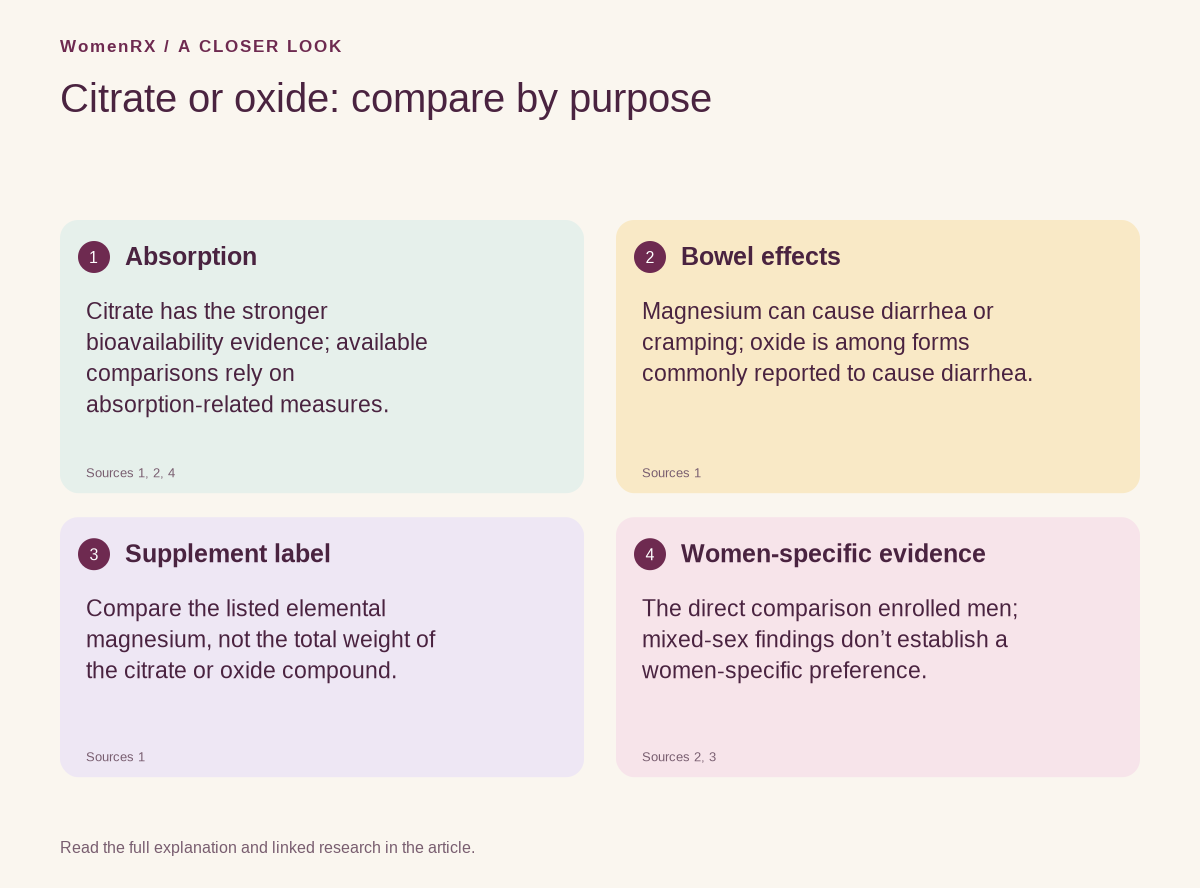
Citrate or oxide: compare by purpose
Absorption: Citrate has the stronger bioavailability evidence; available comparisons rely on absorption-related measures.124
Bowel effects: Magnesium can cause diarrhea or cramping; oxide is among forms commonly reported to cause diarrhea.1
Supplement label: Compare the listed elemental magnesium, not the total weight of the citrate or oxide compound.1
Women-specific evidence: The direct comparison enrolled men; mixed-sex findings don’t establish a women-specific preference.23
Read the figure as text
The forms differ in absorption evidence and product labeling, but absorption alone doesn’t establish which one will deliver a better outcome.- Absorption: Citrate has the stronger bioavailability evidence; available comparisons rely on absorption-related measures.124
- Bowel effects: Magnesium can cause diarrhea or cramping; oxide is among forms commonly reported to cause diarrhea.1
- Supplement label: Compare the listed elemental magnesium, not the total weight of the citrate or oxide compound.1
- Women-specific evidence: The direct comparison enrolled men; mixed-sex findings don’t establish a women-specific preference.23
More questions, answered
Does citrate’s better absorption mean it will work better?
Not necessarily. The evidence favoring citrate over oxide concerns absorption-related measures, such as urinary excretion and blood levels. It doesn’t show that citrate leads to better symptom relief or other health outcomes. 12
Is there evidence that women should choose one form?
No sex-specific preference is established here. One direct study enrolled 14 healthy men; other research included women and men but did not report a women-only comparison. 23
Sources you can check
- Magnesium - Health Professional Fact SheetAccessed 2026-09-25Return to first citation
- Assessment of bioavailability of Mg from Mg citrate and Mg oxide by measuring urinary excretion in Mg-saturated subjects.Werner T, Kolisek M, Vormann J, Pilchova I, Grendar M, Struharnanska E, Cibulka M. · Magnesium research · 2019Return to first citation
- Comparative Clinical Study on Magnesium Absorption and Side Effects After Oral Intake of Microencapsulated Magnesium (MAGSHAPETM Microcapsules) Versus Other Magnesium Sources.Pajuelo D, Meissner JM, Negra T, Connolly A, Mullor JL. · Nutrients · 2024Return to first citation
- Bioavailability of Magnesium and Potassium Salts Used as Potential Substitutes for Sodium Chloride in Human Nutrition - A Review.Merschmann R, Burgmer C, Eckert GP, Wagner AE. · Molecular nutrition & food research · 2025Return to first citation