Magnesium for Sleep or Anxiety: What the Evidence Supports
Magnesium supplements haven’t been shown to be a reliable treatment for insomnia or anxiety, and research doesn’t establish one best form for either concern.
A recent review of adult randomized trials found inconsistent sleep results and low- to very-low-certainty evidence, so magnesium isn’t supported as a routine insomnia treatment. Anxiety evidence is also too limited to establish magnesium as a treatment. Citrate is generally absorbed better than oxide, but that doesn’t show it works better for sleep or anxiety, and no form has been proven best. 1 4 6
The short answer: no proven best form
Magnesium is an essential nutrient, but that doesn’t mean taking more will reliably help you sleep or feel less anxious. The most relevant recent review included 12 randomized trials of magnesium alone for adult sleep problems. Results varied across studies and how sleep was measured; reviewers rated the evidence low to very low and concluded that it doesn’t support magnesium as a routine insomnia treatment. Some adults may notice improvement in particular subjective sleep measures, but the findings aren’t consistent. 4
For anxiety, the evidence is thinner. A systematic review of supplements for anxiety described magnesium-containing products as promising but said more research was needed before they could be recommended. It doesn’t establish magnesium on its own as an effective treatment for an anxiety disorder. 6
What the forms can, and can’t, tell you
Magnesium citrate and magnesium oxide can be compared for absorption, not for sleep or anxiety benefit. The NIH Office of Dietary Supplements says citrate is among the forms that tend to be more bioavailable than oxide. That’s a difference in how much the body absorbs, not proof that citrate improves sleep or anxiety more. 1
The sleep-trial review found substantial variation in formulations and doses, and its summary doesn’t establish a winning form. It also doesn’t support choosing magnesium glycinate as a sleep treatment over citrate, oxide, or another form. A product name or an absorption advantage shouldn’t be mistaken for evidence of a better result. 1 4
If you’re comparing labels, look at the amount of elemental magnesium, not just the weight of the magnesium compound. The Supplement Facts panel lists elemental magnesium. Also check whether other products you take, including some antacids or laxatives, contain magnesium, so you can account for the total. 1
When sleep problems may need a different answer
Sleep trouble can have causes that magnesium won’t address. Stress, medicines, other health conditions, and other sleep disorders can contribute to ongoing insomnia. Menopause can also be associated with sleep problems; that alone doesn’t establish magnesium deficiency as the cause. 2 3
A small pilot trial offers a limited point of comparison for postmenopausal women: among women with osteoporosis receiving zoledronate, adding magnesium did not significantly change the measured sleep or anxiety outcomes. Because the study involved a specific group and magnesium was added alongside another treatment, it can’t settle whether magnesium helps other women or people with different sleep concerns. 5
If difficulty sleeping has lasted for months, or you’re regularly struggling to fall asleep or stay asleep, it’s worth looking for the cause rather than relying on a supplement alone. Insomnia may be related to another condition, a medicine, or a separate sleep disorder, and addressing that can matter more than choosing a magnesium form. 2
Safety is about the total and your kidneys
For adults, the tolerable upper intake level is 350 mg per day of magnesium from supplements and medicines. It does not include magnesium naturally present in food. This limit is not a recommended dose for sleep or anxiety; higher amounts can cause diarrhea, nausea, and abdominal cramping. 1
Kidneys remove excess magnesium. The risk of magnesium building up is higher when kidney function is impaired, so kidney disease is a reason to get individualized advice before using a magnesium supplement. 1
The practical takeaway: magnesium may be worth discussing when you have a specific reason to suspect low intake, but current evidence doesn’t identify a best sleep or anxiety form. If the main problem is persistent insomnia or anxiety, focus on identifying and addressing that problem rather than treating a supplement label as the answer.
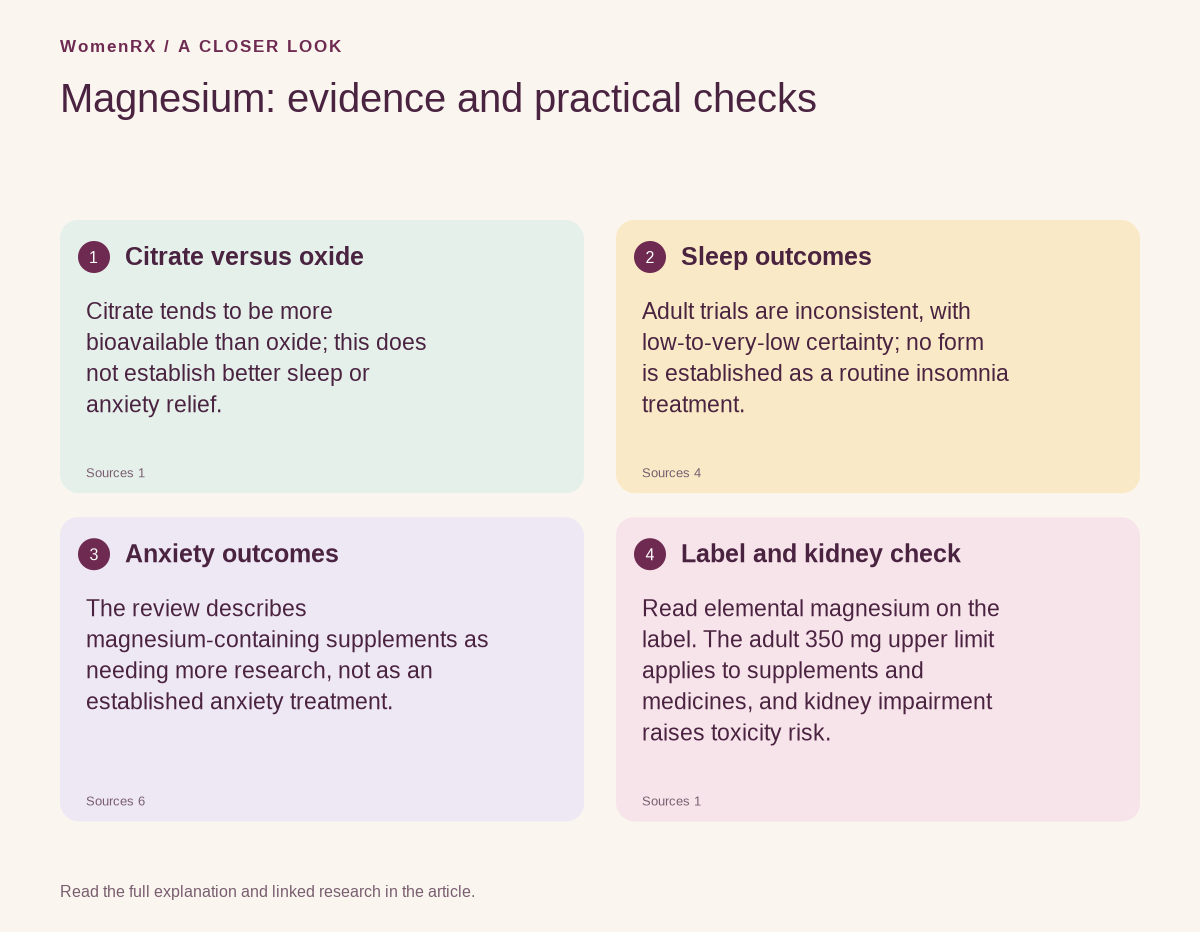
Magnesium: evidence and practical checks
Citrate versus oxide: Citrate tends to be more bioavailable than oxide; this does not establish better sleep or anxiety relief.1
Sleep outcomes: Adult trials are inconsistent, with low-to-very-low certainty; no form is established as a routine insomnia treatment.4
Anxiety outcomes: The review describes magnesium-containing supplements as needing more research, not as an established anxiety treatment.6
Label and kidney check: Read elemental magnesium on the label. The adult 350 mg upper limit applies to supplements and medicines, and kidney impairment raises toxicity risk.1
Read the figure as text
Separate absorption differences from proven symptom benefits, then check the label and kidney-related safety before considering a supplement.- Citrate versus oxide: Citrate tends to be more bioavailable than oxide; this does not establish better sleep or anxiety relief.1
- Sleep outcomes: Adult trials are inconsistent, with low-to-very-low certainty; no form is established as a routine insomnia treatment.4
- Anxiety outcomes: The review describes magnesium-containing supplements as needing more research, not as an established anxiety treatment.6
- Label and kidney check: Read elemental magnesium on the label. The adult 350 mg upper limit applies to supplements and medicines, and kidney impairment raises toxicity risk.1
More questions, answered
Is magnesium glycinate proven to help you sleep?
No. The available sleep-trial review doesn’t establish glycinate as more effective than other forms, or as a proven insomnia treatment. 4
Does better absorption mean better sleep results?
No. Magnesium citrate tends to be absorbed better than oxide, but that comparison doesn’t demonstrate a sleep or anxiety advantage. 1
Sources you can check
- Magnesium - Health Professional Fact SheetAccessed 2026-09-25Return to first citation
- Insomnia | MedlinePlusAccessed 2026-09-25Return to first citation
- Insomnia - NHSAccessed 2026-09-25Return to first citation
- Magnesium Supplementation for Sleep in Adults: A Systematic Review of Randomized Controlled Trials.Lopresti AL, Smith SJ, Drummond PD. · Journal of dietary supplements · 2026Return to first citation
- Quantitative sensory testing of pain in osteoporosis: a pilot randomized clinical trial with magnesium supplementation.Pickering ME, Morel V, Nicolas M, Dualé C, Sortais E, Graven-Nielsen T, Pereira B, Pickering G. · Aging clinical and experimental research · 2026Return to first citation
- Nutritional and herbal supplements for anxiety and anxiety-related disorders: systematic review.Lakhan SE, Vieira KF. · Nutrition journal · 2010Return to first citation