Choosing Magnesium for Migraine, Sleep, or Another Concern
Magnesium has a place in some migraine discussions, but a more absorbable form isn’t automatically a better treatment.
Start with why you want magnesium. Migraine guidance includes it among options with some evidence of benefit, but doesn’t identify a best supplement form; a sleep benefit is less clear. On any label, compare the elemental magnesium amount in Supplement Facts, not the compound weight. Citrate is generally better absorbed than oxide, but absorption alone doesn’t predict symptom relief. 15
Let the reason guide the choice
If migraine is your concern, magnesium is a reasonable option to discuss as part of a prevention plan, not a substitute for working out what kind of headaches you’re having. A 2026 European Headache Federation review and consensus statement notes efficacy for magnesium in migraine management, while acknowledging limited evidence for sex-specific treatment decisions. It doesn’t establish which over-the-counter form works best. MedlinePlus also suggests magnesium as an option when magnesium levels are low. 52
That distinction matters if your migraines tend to arrive with your period. Menstrual migraine attacks can be longer and more severe than attacks at other times, but that doesn’t show that a particular magnesium product treats them. The European review discusses menstrual migraine treatments separately; its mention of magnesium shouldn’t be read as a form-specific recommendation for period-related attacks. 35
If sleep is your reason, be more skeptical of a bottle marketed for bedtime. Research on magnesium and sleep is discussed in a narrative review, but the material reported there doesn’t establish which people benefit, whether a supplement improves sleep reliably, or whether one form outperforms another. A claim that magnesium glycinate is the sleep form goes further than those findings support. 6
What the label can tell you
Look at the Supplement Facts panel for the amount of elemental magnesium. That number represents magnesium itself, not the weight of the entire compound named on the front of the bottle. Compare that number across products rather than assuming, for example, that two products labeled “magnesium citrate” provide the same amount. 1
Form still has a practical role. In small absorption studies, magnesium citrate and several other more soluble forms were absorbed more completely than magnesium oxide. That helps explain a difference between forms, but it isn’t a trial showing that citrate prevents more migraines or improves sleep more than oxide. The available form comparison doesn’t establish a clinical advantage for glycinate, either. 1
Your gut may have a say in the decision. Unabsorbed magnesium salts can draw water into the intestine and stimulate movement, causing a laxative effect or diarrhea. If that happens, it’s a reason to reassess the product rather than assume discomfort means it’s working. 1
When your health history changes the question
Kidney function deserves attention because the kidneys regulate magnesium balance. Research involving people on hemodialysis addresses magnesium under closely managed circumstances; it isn’t a guide to choosing an over-the-counter supplement when you have kidney disease. If you have kidney disease or receive dialysis, get advice specific to your care before adding magnesium. 14
Bring your medicine and supplement list into that conversation. For one concrete example, a review of studies in people receiving hemodialysis identifies proton pump inhibitors as medicines that can impair intestinal magnesium absorption in that setting. Separately, an NIH fact sheet reports that very high supplemental zinc intake interfered with magnesium absorption in one study. Neither finding tells you to change a medicine or take more magnesium on your own. A pharmacist can check your exact combination of products and prescriptions. 41
Pregnancy and breastfeeding also call for a decision tailored to you. The European migraine consensus considers magnesium generally safe in those contexts, but says reproductive safety data are scarce. That broad assessment doesn’t verify every supplement formulation or amount. If you’re pregnant or have recently given birth and develop a migraine attack, seek prompt medical assessment rather than relying on a supplement to manage it. 53
A useful comparison, then, has three parts: your goal, the elemental amount, and what the form evidence actually shows. For migraine, magnesium may belong in a wider plan. For sleep, a bedtime label isn’t proof of benefit. And for either goal, better absorption isn’t the same as a better outcome. 156
What common magnesium forms tell you
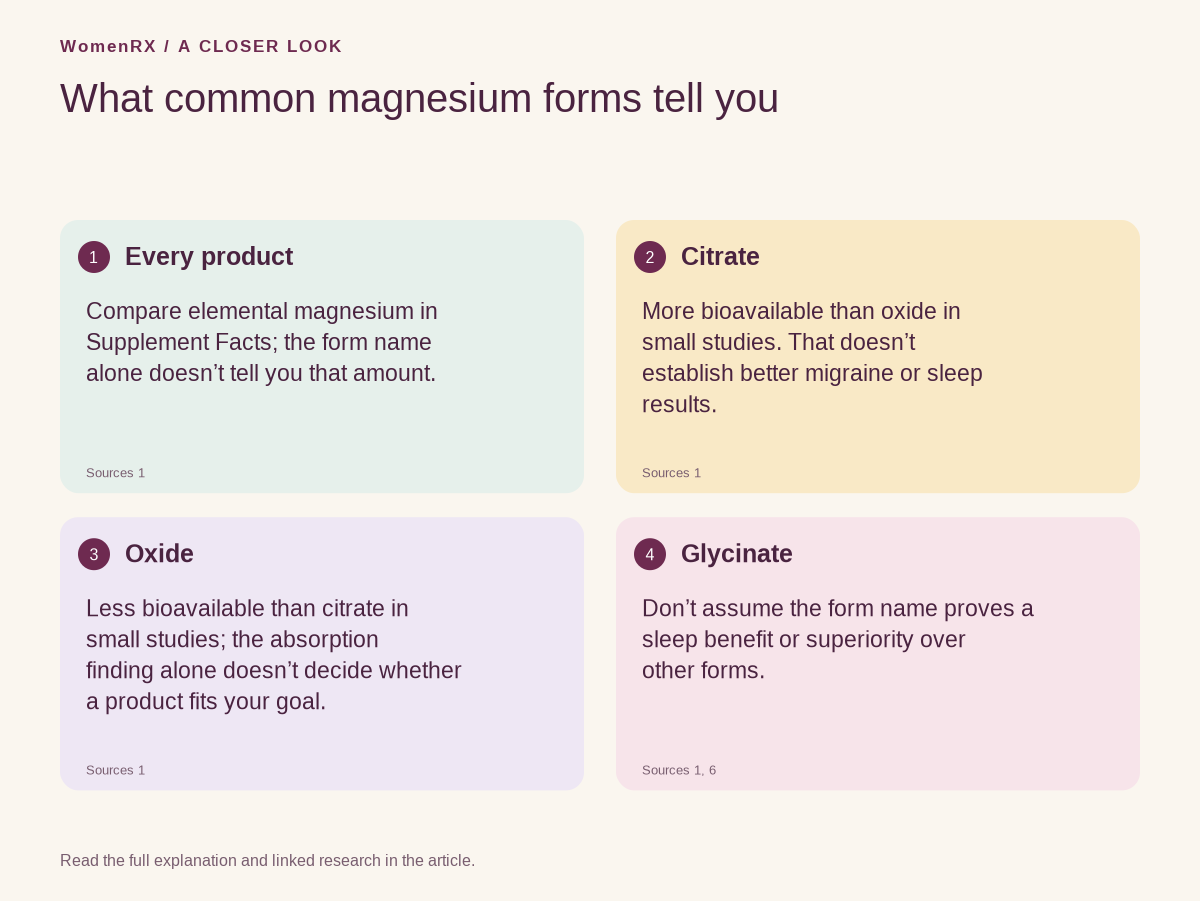
Every product: Compare elemental magnesium in Supplement Facts; the form name alone doesn’t tell you that amount.1
Citrate: More bioavailable than oxide in small studies. That doesn’t establish better migraine or sleep results.1
Oxide: Less bioavailable than citrate in small studies; the absorption finding alone doesn’t decide whether a product fits your goal.1
Glycinate: Don’t assume the form name proves a sleep benefit or superiority over other forms.16
Read the figure as text
The form name helps you interpret absorption findings, while the product’s own Supplement Facts panel gives its elemental magnesium amount.- Every product: Compare elemental magnesium in Supplement Facts; the form name alone doesn’t tell you that amount.1
- Citrate: More bioavailable than oxide in small studies. That doesn’t establish better migraine or sleep results.1
- Oxide: Less bioavailable than citrate in small studies; the absorption finding alone doesn’t decide whether a product fits your goal.1
- Glycinate: Don’t assume the form name proves a sleep benefit or superiority over other forms.16
More questions, answered
Does a normal blood magnesium result settle whether I need a supplement?
Not entirely. Less than 1% of the body’s magnesium is in blood serum, and the body keeps that level tightly controlled. A normal result doesn’t, by itself, answer whether magnesium will help a particular symptom; don’t use symptoms alone to diagnose a deficiency, either. 16
Sources you can check
- Magnesium - Health Professional Fact SheetAccessed 2026-09-25Return to first citation
- Migraine | MedlinePlusAccessed 2026-09-25Return to first citation
- Migraine - NHSAccessed 2026-09-25Return to first citation
- Effects of Increasing the Concentration of Dialysate Magnesium on Cardiovascular Health: A Narrative Review.Tannar B, Al-Hellawi H, Sontrop JM, Acedillo RR, Al-Jaishi AA, Anderson S, Bagga A, Berry D, Beaubien E, Blake PG, Bohm C, Brown PA, Bueti J, Chan CT, Cote B, Cowan AC, Day NE, Dev... · Canadian journal of kidney health and disease · 2026Return to first citation
- Sex-specific management of migraine a systematic review and consensus statement from the European Headache Federation (EHF).Braca S, Casillo F, Moreira S, Ekizoglu E, Bjork MH, Szewczyk AK, Van Dycke A, Uluduz D, Coppola G, Deligianni C, Lampl C, Tronvik E, Amin FM, Versijpt J, Ryliškienė K, Rio MSD, Ho... · The journal of headache and pain · 2026Return to first citation
- Why Serum Magnesium Fails: A Narrative Review of Magnesium Biochemistry, Compartmental Exchange, and Endpoint Selection for Supplementation Trials.Chandarana J, Butani K. · Journal of the American Nutrition Association · 2026Return to first citation