Does Magnesium Glycinate Improve Sleep?
Magnesium may be relevant to sleep, but evidence for magnesium in general doesn’t prove that glycinate is a sleep aid.
Magnesium glycinate hasn’t been established as a proven sleep treatment, and there’s no basis here to call it better than other forms. Research on magnesium overall is mixed and includes studies of other formulations or combinations. If you’re considering a supplement, check the label for elemental magnesium, consider your food intake, and factor in kidney health and medication interactions. 1 2 4
Magnesium glycinate is often considered for sleep, but a familiar supplement isn’t the same as a proven treatment. Research on magnesium overall can’t show that glycinate itself improves sleep, or that it works better than another form. The available human findings are mixed and come from different groups and formulations. 2 4
What the sleep research can tell you
One randomized trial studied 290 adults with diabetes and insomnia who completed two months of treatment. Participants received magnesium, potassium, both, or placebo; the study reported improvements in insomnia scores in the supplement groups. But the reported results don’t establish that glycinate improves sleep: the trial involved a specific population, included potassium-only and combination groups, and the available results don’t specify the magnesium formulation or give the size of the sleep changes. 2
A separate randomized trial tested magnesium L-threonate, not glycinate, in 100 adults aged 18 to 45 with dissatisfied sleep. After six weeks, some self-reported sleep-related measures improved, but there were no group differences in sleep outcomes recorded by a wearable device. That’s a useful reminder that a change in how sleep feels doesn’t necessarily show up in measured sleep, and a result for one magnesium form doesn’t prove a result for another. 4
Dietary research also needs a different interpretation: in a cross-sectional study of Saudi university students, lower magnesium intake was associated with some poorer sleep measures. An association can’t show that low intake caused the sleep problems or that taking a supplement will fix them. 3
Taken together, these findings don’t establish glycinate as a sleep treatment or as a superior form. They also don’t rule out a benefit for someone whose magnesium intake is inadequate. 1 2 4
Intake needs and supplement labels are different
Recommended intake is a target for magnesium from all sources, not a sleep-supplement dose. For adult women, the recommended dietary allowance is 310 mg a day at ages 19-30 and 320 mg at ages 31 and older. During pregnancy, it is 350 mg at ages 19-30 and 360 mg at ages 31-50. These numbers describe nutritional needs; they don’t show that supplementation improves sleep. 1
Magnesium-rich foods include leafy greens, beans, nuts, seeds, and whole grains. For example, cooked spinach, black beans, and almonds each contribute magnesium. Food is a practical way to support usual intake without assuming a supplement is necessary. 1
If you read a supplement label, look for the amount of elemental magnesium in the Supplement Facts panel. That’s the magnesium amount, not the weight of the entire glycinate compound. The adult upper limit of 350 mg per day applies to magnesium from supplements and medicines, not magnesium naturally present in food. It’s a safety limit, not a suggested dose or a sleep target. Magnesium in antacids and laxatives can count too. 1
Safety checks that matter
Magnesium from supplements or medicines can cause diarrhea, nausea, and stomach cramps. The risk of excess magnesium is greater when kidney function is impaired, because the kidneys help remove extra magnesium. If you have kidney disease, don’t treat a supplement as a low-risk sleep experiment. 1
Magnesium can reduce absorption of some oral antibiotics, including doxycycline and ciprofloxacin, and oral bisphosphonates such as alendronate. Ask a pharmacist about spacing if you use one of these medicines. Some diuretics can increase magnesium loss, while others reduce it; long-term use of proton pump inhibitors can also affect magnesium levels. 1
Older adults are more likely to have low dietary intakes and may have health conditions or take medicines that affect magnesium status. That makes it sensible to consider the whole picture rather than assume that sleep trouble means a magnesium deficiency. 1
The practical takeaway: glycinate may be a form someone chooses, but it isn’t established as a sleep fix. Check elemental magnesium, count other supplement or medicine sources, and weigh kidney health and medication interactions before adding it.
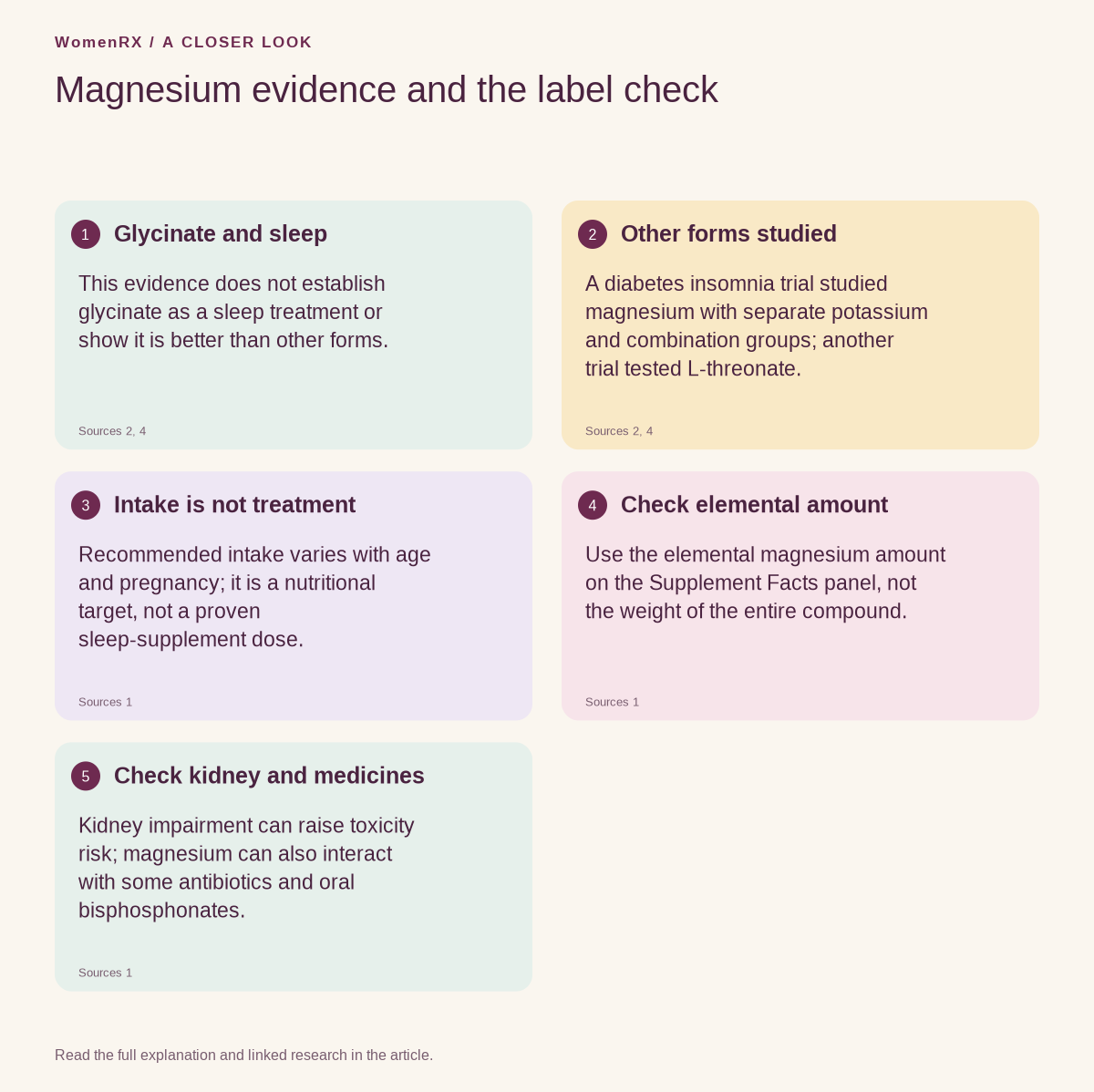
Magnesium evidence and the label check
Glycinate and sleep: This evidence does not establish glycinate as a sleep treatment or show it is better than other forms.24
Other forms studied: A diabetes insomnia trial studied magnesium with separate potassium and combination groups; another trial tested L-threonate.24
Intake is not treatment: Recommended intake varies with age and pregnancy; it is a nutritional target, not a proven sleep-supplement dose.1
Check elemental amount: Use the elemental magnesium amount on the Supplement Facts panel, not the weight of the entire compound.1
Check kidney and medicines: Kidney impairment can raise toxicity risk; magnesium can also interact with some antibiotics and oral bisphosphonates.1
Read the figure as text
Separate findings about particular study formulations from what a glycinate label and your own safety context can tell you.- Glycinate and sleep: This evidence does not establish glycinate as a sleep treatment or show it is better than other forms.24
- Other forms studied: A diabetes insomnia trial studied magnesium with separate potassium and combination groups; another trial tested L-threonate.24
- Intake is not treatment: Recommended intake varies with age and pregnancy; it is a nutritional target, not a proven sleep-supplement dose.1
- Check elemental amount: Use the elemental magnesium amount on the Supplement Facts panel, not the weight of the entire compound.1
- Check kidney and medicines: Kidney impairment can raise toxicity risk; magnesium can also interact with some antibiotics and oral bisphosphonates.1
More questions, answered
Does glycinate work better than other forms for sleep?
The available findings don’t establish that magnesium glycinate works better for sleep than other forms. Studies using another magnesium form or a magnesium combination can’t settle that comparison. 2 4
Does a higher recommended intake during pregnancy mean magnesium helps sleep?
No. Pregnancy changes the recommended dietary intake, but that number is a nutritional target, not evidence that magnesium supplements improve sleep. 1
Sources you can check
- Magnesium - Health Professional Fact SheetAccessed 2026-09-25Return to first citation
- Effects of magnesium and potassium supplementation on insomnia and sleep hormones in patients with diabetes mellitus.Khalid S, Bashir S, Mehboob R, Anwar T, Ali M, Hashim M, Waseem H, Basharat S. · Frontiers in endocrinology · 2024Return to first citation
- Association Between Dietary Magnesium Intake and Sleep Quality in Saudi University Students: A Cross-Sectional Study.Alshammari AA, Alsawad KA, Ahmed NK, Alsaadi R, Alholieli RS, Alsaif S, Al Mulhim NS, Rafique N, Al Ghamdi K, ALQarni AS, Al-Hariri M. · Nature and science of sleep · 2025Return to first citation
- The effects of magnesium L-threonate (Magtein®) on cognitive performance and sleep quality in adults: a randomised, double-blind, placebo-controlled trial.Lopresti AL, Smith SJ. · Frontiers in nutrition · 2025Return to first citation