Magnesium Supplements: How to Choose What Fits Your Needs
Start with your diet, the reason you’re considering magnesium, and the amount of elemental magnesium on the label.
Most women don’t need a magnesium supplement just because they’re women. First compare your usual food intake with the recommended amount for your age and life stage, then consider whether a health condition, medicine, or confirmed low level changes the picture. If you choose a product, compare its elemental magnesium and form, and check the dose and medication interactions before taking it. 1
Start with why you’re considering magnesium
A supplement may make sense when your diet regularly falls short or when a health condition or medication raises the chance of low magnesium. But symptoms such as fatigue, weakness, nausea, or cramps can have many causes, so they don’t confirm a deficiency on their own. Magnesium deficiency from low intake alone is uncommon in otherwise healthy people. 1
People with ongoing diarrhea or certain gut conditions, type 2 diabetes, or alcohol dependence may have higher risk of magnesium inadequacy. Older adults are also more likely to have low intake or other factors that affect magnesium. Long-term use of some medicines can affect magnesium status, too. 1
If you’re considering a supplement because of a symptom, a test result, or a medicine you take, the useful next step is to ask what would make magnesium the likely explanation and whether assessment is appropriate. A blood magnesium test is commonly used, but it doesn’t reflect the body’s total magnesium stores particularly well; clinicians may need to consider the result alongside your health and other findings. 1
Check your intake by age and life stage
The recommended dietary allowance (RDA) includes magnesium from food, drinks, and supplements. For women, it’s 360 mg daily from ages 14 to 18, 310 mg daily from ages 19 to 30, and 320 mg daily from ages 31 onward. During pregnancy, the RDA is 400 mg daily at ages 14 to 18, 350 mg at ages 19 to 30, and 360 mg at ages 31 to 50. During breastfeeding, it’s 360 mg at ages 14 to 18, 310 mg at ages 19 to 30, and 320 mg at ages 31 to 50. 1
These are targets for total daily intake, not amounts to add on top of your diet. Magnesium-rich foods include pumpkin seeds, chia seeds, almonds, spinach, beans, and whole grains. For example, a meal or snack with beans, whole grains, and leafy greens can contribute magnesium without requiring a separate pill. 1
Pregnancy needs are higher than those for nonpregnant women of the same age, but that doesn’t mean every pregnant person needs a supplement. In one randomized trial of 318 low-income, low-risk pregnant women in Brazil, oral magnesium citrate did not reduce preeclampsia compared with placebo: 18.1% of the magnesium group and 19.7% of the placebo group developed it. That study answers a particular prevention question; it doesn’t determine whether an individual with low intake or a diagnosed deficiency should receive magnesium. 3
Compare the label, not just the form name
A product’s Supplement Facts panel lists elemental magnesium, the amount that counts toward your intake. It does not list just the total weight of the magnesium compound. Use the elemental amount when comparing products or adding up magnesium from supplements and magnesium-containing medicines. 1
Forms differ in how well they dissolve and are absorbed. Small studies found that magnesium citrate, chloride, lactate, and aspartate tend to be more bioavailable than magnesium oxide or sulfate. That doesn’t prove one form is best for every concern, or that a more absorbable form will improve a particular symptom. 1
If a product promises a benefit for sleep or another specific concern, don’t assume the form name proves that claim. Magnesium is involved in bone biology, but the evidence on preventing fractures is unclear; small studies in postmenopausal women don’t establish that supplements prevent osteoporosis or fractures. 1 2
Keep the supplemental upper limit in view
For adults, the tolerable upper intake level is 350 mg a day from supplements and medicines. It does not include magnesium naturally present in food. This is a safety limit, not a recommended supplement dose; magnesium in some antacids and laxatives counts, too. High supplemental or medicinal amounts can cause diarrhea, nausea, and abdominal cramps. 1
Excess magnesium can be more dangerous when kidney function is impaired, because the kidneys may not remove it effectively. If you have kidney disease, don’t start a magnesium supplement or magnesium-containing laxative without first reviewing it with your care team. 1
Check medicines before you add a product
Magnesium can reduce absorption of oral bisphosphonates used for osteoporosis, as well as tetracycline and quinolone antibiotics. The exact spacing depends on the medicine; ask a pharmacist how to time the products rather than guessing. 1
Some medicines can change magnesium levels rather than simply interact with a supplement. Long-term use of proton pump inhibitors can contribute to low magnesium, and loop or thiazide diuretics can increase magnesium loss in urine. Potassium-sparing diuretics can reduce magnesium excretion. These are reasons to review your medication list and the reason for supplementation, not to stop a prescribed medicine on your own. 1
A practical decision
If your diet is varied and you have no known risk factors, start by looking at food sources rather than assuming you need a pill. If you have a low test result, a relevant health condition, or a medicine that can affect magnesium, discuss what the result means and whether a supplement is appropriate. If you compare products, check elemental magnesium, count magnesium from medicines, and confirm the form and timing are suitable for your other medications. 1
From possible need to safer choice
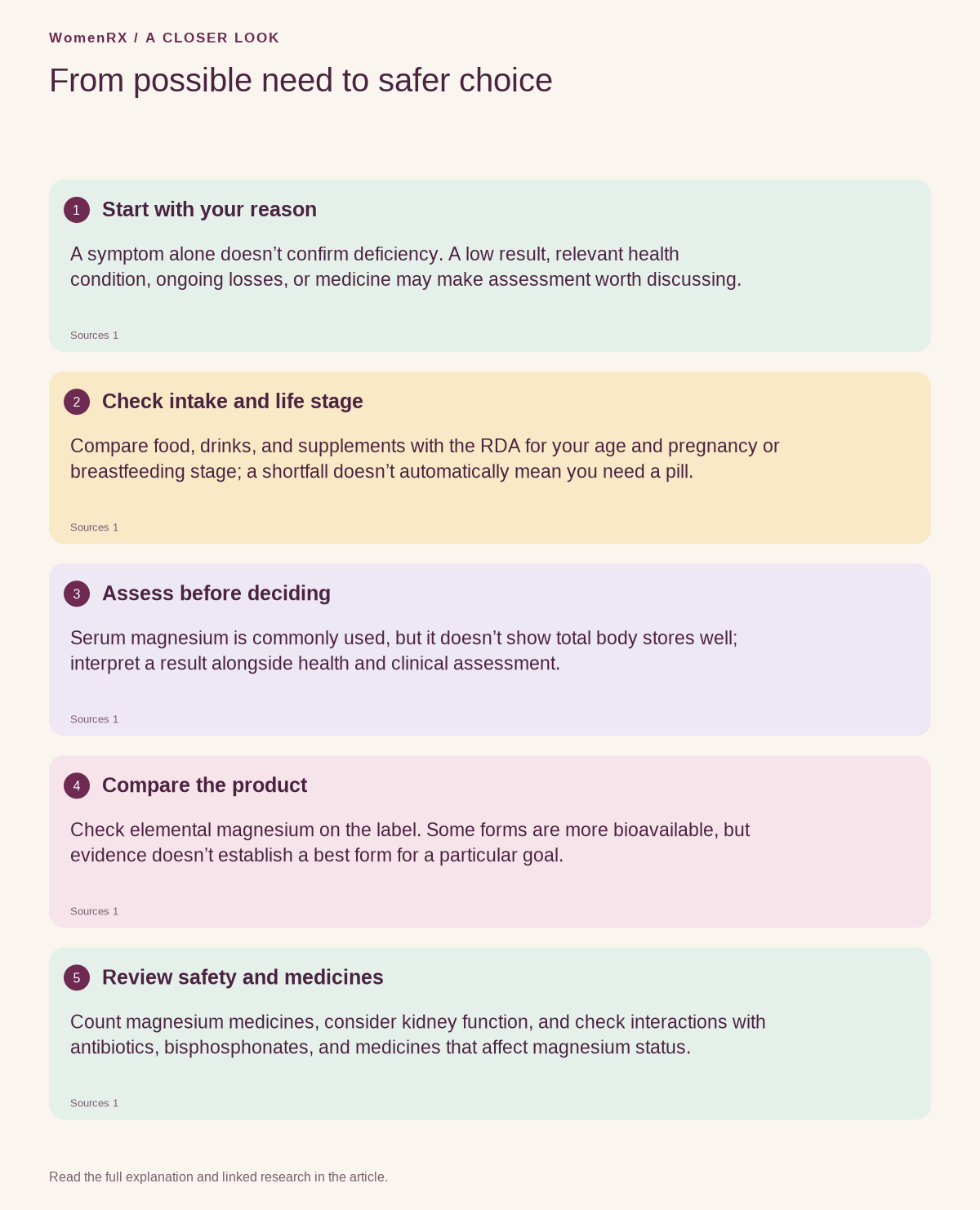
Start with your reason: A symptom alone doesn’t confirm deficiency. A low result, relevant health condition, ongoing losses, or medicine may make assessment worth discussing.1
Check intake and life stage: Compare food, drinks, and supplements with the RDA for your age and pregnancy or breastfeeding stage; a shortfall doesn’t automatically mean you need a pill.1
Assess before deciding: Serum magnesium is commonly used, but it doesn’t show total body stores well; interpret a result alongside health and clinical assessment.1
Compare the product: Check elemental magnesium on the label. Some forms are more bioavailable, but evidence doesn’t establish a best form for a particular goal.1
Review safety and medicines: Count magnesium medicines, consider kidney function, and check interactions with antibiotics, bisphosphonates, and medicines that affect magnesium status.1
Read the figure as text
Follow the decision from your reason for considering magnesium through intake, assessment, product comparison, and safety checks.- Start with your reason: A symptom alone doesn’t confirm deficiency. A low result, relevant health condition, ongoing losses, or medicine may make assessment worth discussing.1
- Check intake and life stage: Compare food, drinks, and supplements with the RDA for your age and pregnancy or breastfeeding stage; a shortfall doesn’t automatically mean you need a pill.1
- Assess before deciding: Serum magnesium is commonly used, but it doesn’t show total body stores well; interpret a result alongside health and clinical assessment.1
- Compare the product: Check elemental magnesium on the label. Some forms are more bioavailable, but evidence doesn’t establish a best form for a particular goal.1
- Review safety and medicines: Count magnesium medicines, consider kidney function, and check interactions with antibiotics, bisphosphonates, and medicines that affect magnesium status.1
More questions, answered
Is magnesium from food included in the 350 mg upper limit?
No. The adult upper limit applies to magnesium from supplements and medicines, not magnesium naturally found in food. Magnesium-containing antacids and laxatives count toward it. 1
Does a normal blood magnesium result rule out low magnesium stores?
Not necessarily. Serum magnesium is the most commonly used test, but it has limited ability to reflect total body magnesium. A result needs to be considered alongside your health and clinical assessment. 1
Sources you can check
- Magnesium - Health Professional Fact SheetAccessed 2026-09-25Return to first citation
- Magnesium and Fracture Risk in the General Population and Patients Receiving Dialysis: A Narrative Review.Cowan AC, Clemens KK, Sontrop JM, Dixon SN, Killin L, Anderson S, Acedillo RR, Bagga A, Bohm C, Brown PA, Cote B, Dev V, Harris C, Hiremath S, Kiaii M, Lacson E, Molnar AO, Oliver ... · Canadian journal of kidney health and disease · 2023Return to first citation
- Magnesium supplementation and preeclampsia in low-income pregnant women - a randomized double-blind clinical trial.de Araújo CAL, de Sousa Oliveira L, de Gusmão IMB, Guimarães A, Ribeiro M, Alves JGB. · BMC pregnancy and childbirth · 2020Return to first citation