When to Take a Prebiotic: Find a Comfortable Routine
If your prebiotic’s directions leave timing open, choose a time that fits your routine and lets you notice how your stomach feels.
Start with the directions on your prebiotic product. If they leave timing open, choose a time that’s easy to repeat and comfortable for you. One trial used a blend containing inulin, rice bran, and anthocyanin after meals and before bed, but it didn’t compare schedules. It can’t tell you whether morning, evening, or taking it with food is better. 3
What one trial’s schedule can, and can’t, tell you
If you’re deciding between breakfast and bedtime, choose the time that fits the product directions and your day. In a trial involving people with type 2 diabetes, participants in the supplement group took a combined supplement containing inulin fiber, rice bran, and anthocyanin after meals and before bed. Because the study didn’t compare different schedules, it can’t tell us whether that timing mattered. 3
That distinction is useful: a schedule used in one study isn’t proof that everyone should follow it. The trial doesn’t report a timing result specifically for women, and pregnancy- or breastfeeding-specific timing isn’t addressed. 3
Let the label and your stomach guide you
“Prebiotic” can refer to different fibers and products. Check the directions on your specific package rather than assuming all products should be taken with food, on an empty stomach, or at the same time of day. If the directions leave timing open, consistency and comfort are reasonable ways to choose.
Fiber can cause gas, bloating, or cramps when intake increases too quickly. MedlinePlus recommends increasing dietary fiber slowly; that’s general fiber guidance, not a tested schedule for every prebiotic supplement. 1 If your product’s directions allow a gradual start, that may be a useful comfort adjustment. Don’t exceed the label directions to try to get a faster effect.
A simple way to choose
- If you already take it comfortably: Keep that time.
- If you’re starting and want to notice how you feel: Choose a time when you’re awake and can pay attention to any digestive changes. That’s a practical tracking choice, not a proven way to prevent symptoms.
- If you notice gas or bloating: Check whether the product directions allow a gradual start, and consider whether other recent changes in your fiber intake could be contributing. Increasing fiber quickly can cause gas, bloating, and cramps. 1
- If the label specifies a timing or food instruction: Follow that product-specific direction rather than applying advice meant for a different formulation.
If symptoms are persistent or concerning, don’t assume the clock is the only explanation. Bloating can have causes beyond a supplement, including other foods and digestive conditions. 2 A timing change may be worth trying when it makes the routine more comfortable, but it isn’t a substitute for figuring out what else could be going on.
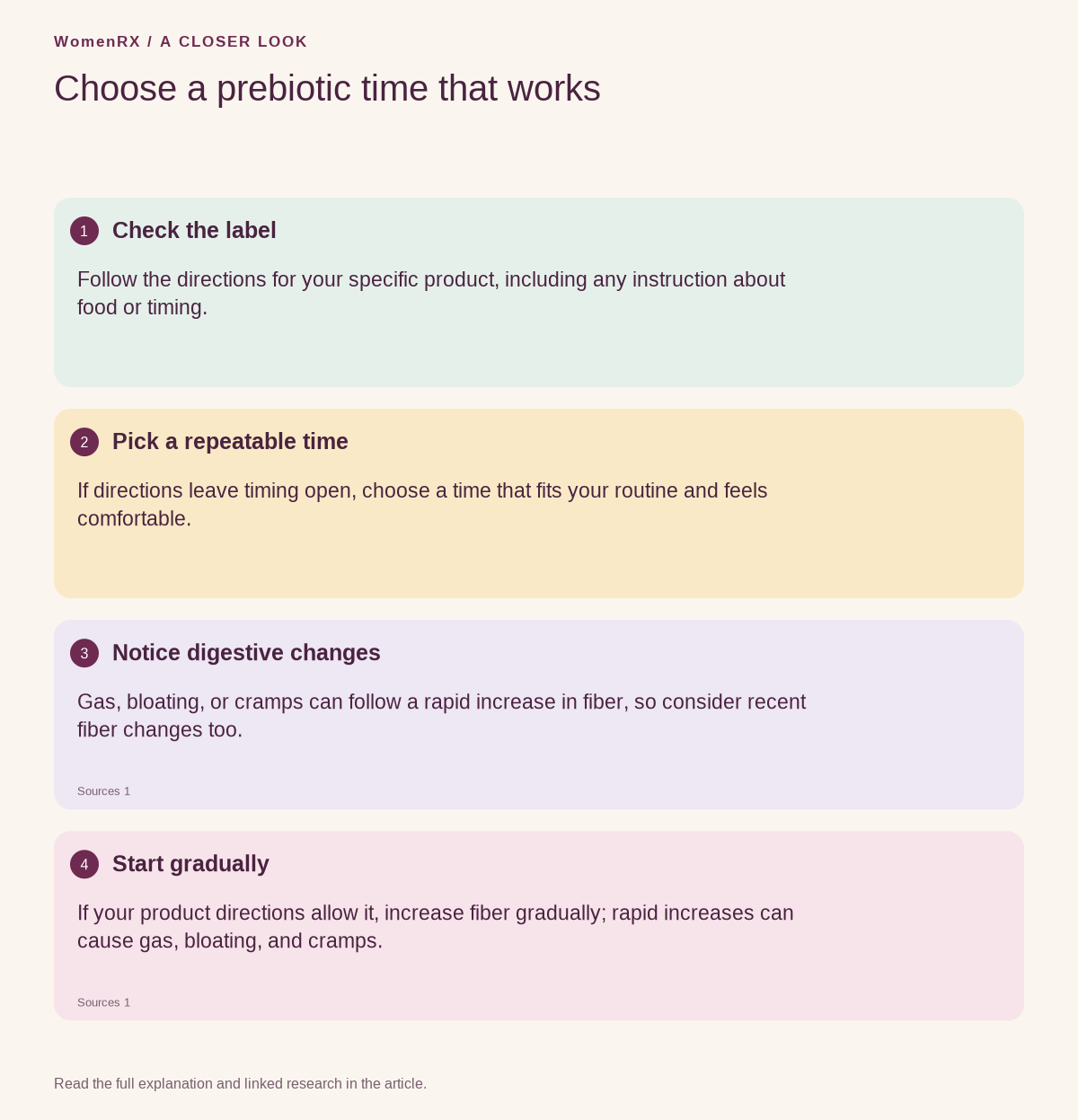
Choose a prebiotic time that works
Check the label: Follow the directions for your specific product, including any instruction about food or timing.
Pick a repeatable time: If directions leave timing open, choose a time that fits your routine and feels comfortable.
Notice digestive changes: Gas, bloating, or cramps can follow a rapid increase in fiber, so consider recent fiber changes too.1
Start gradually: If your product directions allow it, increase fiber gradually; rapid increases can cause gas, bloating, and cramps.1
Read the figure as text
Use this quick check to separate product instructions from personal routine and comfort.- Check the label: Follow the directions for your specific product, including any instruction about food or timing.
- Pick a repeatable time: If directions leave timing open, choose a time that fits your routine and feels comfortable.
- Notice digestive changes: Gas, bloating, or cramps can follow a rapid increase in fiber, so consider recent fiber changes too.1
- Start gradually: If your product directions allow it, increase fiber gradually; rapid increases can cause gas, bloating, and cramps.1
More questions, answered
Can bloating have a cause other than my prebiotic?
Yes. Foods and drinks, swallowed air, and digestive conditions such as celiac disease or irritable bowel syndrome can also contribute to bloating. If it keeps happening or doesn’t go away, don’t assume changing the time of your prebiotic will address the cause. 2
Sources you can check
- Dietary Fiber: MedlinePlusAccessed 2026-09-25Return to first citation
- Bloating - NHSAccessed 2026-09-25Return to first citation
- Diabetes Therapeutics of Prebiotic Soluble Dietary Fibre and Antioxidant Anthocyanin Supplement in Patients with Type 2 Diabetes: Randomised Placebo-Controlled Clinical Trial.Teparak C, Uriyapongson J, Phoemsapthawee J, Tunkamnerdthai O, Aneknan P, Tong-Un T, Panthongviriyakul C, Leelayuwat N, Alkhatib A. · Nutrients · 2025Return to first citation