Prebiotic Supplements: What Changes, and When?
The ingredient matters: research on inulin and fructooligosaccharides measured different digestive outcomes over different timeframes.
There isn’t one reliable timeline for prebiotic supplements. In a small trial of adults with functional constipation, four weeks of chicory inulin was associated with changes in bowel frequency and abdominal symptoms, though the crossover design had a carry-over concern. In an IBS trial, fructooligosaccharides (FOS) initially worsened symptoms for some, with no significant difference from placebo at 12 weeks. 3 2
“Prebiotic” doesn’t name one ingredient
A supplement’s effects depend on which fiber it contains, how much was studied, and what the researchers measured. In the available adult digestive-symptom trials, chicory inulin was tested in people with functional constipation, while fructooligosaccharides (FOS) were tested in people with irritable bowel syndrome (IBS). Those are different ingredients, populations, and outcomes, so the results don’t establish a single timeline for prebiotics as a category. 3 2
That distinction matters if you’re watching for a change. More frequent bowel movements, softer stools, less abdominal discomfort, and a shift in gut bacteria are separate findings. A study measuring one doesn’t automatically show that the others improved too.
What the inulin study can, and can’t, tell you
A randomized, double-blind trial studied 39 adults with functional constipation. Participants took 12 grams of chicory inulin daily during a four-week treatment period and placebo during another four-week period. Researchers measured bowel frequency, stool consistency, constipation symptoms, quality of life, and fecal microbiota. The study reported greater changes in bowel frequency and abdominal symptoms with inulin than placebo. 3
There’s a reason to be cautious about treating four weeks as a promised deadline: the crossover results showed a carry-over concern. Half of the participants who received inulin in the first period had their largest improvements during that period. An analysis of the first period alone supported a positive effect, but this was still a small study. It can offer a timeframe for what researchers measured, not a guarantee of when you’ll notice a change. 3
The trial also reported shifts in certain bacterial groups. Those microbiome measurements are not a substitute for how often someone had a bowel movement or how their abdomen felt. They’re different outcomes, even when a study measures both. 3
FOS and IBS followed a different pattern
In a separate randomized trial, 96 people with IBS were analyzed after taking 20 grams of FOS daily or placebo for 12 weeks. At the start of treatment, symptoms worsened in the FOS group. At four to six weeks, symptoms had improved more in the placebo group than in the FOS group. By the end of 12 weeks, the groups didn’t differ significantly: symptoms had improved in 58% of the FOS group and 65% of the placebo group, and worsened in 8% and 13%, respectively. 2
So this study doesn’t show that FOS reliably relieves IBS symptoms after a certain number of weeks. Nor does its 12-week result mean you should push through worsening symptoms: the trial compared group outcomes and cannot tell you what’s right for you. The amount and ingredient tested also aren’t a general recommendation for supplement use. 2
A practical way to judge a product
Start with the ingredient and the goal. If you’re interested in a product for constipation, don’t assume an IBS study of FOS predicts what inulin will do. Check the product label for the fiber and amount, then compare that with the ingredient, population, and amount in any study you’re using to set expectations.
It can also help to keep the outcome simple. Before and while trying a supplement, note the bowel change you care about, such as frequency or stool consistency, and whether gas, bloating, or discomfort changes too. That makes it easier to tell whether the intended change is happening alongside an unwanted one. Increasing fiber too quickly can cause gas, bloating, and cramps, so a gradual increase is sensible general fiber guidance; it doesn’t establish a prebiotic-specific schedule. 1
What the studies say about women
The FOS trial included 80 women and 16 men among the 96 people analyzed, but the reported results don’t separate outcomes for women from those for men. The inulin trial’s reported summary doesn’t provide a sex breakdown. Neither study summary establishes effects during pregnancy or breastfeeding. The findings therefore shouldn’t be treated as women-specific, or as evidence about vaginal or urinary health. 2 3
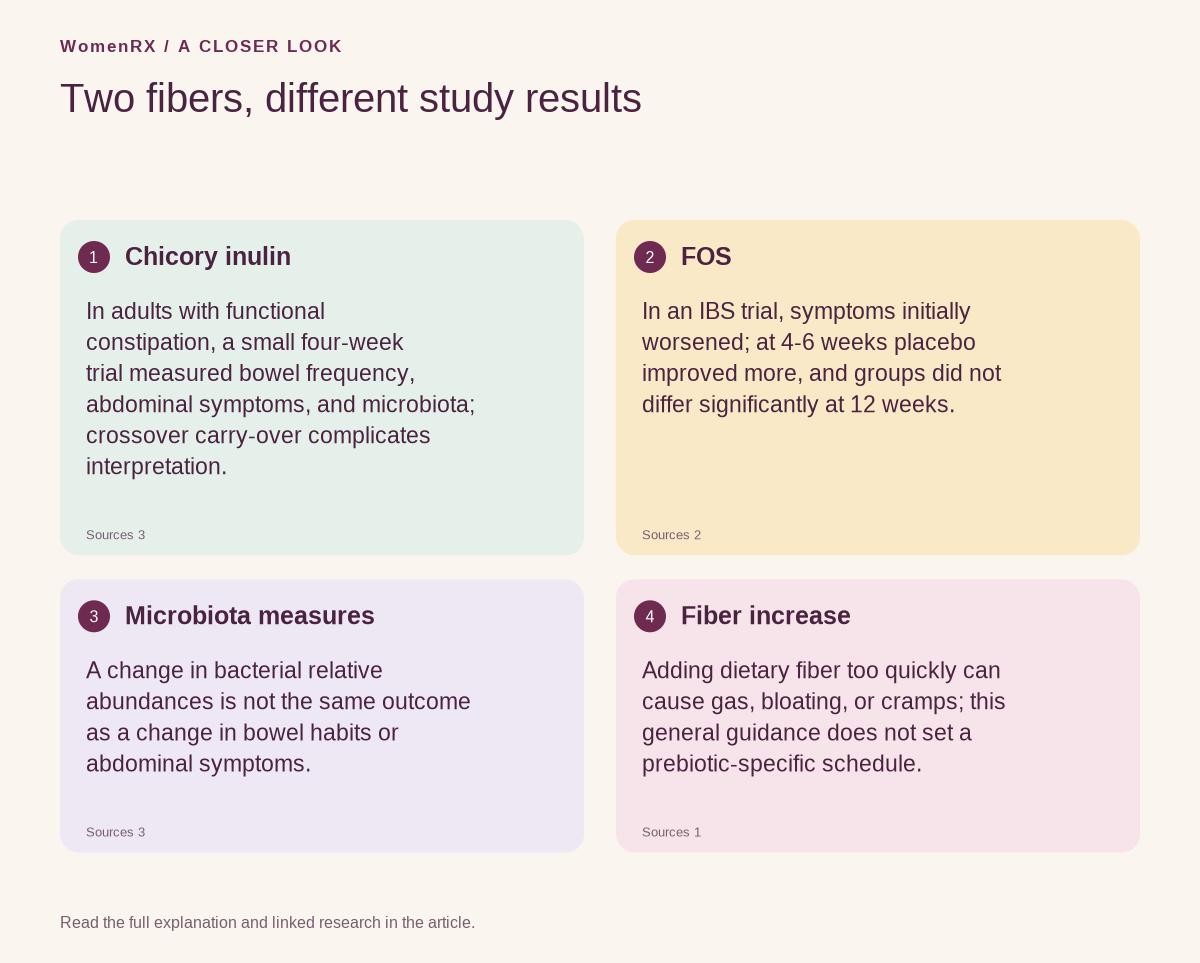
Two fibers, different study results
Chicory inulin: In adults with functional constipation, a small four-week trial measured bowel frequency, abdominal symptoms, and microbiota; crossover carry-over complicates interpretation.3
FOS: In an IBS trial, symptoms initially worsened; at 4-6 weeks placebo improved more, and groups did not differ significantly at 12 weeks.2
Microbiota measures: A change in bacterial relative abundances is not the same outcome as a change in bowel habits or abdominal symptoms.3
Fiber increase: Adding dietary fiber too quickly can cause gas, bloating, or cramps; this general guidance does not set a prebiotic-specific schedule.1
Read the figure as text
The ingredient, condition studied, outcome, and follow-up all affect what a trial can say about digestive changes.- Chicory inulin: In adults with functional constipation, a small four-week trial measured bowel frequency, abdominal symptoms, and microbiota; crossover carry-over complicates interpretation.3
- FOS: In an IBS trial, symptoms initially worsened; at 4-6 weeks placebo improved more, and groups did not differ significantly at 12 weeks.2
- Microbiota measures: A change in bacterial relative abundances is not the same outcome as a change in bowel habits or abdominal symptoms.3
- Fiber increase: Adding dietary fiber too quickly can cause gas, bloating, or cramps; this general guidance does not set a prebiotic-specific schedule.1
More questions, answered
Does a change in gut bacteria mean my symptoms should improve?
Not necessarily. The inulin trial measured both microbiota and digestive outcomes, but a microbiome shift is a different measurement from a change in bowel habits or abdominal symptoms. Judge the outcome you actually care about rather than treating one as proof of the other. 3
Can I use the FOS study to predict how inulin will feel?
No. The FOS trial involved people with IBS, while the inulin trial involved adults with functional constipation. The ingredient, population, and outcomes differed, so one trial can’t set a dependable expectation for the other. 2 3
Sources you can check
- Dietary Fiber: MedlinePlusAccessed 2026-09-25Return to first citation
- Efficacy, safety, and tolerability of fructooligosaccharides in the treatment of irritable bowel syndrome.Olesen M, Gudmand-Hoyer E. · The American journal of clinical nutrition · 2000Return to first citation
- Inulin-induced improvements on bowel habit and gut microbiota in adults with functional constipation: findings of a randomized, double-blind, placebo-controlled study.Puhlmann ML, Wegh CAM, van der Zalm SCC, Dam V, Doolan A, Meyer D, Belzer C, Vaughan EE, Benninga MA, Smidt H. · BMC gastroenterology · 2025Return to first citation