Prebiotic Supplements and Weight: What the Evidence Shows
Some human studies suggest changes in appetite or body fat, but they don’t establish reliable weight loss from a prebiotic supplement.
These human studies don’t justify choosing a prebiotic product specifically for weight loss. In a three-month study of 66 women with overweight, everyone following a low-calorie diet lost weight, but adding oat beta-glucan didn’t lead to significantly greater weight loss than the comparison diet. That’s a different fiber from inulin or FOS, and the inulin findings don’t establish a body-weight benefit either. 2 3
Start with the outcome you care about
A supplement can affect hunger, body-fat measurements, or gut bacteria without producing a meaningful change on the scale. Those are different outcomes, and an improvement in one doesn’t guarantee an improvement in another. Body weight itself includes water, muscle, bone, and fat, so it doesn’t tell the whole story either. 1
For a product marketed for weight management, the most relevant question is whether people taking that specific ingredient lost more weight than similar people taking a placebo. Changes in fullness or gut bacteria may be interesting, but they aren’t substitutes for that result.
What the human studies found
One 24-week randomized, placebo-controlled trial enrolled adults aged 18 to 70 with metabolic dysfunction-associated steatotic liver disease. Everyone received weight-loss counseling; one group also took a supplement containing oligofructose-enriched inulin, while the comparison group took a placebo. The change in liver fat did not differ between groups. The prebiotic group did have a greater decrease in trunk-fat percentage and reported less hunger and desire to eat. That’s a possible signal for appetite and body composition, not proof of greater overall weight loss. The reported findings don’t establish a greater reduction in body weight than placebo. 3
A separate three-month trial offers a direct weight comparison, though it studied oat beta-glucan, not inulin or FOS. It included 66 women with overweight who followed a low-calorie diet. Participants received one of two beta-glucan amounts or no beta-glucan. All groups lost weight and reduced waist circumference, but the changes weren’t significantly different between groups. In other words, this study didn’t show that adding beta-glucan improved weight loss beyond the diet. It’s useful evidence about that specific fiber in that setting, not proof about every ingredient called a prebiotic. 2
A 2025 systematic review and meta-analysis looked at 11 randomized trials involving 546 adults with prediabetes. The analysis found a decrease in body-fat percentage, but no significant change in BMI or waist circumference. The reviewers rated the evidence as very low certainty for most outcomes. So this result is worth noticing, but it doesn’t establish that prebiotics cause weight loss. 4
These studies also tested particular products in particular settings. The trial with inulin paired supplementation with counseling, while the review pooled studies of prebiotics in people with prediabetes. Neither tells us that every product labeled “prebiotic,” or every person taking one, will have the same result. Weight-loss supplement products can contain multiple ingredients, which makes it harder to identify what caused a reported effect. 2 3
Why appetite isn’t the same as weight loss
Feeling less hungry could make eating patterns easier to maintain, but it’s an intermediate outcome. To show that a supplement helps with weight management, a study needs to demonstrate a difference in weight over time, not just a change in appetite ratings. The inulin trial reported appetite differences and a trunk-fat finding, but its reported results do not establish a greater reduction in body weight than placebo. 3
Likewise, a body-fat result can matter without showing that the scale moved. The prediabetes review’s body-fat percentage finding came alongside no significant BMI or waist change, and the low certainty means the result could change as better studies become available. 4
What to check before trying a product
Read the ingredient panel, not just the front-of-package promise. Look for the named prebiotic ingredient and whether the product combines it with other active ingredients. A finding for inulin-enriched oligofructose doesn’t automatically apply to a different fiber, a blend, or a product that doesn’t disclose comparable ingredients. Supplement formulations and amounts can vary, and research on one ingredient may not predict the effect of a combination. 2 3
Then match the claim to the evidence: does the study measure body weight, or only appetite, body fat, or a gut-microbe change? Was the supplement tested by itself or alongside counseling or a diet? How long did the study run? These distinctions help separate a plausible idea from evidence that a product delivers the outcome you want.
What about women?
The clearest women-only weight comparison here is the three-month beta-glucan trial: all 66 women with overweight following a low-calorie diet lost weight, but adding beta-glucan did not produce significantly greater weight loss than the comparison diet. This finding concerns oat beta-glucan, not inulin or FOS, and it doesn’t establish whether results differ by menopause stage. 2
The inulin trial included adults aged 18 to 70. The findings described here cannot establish whether effects differ by sex or menopause stage, including perimenopause and postmenopause. The prediabetes review likewise cannot establish a menopause-specific effect. 3 4
Bottom line: The evidence presented doesn’t show that a prebiotic supplement reliably adds weight loss. The women-only beta-glucan trial found no significant extra weight change over a low-calorie diet, while the inulin findings point to appetite and body-fat outcomes rather than established weight loss. I wouldn’t choose a product specifically for weight loss on this evidence alone.
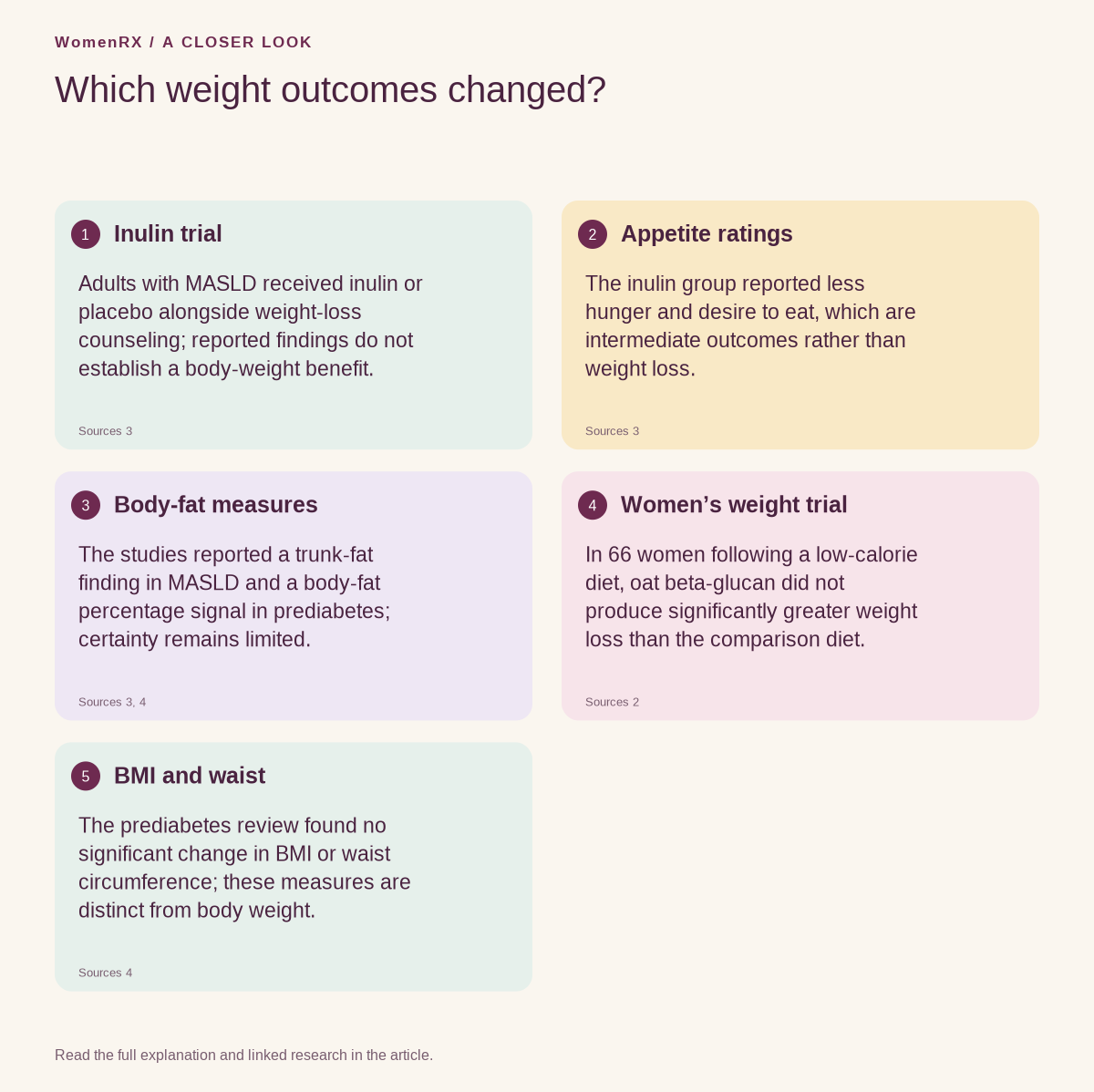
Which weight outcomes changed?
Inulin trial: Adults with MASLD received inulin or placebo alongside weight-loss counseling; reported findings do not establish a body-weight benefit.3
Appetite ratings: The inulin group reported less hunger and desire to eat, which are intermediate outcomes rather than weight loss.3
Body-fat measures: The studies reported a trunk-fat finding in MASLD and a body-fat percentage signal in prediabetes; certainty remains limited.34
Women’s weight trial: In 66 women following a low-calorie diet, oat beta-glucan did not produce significantly greater weight loss than the comparison diet.2
BMI and waist: The prediabetes review found no significant change in BMI or waist circumference; these measures are distinct from body weight.4
Read the figure as text
A direct weight comparison, appetite ratings, body-fat measures, and BMI or waist results answer different questions.- Inulin trial: Adults with MASLD received inulin or placebo alongside weight-loss counseling; reported findings do not establish a body-weight benefit.3
- Appetite ratings: The inulin group reported less hunger and desire to eat, which are intermediate outcomes rather than weight loss.3
- Body-fat measures: The studies reported a trunk-fat finding in MASLD and a body-fat percentage signal in prediabetes; certainty remains limited.34
- Women’s weight trial: In 66 women following a low-calorie diet, oat beta-glucan did not produce significantly greater weight loss than the comparison diet.2
- BMI and waist: The prediabetes review found no significant change in BMI or waist circumference; these measures are distinct from body weight.4
More questions, answered
Do the findings apply specifically to women after menopause?
The women-only trial included women with overweight, but it tested oat beta-glucan alongside a low-calorie diet and found no significant extra weight loss. It doesn’t establish an effect for inulin or FOS, or whether results differ after menopause. The other findings presented here also don’t demonstrate a menopause-specific benefit. 2 3 4
Sources you can check
- Body Weight: MedlinePlusAccessed 2026-09-25Return to first citation
- Dietary Supplements for Weight Loss - Health Professional Fact SheetAccessed 2026-09-25Return to first citation
- Effects of combined prebiotic fiber supplementation and weight loss counseling in adults with metabolic dysfunction-associated steatotic liver disease: a randomized controlled trial.Mayengbam S, Raman M, Parnell JA, Eksteen B, Lambert JE, Eller LK, Nicolucci AC, Aktary ML, Reimer RA. · European journal of nutrition · 2025Return to first citation
- Effect of Prebiotic Supplementation on Health Status in Adults with Prediabetes: A Systematic Review and Meta-Analysis of Randomized Clinical Trials.Hosseini E, Mokhtari Z, Askari G. · The Journal of nutrition · 2025Return to first citation