Dry Skin Around Menopause: A Simple Routine and When to Look Closer
A steady moisturizer routine can support dry skin, while a persistent or recurring rash may need a closer look.
Dry skin around menopause can have several causes, including aging, weather, medicines, skin conditions, and some health problems. Dryness alone can’t tell you that low estrogen is the cause. Start with simple, gentle washing and a moisturizer containing a humectant such as glycerol or urea, an occlusive such as petrolatum, or both. If a rash or itch persists or keeps returning, consider getting it assessed. 12
Dry, tight, or flaky skin can show up around midlife, but the timing doesn’t tell you what caused it. Dry skin, also called xerosis, can be related to aging or environmental triggers. It can also occur with medicines, a skin condition, or a health problem. So a dry patch by itself isn’t proof that estrogen is low or that menopause is the cause. 12
A useful starting point is to support the skin barrier: the outer layer that helps hold water in and limit its loss. You don’t need a complicated routine to do that.
A simple routine for dry, uncomfortable skin
Keep washing gentle. Try not to scrub dry areas, and keep cleansing simple. This is a practical way to make a routine more comfortable, not a claim that one washing method has been shown to work best for everyone.
Choose a moisturizer by what its ingredients do. Humectants such as glycerol and urea help improve the skin’s water-holding capacity. Occlusives such as petrolatum and paraffin help reduce water loss and support the barrier. A product may contain ingredients from both groups. 14
Use a product you’ll stick with. Emollients are a mainstay of basic dry-skin care, and ongoing use is part of managing xerosis. Research includes varied products and study designs, so it doesn’t identify one formulation as best for everyone. Texture can be a personal preference: choose something that feels comfortable enough for you to use regularly. 23
Notice whether the pattern is changing. If your skin is generally rough or tight, a basic emollient may be a reasonable first step. If one area stays itchy, a rash keeps coming back, or moisturizing isn’t settling the problem, don’t assume it’s only ordinary dryness. A clinician can assess whether another skin condition or cause may be involved.
When dryness may have another explanation
Dry skin can occur with atopic dermatitis, psoriasis, and other skin conditions. It can also be associated with health problems such as diabetes or hypothyroidism. Weather and other external triggers, aging, medicines, and genetic predisposition are additional possible contributors. These are possibilities, not a way to diagnose the cause from dryness alone. 12
The practical distinction is the pattern: broad, rough dryness may respond to routine barrier care, while persistent or recurring rash or itch deserves a closer look. An assessment can help distinguish uncomplicated xerosis from an inflammatory skin condition or another cause.
Midlife skin changes and dry skin can overlap in time, but that overlap doesn’t prove a menopause-specific cause. A moisturizer can support hydration and the skin barrier; dry skin alone doesn’t show that you need hormone treatment, and skincare shouldn’t be described as reversing skin aging. 12
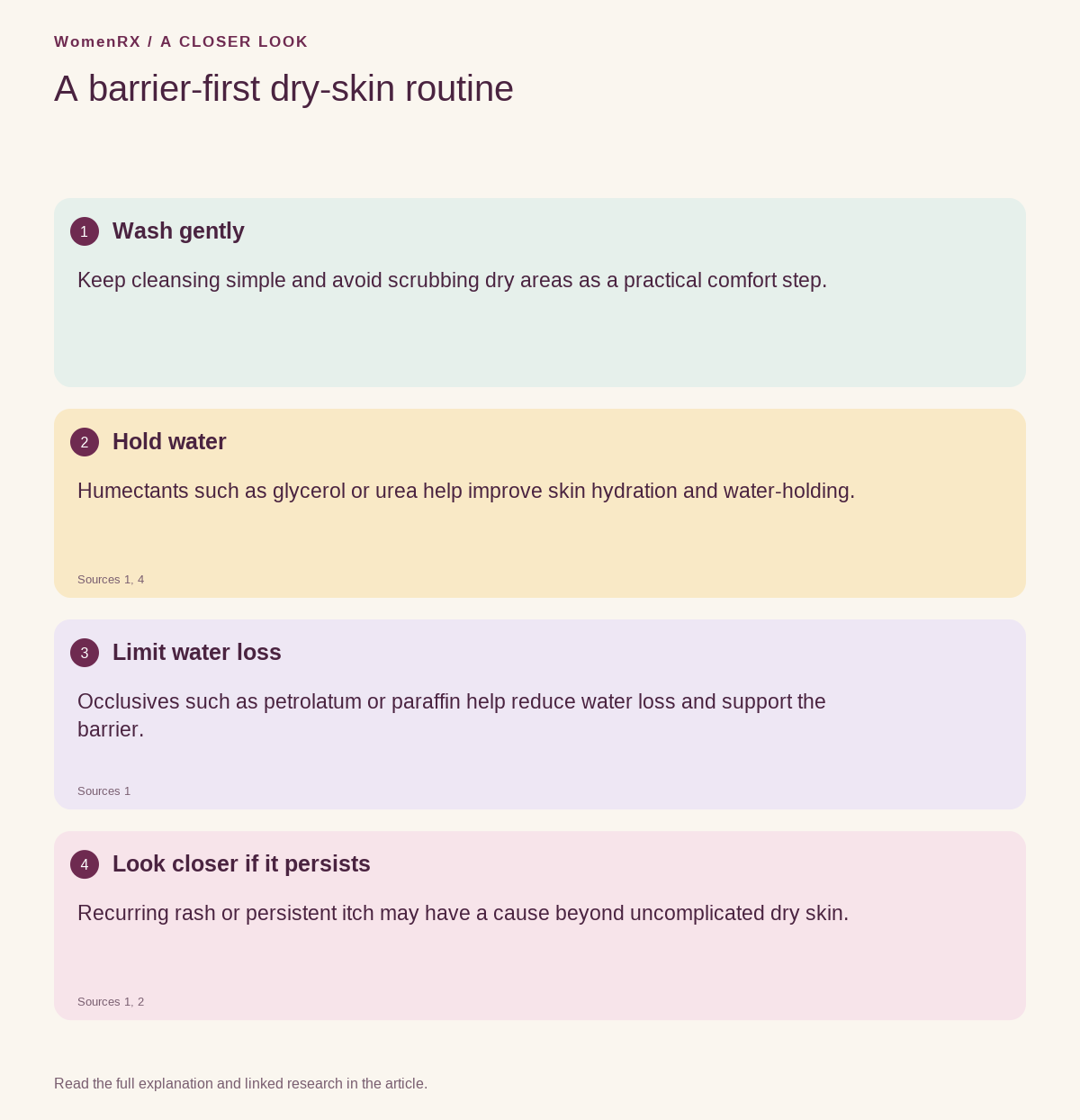
A barrier-first dry-skin routine
Wash gently: Keep cleansing simple and avoid scrubbing dry areas as a practical comfort step.
Hold water: Humectants such as glycerol or urea help improve skin hydration and water-holding.14
Limit water loss: Occlusives such as petrolatum or paraffin help reduce water loss and support the barrier.1
Look closer if it persists: Recurring rash or persistent itch may have a cause beyond uncomplicated dry skin.12
Read the figure as text
Use this sequence to simplify dry-skin care and recognize when a recurring symptom may need assessment.- Wash gently: Keep cleansing simple and avoid scrubbing dry areas as a practical comfort step.
- Hold water: Humectants such as glycerol or urea help improve skin hydration and water-holding.14
- Limit water loss: Occlusives such as petrolatum or paraffin help reduce water loss and support the barrier.1
- Look closer if it persists: Recurring rash or persistent itch may have a cause beyond uncomplicated dry skin.12
Sources you can check
- Restoring Skin Hydration and Barrier Function: Mechanistic Insights Into Basic Emollients for Xerosis Cutis.Fluhr JW, Muguet V, Christen-Zaech S. · International journal of dermatology · 2025Return to first citation
- Basic Emollients for Xerosis Cutis Not Associated With Atopic Dermatitis: A Review of Clinical Studies.Szepietowski JC, Tadini G. · International journal of dermatology · 2025Return to first citation
- Clinical Benefits of Basic Emollient Therapy for the Management of Patients With Xerosis Cutis.Vestergaard C, Torrelo A, Christen-Zaech S. · International journal of dermatology · 2025Return to first citation
- Basic Emollients for Xerosis Cutis in Atopic Dermatitis: A Review of Clinical Studies.Wollenberg A, Barbarot S, Torrelo A. · International journal of dermatology · 2025Return to first citation