Dry Skin During Menopause: What Helps and When to Get Advice
A gentle cleanser and regular moisturizer are a good starting point, but a new rash or persistent itch deserves a closer look.
Itchy skin is common after menopause, but neither itch nor dry skin proves that hormones are the cause. 41 Start with lukewarm, shorter showers, a gentle cleanser, and an unperfumed moisturizer used regularly. 42 If itching is severe, keeps returning, affects your day, or comes with a new rash or swelling that worries you, get it assessed. 41
Start with the skin you can see
If your skin feels tight after a shower or looks rough and flaky, begin with a simpler routine rather than a shelf full of new products. Use a gentle cleanser, keep baths and showers lukewarm rather than hot, and avoid staying in the water for a long time. Apply an unperfumed moisturizer regularly. If clothing rubs or makes you itch, loose cotton may feel more comfortable than wool or tight synthetic fabrics. 4
There’s a practical reason to give the routine a fair try. In a randomized study of 52 people with moderate to severe dry skin, those using a mild cleanser and moisturizer had greater improvement in visible dryness and skin findings after two weeks than those using the cleanser alone. The study wasn’t specific to menopause and doesn’t establish that any one product is best. It does support keeping the basics consistent. 2
Mature skin can be more prone to dryness as the outer skin barrier changes with age. A review describes reduced lipids in that barrier and notes that both inherited and environmental factors can contribute to dryness. That’s why it makes sense to look at your whole situation, including bathing habits and products, rather than assume a change in your skin has one hormonal explanation. 34
When dryness looks like more than dryness
Itch and roughness don’t tell you the cause by themselves. Dry skin is one possibility; eczema, psoriasis, reactions to cosmetics or other irritants, and some infections can also cause itching. Medicines and conditions such as diabetes or thyroid disease are among other possible causes. A rash may offer a clue, but you don’t need to identify it yourself before asking for help. 14
Notice what changed. For example, did the irritation appear around the time you switched soap or laundry detergent, or did a visible rash appear where you’d been scratching? Those observations are useful to share, not a way to confirm a diagnosis. If a new rash, lump, or swelling worries you, arrange an assessment instead of treating it as uncomplicated dryness. The same applies if itching is severe, widespread, affecting daily life, or not improving with self-care. 14
If you suspect a medicine is involved, mention the medicine and when the itching began when you seek advice. Medicines can cause itching, but timing alone can’t establish that one is responsible. 1
Where menopause fits
Itchy skin is common after menopause, though that doesn’t mean every new patch of dryness in perimenopause or postmenopause is caused by a change in hormones. Age-related skin-barrier changes, irritating products, skin conditions, and other health problems may overlap at the same time. 431
So make your next move fit what’s happening: try the gentle routine for ordinary dryness, but don’t keep escalating products if the skin develops a concerning rash or the itch persists. If you’re pregnant rather than approaching or past menopause, itching warrants a separate conversation with your pregnancy care team because it can occasionally signal a liver condition. 4
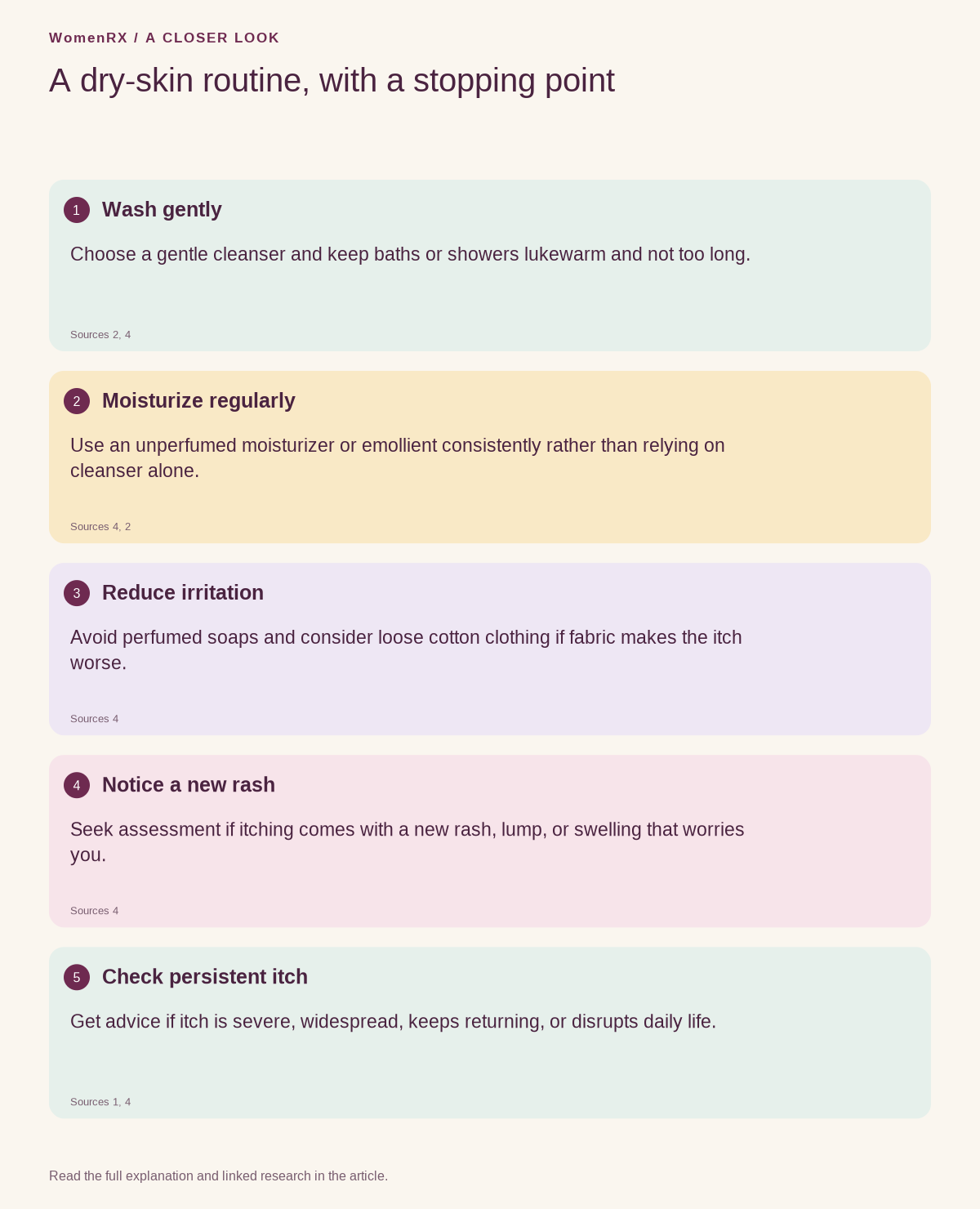
A dry-skin routine, with a stopping point
Wash gently: Choose a gentle cleanser and keep baths or showers lukewarm and not too long.24
Moisturize regularly: Use an unperfumed moisturizer or emollient consistently rather than relying on cleanser alone.42
Reduce irritation: Avoid perfumed soaps and consider loose cotton clothing if fabric makes the itch worse.4
Notice a new rash: Seek assessment if itching comes with a new rash, lump, or swelling that worries you.4
Check persistent itch: Get advice if itch is severe, widespread, keeps returning, or disrupts daily life.14
Read the figure as text
Use the first steps for ordinary dryness; the last steps identify when a routine alone may not be enough.- Wash gently: Choose a gentle cleanser and keep baths or showers lukewarm and not too long.24
- Moisturize regularly: Use an unperfumed moisturizer or emollient consistently rather than relying on cleanser alone.42
- Reduce irritation: Avoid perfumed soaps and consider loose cotton clothing if fabric makes the itch worse.4
- Notice a new rash: Seek assessment if itching comes with a new rash, lump, or swelling that worries you.4
- Check persistent itch: Get advice if itch is severe, widespread, keeps returning, or disrupts daily life.14
Sources you can check
- Itching | Pruritus | Itchy skin | MedlinePlusAccessed 2026-09-25Return to first citation
- A consistent skin care regimen leads to objective and subjective improvements in dry human skin: investigator-blinded randomized clinical trial.Kim S, Ly BK, Ha JH, Carson KA, Hawkins S, Kang S, Chien AL. · The Journal of dermatological treatment · 2022Return to first citation
- Promoting a Healthy Skin Barrier Using Skin Care in People With Mature Skin Xerosis.Gold M, Andriessen A, Burgess C, Callender V, Goldberg D, Hougeir F, Kircik L, Schlesinger T. · Journal of drugs in dermatology : JDD · 2024Return to first citation
- Itchy skin - NHSAccessed 2026-09-25Return to first citation