Dry Eyes During Menopause: What Helps and When to Get Help
Gritty or burning eyes deserve care, but menopause isn’t the only possible reason they feel dry.
Dry eyes can feel gritty, sore, watery, or intermittently blurry when you don’t make enough tears or they dry up too quickly. Menopause may be part of the picture, but screens, dry air, contact lenses, medicines, and other health conditions matter too. Try reducing likely triggers and ask about lubricating eye drops; get persistent symptoms checked and seek prompt care for warning signs. 872
Why eyes can feel dry, even when they water
Each blink spreads tears across the eye’s surface, helping keep it comfortable and vision clear. Dry-eye symptoms can develop when there aren’t enough tears or when tears evaporate too quickly. That can feel gritty, burning, or sore. It can also cause intermittent blur, light sensitivity, or surprisingly watery eyes. 18
Problems with the oil-producing glands along your eyelids are linked to evaporative dry eye. If those glands aren’t working well, adding moisture may help symptoms without addressing the whole problem. An eye exam can help distinguish this pattern from other causes and guide what to try next. 68
Where menopause fits, and where it doesn’t
Hormone changes around menopause have been implicated in eyelid oil-gland problems and evaporative dry eye. That’s a reason to take symptoms seriously, not a way to diagnose their cause. A systematic review of observational studies did not find a statistically significant association between menopause itself and dry-eye disease. Its findings can’t tell an individual woman why her eyes hurt. 67
For example, if your eyes began bothering you in perimenopause, it’s worth considering what else changed around the same time. Longer stretches at a screen, contact lens wear, heated or air-conditioned rooms, and time in wind or dry air can all contribute. Dry eye also becomes more likely with age, and conditions including blepharitis and Sjögren’s syndrome can be involved. Research has also found associations with diabetes and thyroid disease. None of these possibilities means you should assume you have one of those conditions; they’re reasons not to label every new eye symptom “just menopause.” 87
Match the first step to what you notice
If symptoms are mild and come and go, start with the circumstances you can change. If they build during computer work, take breaks to rest your eyes. If indoor air feels dry, a humidifier may help. Limit time in smoky, dusty, or strongly heated or air-conditioned spaces when you can. If contacts make your eyes uncomfortable, switch to glasses to give your eyes a rest. These steps address common contributors, though they won’t treat every cause of dry eye. 8
Lubricating eye drops, often called artificial tears, are a common first treatment for dry eye. They can ease symptoms, but they may not be enough when symptoms are more persistent or severe. There isn’t one drop that suits everyone or every cause. An eye-care professional or pharmacist can help you choose an option that fits what you’re experiencing. 48
Crusting or irritation around the eyelids suggests another useful focus: lid care. NHS dry-eye guidance describes gently cleaning the lids and using a warm, not hot, compress to help the oils from eyelid glands flow. If your eyes remain uncomfortable, an exam can check whether an eyelid problem needs more targeted care. 8
Medicines are worth considering too. Some antidepressants and blood pressure medicines are examples of drugs that may contribute to dry eyes. If symptoms began after a medicine change, raise that connection with the clinician who prescribed it rather than stopping it on your own. The timing is a clue, not proof that the medicine is the cause. 8
When an eye exam changes the plan
Arrange an eye-care visit if dry eyes haven’t improved after a few weeks of home care, if your eyelids have changed shape, or if symptoms keep interfering with reading, screens, or contacts. An optometrist or ophthalmologist can look for contributors rather than simply treating the sensation of dryness. Depending on the cause and severity, dry-eye care may include treatments beyond artificial tears, such as anti-inflammatory treatment or measures to retain tears in selected cases. 83
The menopause hormone-therapy position statement describes benefits for bothersome hot flashes, genitourinary symptoms, and bone-loss prevention. If you’re considering hormone therapy for those reasons, mention your eye symptoms separately and follow the eye-care steps above. 58
Don’t wait out a warning sign as ordinary dryness. Get prompt eye assessment for a painful red eye, especially if you wear contact lenses. Seek immediate assessment for sudden loss of vision, flashes of light, new black spots, double vision, or blurred vision with eye pain. A new or concerning change in sight needs attention even if your eyes have felt dry for months. 82
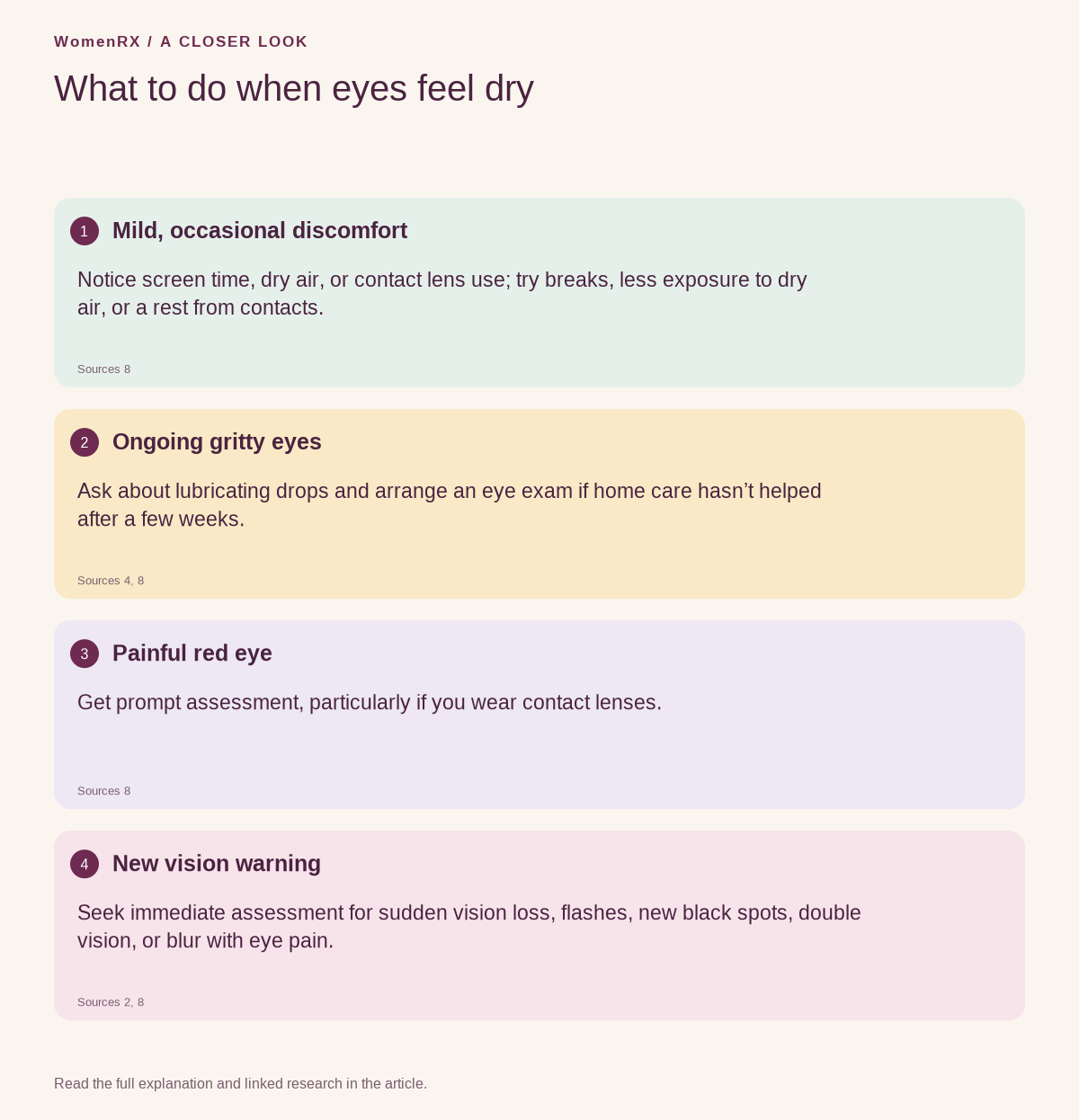
What to do when eyes feel dry
Mild, occasional discomfort: Notice screen time, dry air, or contact lens use; try breaks, less exposure to dry air, or a rest from contacts.8
Ongoing gritty eyes: Ask about lubricating drops and arrange an eye exam if home care hasn’t helped after a few weeks.48
Painful red eye: Get prompt assessment, particularly if you wear contact lenses.8
New vision warning: Seek immediate assessment for sudden vision loss, flashes, new black spots, double vision, or blur with eye pain.28
Read the figure as text
Use the symptom pattern to choose a reasonable next step, while treating new vision warning signs separately from routine dryness.- Mild, occasional discomfort: Notice screen time, dry air, or contact lens use; try breaks, less exposure to dry air, or a rest from contacts.8
- Ongoing gritty eyes: Ask about lubricating drops and arrange an eye exam if home care hasn’t helped after a few weeks.48
- Painful red eye: Get prompt assessment, particularly if you wear contact lenses.8
- New vision warning: Seek immediate assessment for sudden vision loss, flashes, new black spots, double vision, or blur with eye pain.28
More questions, answered
Does a watery eye rule out dry eye?
No. Eyes that are more watery than usual can still have dry-eye symptoms. Because watery eyes can have other causes too, persistent symptoms are worth an eye exam rather than guessing from that one sign. 81
Sources you can check
- Tears | Dry Eye | MedlinePlusAccessed 2026-09-25Return to first citation
- Eye Care | Vision Care | MedlinePlusAccessed 2026-09-25Return to first citation
- Is Current Evidence Sufficient to Establish the Efficacy of Botulinum Toxin A in Treating Persistent Dry Eye Disease? A Systematic Review and Meta-Analysis of Interventional Studies With a Critical Review Using GRADE Tool.Abdollahi M, Semnani F, Vahedi H, Sobhi N, Mohammadkhani M, Nabavi A, Jafarizadeh A. · Health science reports · 2026Return to first citation
- Safety and Efficacy of Diquafosol Compared to Artificial Tears for the Treatment of Dry Eye: A Systematic Review and Meta-Analysis.Serrano-Robles JG, Pérez-Vázquez AK, Vera-Duarte GR, Navas A, Ramirez-Miranda A, Graue-Hernandez EO, Kahuam-López N. · International journal of molecular sciences · 2025Return to first citation
- The 2022 hormone therapy position statement of The North American Menopause Society.“The 2022 Hormone Therapy Position Statement of The North American Menopause Society” Advisory Panel. · Menopause (New York, N.Y.) · 2022Return to first citation
- Perfluorohexyloctane Eye Drops in Premenopausal and Postmenopausal Women with Dry Eye Disease Associated with Meibomian Gland Dysfunction: A Post Hoc Analysis of a Phase 3 Trial.Zhu Y, Xie J, Shi X, Sun Y. · Current eye research · 2026Return to first citation
- Association between potential factors and dry eye disease: A systematic review and meta-analysis.Yang K, Wu S, Ke L, Zhang H, Wan S, Lu M, Mao J, Gao Y, Yang Y, Xing Y, Yang W. · Medicine · 2024Return to first citation
- Dry eyes - NHSAccessed 2026-09-25Return to first citation