Dry Eyes During Perimenopause: What Helps and When to Get Checked
Gritty eyes may show up during the menopause transition, but the next step depends more on your symptoms than on assuming hormones are the cause.
Dry eye can feel gritty, itchy, sore, watery, or blurry when you don’t make enough tears or they dry up too quickly. Screen breaks and daily eyelid cleaning are reasonable first steps. If dryness persists after a few weeks, arrange an eye-care assessment. A painful red eye or redness with contact lenses needs urgent assessment. Pain when looking at light, a very dark-red eye, or an injured eye needs immediate care. 2
Your eyes feel gritty after a day at the computer, or they water even though they feel dry. Both can fit dry eye. Tears normally keep the eye’s surface moist, and dryness can develop when there aren’t enough tears or they dry up too quickly. The feeling is real, but it doesn’t identify the cause on its own. 12
Could perimenopause be involved?
Hormones may influence the tear film, which is one reason researchers study dry eye around menopause. In a study comparing people at one point in time, postmenopausal women had more dry-eye symptoms and signs of tear-film instability than age-matched men and younger women. That finding doesn’t show that menopause caused the difference, and it doesn’t tell us what happens to an individual woman during perimenopause. 46
Other causes still matter. Blepharitis, an eyelid condition, and conditions such as Sjögren’s syndrome or lupus can be associated with dry eyes. That doesn’t mean you have one of them. It means persistent symptoms deserve a look rather than a guess that hormones explain everything. 2
Start with what you can change
Notice when symptoms flare. If long stretches at a screen make your eyes uncomfortable, take breaks to rest them. Positioning a computer screen just below eye level is another suggested home measure. These steps don’t test whether hormones are involved; they address a common situation in which dryness may bother you. 2
Give your eyelids some attention. Daily eyelid cleaning is suggested for dry eyes. If your eyelids have changed shape, though, arrange an assessment instead of relying on home care alone. 2
Bring up medicines without stopping them yourself. If you suspect a prescribed medicine is contributing, ask the person who prescribed it before making a change. 2
Treat contact-lens redness differently. A red eye while wearing contact lenses can signal an infection and needs urgent assessment. Don’t wait a few weeks to see whether screen breaks or eyelid care fix it. 2
What about eye drops or hormone therapy?
A small study followed 30 menopausal women with moderate dry eye who used drops containing hyaluronic acid, vitamin B12, and other ingredients. After 30 days, symptoms and tear measurements had improved. But there was no comparison group, and the mixture makes it impossible to tell which ingredient helped or whether those drops work better than another option. It isn’t evidence that you need a menopause-specific drop. 5
Likewise, a possible hormonal contribution isn’t a reason to start or change hormone therapy for dry eyes. Menopause hormone-therapy guidance addresses other established treatment purposes; it doesn’t establish hormone therapy as a dry-eye treatment. 36 If home measures aren’t enough, an eye-care professional can examine your eyes and help choose treatment based on what’s happening at the eye’s surface. 2
When dryness needs an eye exam
If your eyes are still dry after a few weeks of home care, arrange an eye-care assessment. Do the same if you notice a change in the shape of your eyelids. An examination can help sort out the cause rather than leaving you to keep trying the same steps. 2
Get urgent assessment for a painful red eye or a red eye when you wear contact lenses. Get immediate care if it hurts to look at light, your eye is very dark red, you have a red eye with a severe headache and nausea, or your eye has been injured or pierced. 2
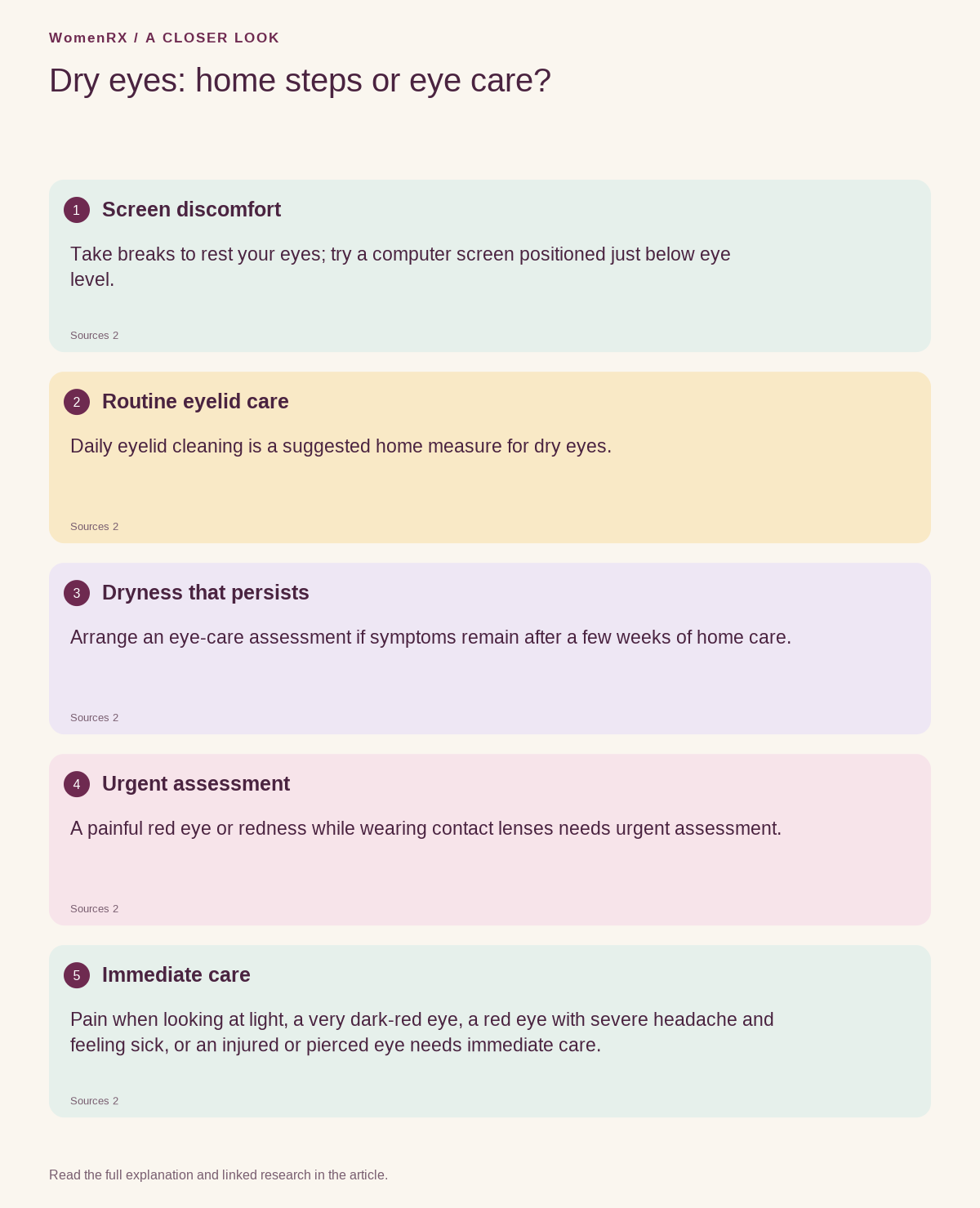
Dry eyes: home steps or eye care?
Screen discomfort: Take breaks to rest your eyes; try a computer screen positioned just below eye level.2
Routine eyelid care: Daily eyelid cleaning is a suggested home measure for dry eyes.2
Dryness that persists: Arrange an eye-care assessment if symptoms remain after a few weeks of home care.2
Urgent assessment: A painful red eye or redness while wearing contact lenses needs urgent assessment.2
Immediate care: Pain when looking at light, a very dark-red eye, a red eye with severe headache and feeling sick, or an injured or pierced eye needs immediate care.2
Read the figure as text
Use the symptom, not an assumed hormonal cause, to decide what to do next.- Screen discomfort: Take breaks to rest your eyes; try a computer screen positioned just below eye level.2
- Routine eyelid care: Daily eyelid cleaning is a suggested home measure for dry eyes.2
- Dryness that persists: Arrange an eye-care assessment if symptoms remain after a few weeks of home care.2
- Urgent assessment: A painful red eye or redness while wearing contact lenses needs urgent assessment.2
- Immediate care: Pain when looking at light, a very dark-red eye, a red eye with severe headache and feeling sick, or an injured or pierced eye needs immediate care.2
Sources you can check
- Tears | Dry Eye | MedlinePlusAccessed 2026-09-25Return to first citation
- Dry eyes - NHSAccessed 2026-09-25Return to first citation
- The 2022 hormone therapy position statement of The North American Menopause Society.“The 2022 Hormone Therapy Position Statement of The North American Menopause Society” Advisory Panel. · Menopause (New York, N.Y.) · 2022Return to first citation
- Impact of menopause on dry eye disease: a cross-sectional comparative study.Pandey H, Kumar R. · Post reproductive health · 2026Return to first citation
- Efficacy of hyaluronic acid 0.3%, cyanocobalamin, electrolytes, and P-Plus in menopause patients with moderate dry eye disease.De-Hita-Cantalejo C, Sánchez-González MC, Silva-Viguera C, García-Romera MC, Feria-Mantero R, Sánchez-González JM. · Graefe's archive for clinical and experimental ophthalmology = Albrecht von Graefes Archiv fur klinische und experimentelle Ophthalmologie · 2022Return to first citation
- Dry Eye Syndrome in Menopause and Perimenopausal Age Group.Peck T, Olsakovsky L, Aggarwal S. · Journal of mid-life health · 2017Return to first citation