Dry Skin Around Menopause: What Helps and When to Check
Menopause may change how your skin feels, but a simple skin-care routine and a closer look at any rash or itch are more useful than assuming hormones explain everything.
Dryness around menopause can reflect changing estrogen levels, ordinary skin aging, or both. Start with a gentle cleanser, regular use of an unperfumed moisturizer, and shorter, lukewarm showers. 316 Get a rash or swelling you’re concerned about assessed. Itch also deserves a closer look if it’s severe, widespread, keeps returning, or doesn’t improve with self-care. 56
Why your skin may feel different
If your usual moisturizer suddenly seems to do less, you’re not imagining the change. Estrogen declines around menopause, and research links that shift with changes in skin structure and moisture. But menopause isn’t the only explanation for dry skin. Aging skin also undergoes changes in its outer barrier, including a reduction in the lipids that help it retain moisture; genes and the environment may play a part too. 31
That distinction matters because the first steps for ordinary dryness are skin care, not a hormone treatment. A 2025 review found that studies of hormone therapy and menopausal skin quality have produced sometimes inconsistent results, and that clinical guidelines don’t support hormone therapy solely to treat skin changes. Menopause hormone therapy has other established uses, but dry skin alone isn’t a reason to start it. 32
Give dry skin a gentler routine
For skin that feels tight, rough, or mildly itchy, keep the routine uncomplicated. Use a gentle cleanser rather than a perfumed soap, and apply an unperfumed moisturizer regularly. Gentle cleansing and moisturizing have reduced dryness and itch in studies of people with mature skin; a review specifically discusses lipid-containing products, including those with ceramides, as one option for supporting the skin barrier. That doesn’t mean you need a particular brand or that a more elaborate product will work better for you. 16
Keep baths or showers cool to lukewarm rather than hot, and don’t linger in the water. If skin itches, a cool damp cloth may feel better than scratching it. These are reasonable steps while you see whether the dryness settles, not a way to diagnose what’s causing the itch. 6
A moisturizer is the useful product category here. Supplements are a different proposition: one randomized study in menopausal women reported improvements in measured skin hydration after six months with a particular combination containing collagen, calcium, and vitamin D, but it found no significant change in transepidermal water loss in any group. Those measurements don’t establish supplements as a general treatment for dry, itchy skin. 4
Know when it’s more than routine dryness
Dry skin can itch, but so can eczema, psoriasis, reactions to irritating substances, medicines, and conditions elsewhere in the body. The presence of menopause doesn’t sort those possibilities out. 5 Use what you can see and how the symptom behaves to decide on a next step:
- Mostly dry or rough skin, without a new rash: Gentle cleansing and moisturizing are a sensible place to start. If the itch doesn’t improve with self-care or keeps coming back, have it assessed. 16
- A new rash, lump, or swelling that concerns you: Don’t assume it’s simply menopausal dryness. An assessment can help identify the cause and whether it needs a different treatment. 6
- Severe itch, itch all over, or itch that disrupts daily life: Arrange an assessment rather than just adding more skin products. The same applies to itch with no apparent cause or itch that hasn’t gone away after a few weeks. 56
For example, a patch of rough skin that feels better with moisturizer poses a different question from a new facial rash or itching over your whole body without obvious dryness. Neither pattern tells you the diagnosis on its own. The point is to let a new or persistent symptom be evaluated instead of explaining it away as a normal part of menopause. 56
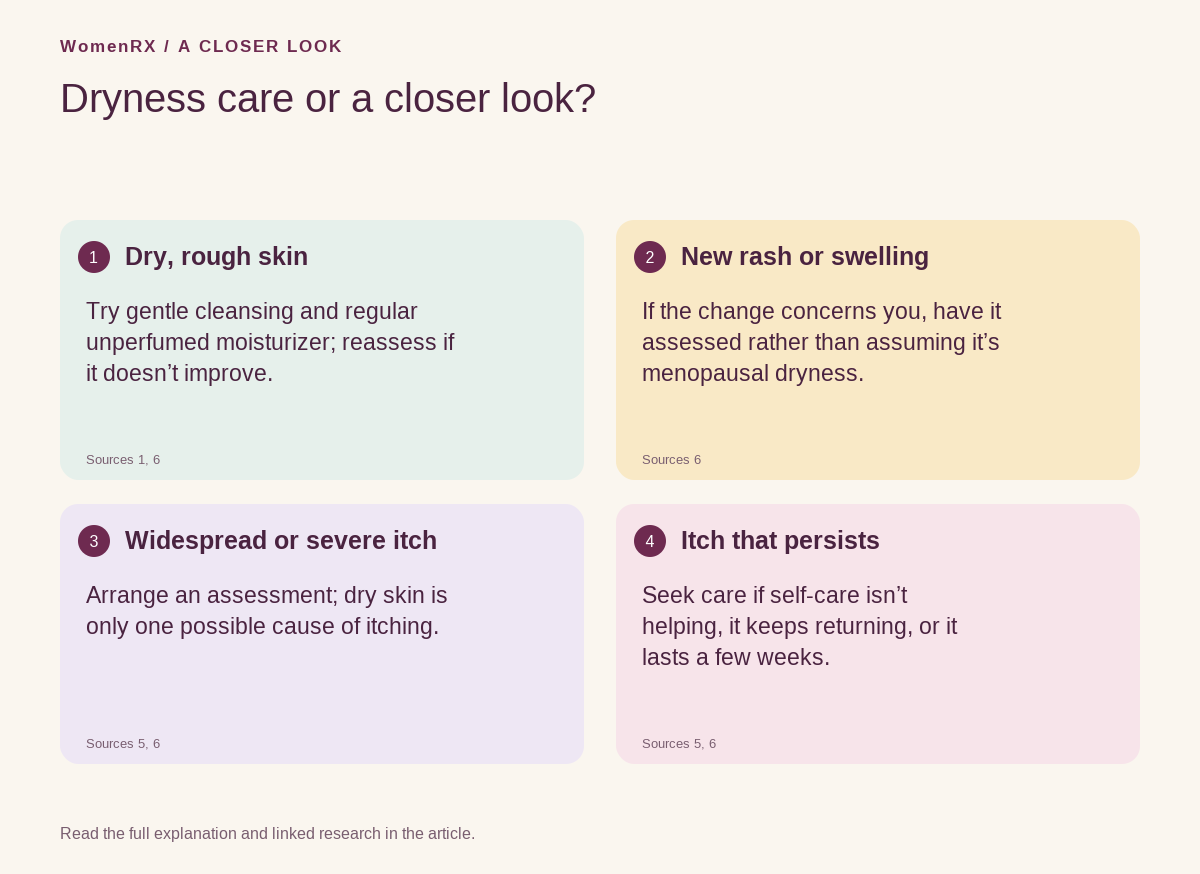
Dryness care or a closer look?
Dry, rough skin: Try gentle cleansing and regular unperfumed moisturizer; reassess if it doesn’t improve.16
New rash or swelling: If the change concerns you, have it assessed rather than assuming it’s menopausal dryness.6
Widespread or severe itch: Arrange an assessment; dry skin is only one possible cause of itching.56
Itch that persists: Seek care if self-care isn’t helping, it keeps returning, or it lasts a few weeks.56
Read the figure as text
The symptom pattern helps you decide whether to try basic skin care or arrange an assessment.- Dry, rough skin: Try gentle cleansing and regular unperfumed moisturizer; reassess if it doesn’t improve.16
- New rash or swelling: If the change concerns you, have it assessed rather than assuming it’s menopausal dryness.6
- Widespread or severe itch: Arrange an assessment; dry skin is only one possible cause of itching.56
- Itch that persists: Seek care if self-care isn’t helping, it keeps returning, or it lasts a few weeks.56
Sources you can check
- Promoting a Healthy Skin Barrier Using Skin Care in People With Mature Skin Xerosis.Gold M, Andriessen A, Burgess C, Callender V, Goldberg D, Hougeir F, Kircik L, Schlesinger T. · Journal of drugs in dermatology : JDD · 2024Return to first citation
- The 2022 hormone therapy position statement of The North American Menopause Society.“The 2022 Hormone Therapy Position Statement of The North American Menopause Society” Advisory Panel. · Menopause (New York, N.Y.) · 2022Return to first citation
- Managing Menopausal Skin Changes: A Narrative Review of Skin Quality Changes, Their Aesthetic Impact, and the Actual Role of Hormone Replacement Therapy in Improvement.Viscomi B, Muniz M, Sattler S. · Journal of cosmetic dermatology · 2025Return to first citation
- Calcium and Vitamin D Supplementation with and Without Collagen on Bone Density and Skin Elasticity in Menopausal Women-A Randomized Controlled Study.Duangjai A, Srivilai J, Nangola S, Amornlerdpison D. · Clinics and practice · 2025Return to first citation
- Itching | Pruritus | Itchy skin | MedlinePlusAccessed 2026-09-25Return to first citation
- Itchy skin - NHSAccessed 2026-09-25Return to first citation