Can Menopause Hormone Therapy Improve Dry Skin?
A small study found improved skin hydration with hormone therapy, but dry skin alone isn’t an established reason to start it.
Hormone therapy might improve skin hydration: a small pilot study found changes in measured skin moisture after treatment. But it doesn’t establish hormone therapy as a reliable treatment for bothersome dry skin. If dryness is your main concern, gentle cleansing and moisturizing are a more direct place to start. Systemic hormone therapy has better-established uses, including treating bothersome hot flashes. 413
If your skin feels drier around menopause, it’s reasonable to wonder whether changing hormone levels are involved. It’s also worth separating two questions: can hormone therapy affect skin, and is dry skin a good reason to start it? The evidence gives a more promising answer to the first than to the second. 43
What changed in the hormone-therapy study
In a six-month pilot study, 24 menopausal women were assigned to estrogen-only treatment, estrogen with progesterone, or no treatment. Researchers measured skin hydration, elasticity, thickness, and surface lipids. They reported improvements in average skin moisture, elasticity, and thickness in the hormone-treatment groups. 4
That finding is interesting, but the untreated group had only three women. The study cannot tell you how likely hormone therapy is to relieve the dry, uncomfortable feeling you may be noticing, or whether a possible skin benefit would justify treatment for you. Measured hydration and relief from bothersome dryness are related questions, not interchangeable outcomes. 4
Why the reason for treatment matters
Systemic menopause hormone therapy is an effective treatment for bothersome hot flashes and night sweats, and it has been shown to prevent bone loss and fractures. Its benefits and risks vary with factors including the treatment type, route, timing, and whether a progestogen is used. Dry skin on the face or body isn’t an established reason to start systemic therapy in the North American Menopause Society’s hormone-therapy position statement. 3
For example, if hot flashes are disrupting your sleep, hormone therapy may be a treatment worth discussing on that basis. You can mention your skin concerns too, without counting on a skin improvement as the reason to begin treatment. If dry skin is your only concern, the small pilot study doesn’t make a strong case for systemic hormone therapy. 34
Vaginal dryness is different from dry skin on your arms, legs, or face. It can be part of genitourinary syndrome of menopause. For bothersome symptoms that haven’t improved with over-the-counter options, the position statement recommends considering treatments such as low-dose vaginal estrogen when systemic hormone therapy isn’t otherwise indicated. That recommendation doesn’t extend to dry skin elsewhere on the body. 3
Give the skin barrier its own attention
Dryness that appears around menopause isn’t necessarily caused by menopause. A review of mature skin describes changes in the outer skin layer’s lipids with age and says genetic and environmental factors can also contribute. A separate review notes that dry skin can occur with diabetes. Neither point means you can identify the cause from dryness alone. 12
When dryness is the main problem, a gentle cleanser and moisturizer are a practical starting point. A review of mature-skin care reports that gentle cleansing and lipid-containing moisturizers, including ceramide-containing products, have helped reduce dryness and itching. This skin-care evidence isn’t specific to menopausal women, but it addresses the skin barrier directly rather than treating a possible cause on assumption. 1
Notice whether the dryness is widespread or confined to one area, whether it itches, and whether it persists despite skin care. Those details can help guide a conversation about other explanations, particularly if you have diabetes or other health changes. The useful dividing line is simple: consider hormone therapy for an established menopause-related reason, not as a substitute for assessing and caring for dry skin itself. 23
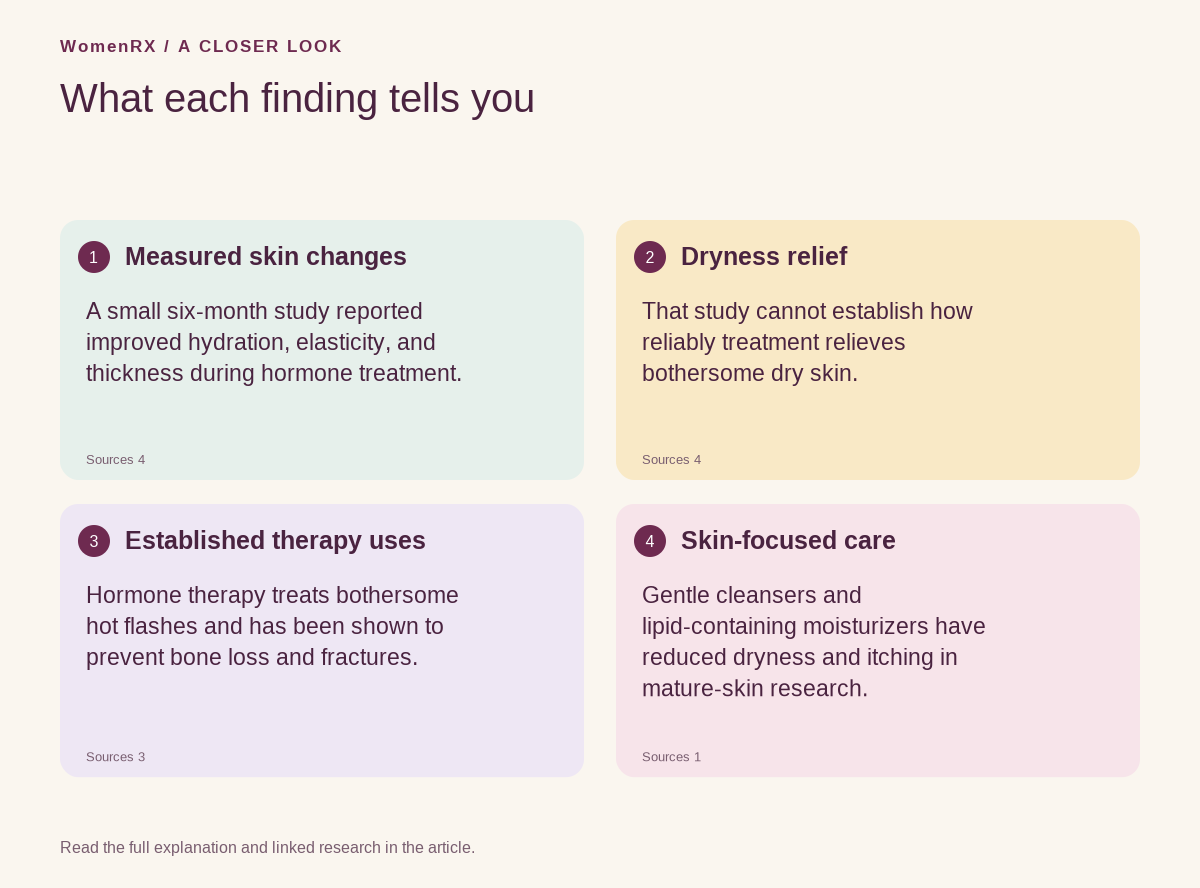
What each finding tells you
Measured skin changes: A small six-month study reported improved hydration, elasticity, and thickness during hormone treatment.4
Dryness relief: That study cannot establish how reliably treatment relieves bothersome dry skin.4
Established therapy uses: Hormone therapy treats bothersome hot flashes and has been shown to prevent bone loss and fractures.3
Skin-focused care: Gentle cleansers and lipid-containing moisturizers have reduced dryness and itching in mature-skin research.1
Read the figure as text
This evidence map separates a preliminary skin finding from established hormone-therapy uses and skin-focused care.- Measured skin changes: A small six-month study reported improved hydration, elasticity, and thickness during hormone treatment.4
- Dryness relief: That study cannot establish how reliably treatment relieves bothersome dry skin.4
- Established therapy uses: Hormone therapy treats bothersome hot flashes and has been shown to prevent bone loss and fractures.3
- Skin-focused care: Gentle cleansers and lipid-containing moisturizers have reduced dryness and itching in mature-skin research.1
More questions, answered
Would vaginal estrogen help dry skin on my face or body?
Low-dose vaginal estrogen is discussed as a treatment for certain genitourinary symptoms, including vaginal dryness. That is a separate concern from dry skin elsewhere, and the recommendation does not establish vaginal estrogen as a body-skin treatment. 3
Sources you can check
- Promoting a Healthy Skin Barrier Using Skin Care in People With Mature Skin Xerosis.Gold M, Andriessen A, Burgess C, Callender V, Goldberg D, Hougeir F, Kircik L, Schlesinger T. · Journal of drugs in dermatology : JDD · 2024Return to first citation
- Diabetic Skin Changes Can Benefit from Moisturizer and Cleanser Use: A ReviewKirsner RS, Yosipovitch G, Hu S, Andriessen A, Hanft JR, Kim PJ, Lavery L, Meneghini L, Ruotsi LC. · Journal of drugs in dermatology : JDD · 2019Return to first citation
- The 2022 hormone therapy position statement of The North American Menopause Society.“The 2022 Hormone Therapy Position Statement of The North American Menopause Society” Advisory Panel. · Menopause (New York, N.Y.) · 2022Return to first citation
- The influence of hormone replacement therapy on skin ageing: a pilot study.Sator PG, Schmidt JB, Sator MO, Huber JC, Hönigsmann H. · Maturitas · 2001Return to first citation