Can Menopause Hormone Therapy Improve Your Skin?
Hormone therapy may improve some measured skin features, but that doesn’t mean it reliably smooths visible wrinkles or is a good choice for skin alone.
Research suggests menopause hormone therapy can improve measured skin thickness, collagen content, and elasticity in some studies. Those changes haven’t consistently translated into fewer visible facial wrinkles: a four-year randomized trial found no significant wrinkle or skin-rigidity benefit. Because skin changes also reflect age, skin tone, and sun exposure, systemic hormone therapy isn’t recommended for a skin-only goal. 3 4 5
What studies measured, and what you might see
Estrogen levels fall during menopause, and estrogen loss can contribute to changes such as dryness, thinning, and reduced elasticity. But skin changes aren’t caused by menopause alone. Age and environmental exposure matter too, and solar radiation is a major contributor to visible skin aging. 2 5
A 2023 systematic review and meta-analysis combined 15 studies involving 1,589 menopausal women, ages 45 to 55. It found improvements in measured skin elasticity, thickness, and collagen content with hormone therapy. For dryness, the pooled result did not show a statistically significant change. These measures describe skin properties; they don’t tell you how noticeable or worthwhile a change would be to an individual woman. 3
The visible-outcome evidence is less reassuring. In a randomized, double-blind, placebo-controlled trial, recently menopausal women received oral estrogen, transdermal estradiol with progesterone, or placebo and were followed for four years. Researchers found no significant difference between groups in facial wrinkle scores or skin rigidity. 4
So the findings aren’t simply contradictory: some research reports changes in skin structure, while a well-designed trial did not find a clear improvement in the facial features people may notice most. A review of the broader research also describes mixed results and notes that clinical guidelines don’t support hormone therapy solely for estrogen-related skin changes. 2
Why systemic therapy isn’t a skin treatment
Systemic hormone therapy affects the body beyond the skin. Menopause guidance describes established uses such as treating bothersome hot flashes and preventing bone loss in appropriate women, with the balance of benefits and risks varying by age, time since menopause, treatment details, and personal health factors. It isn’t recommended for skin and hair concerns alone. 1 5
That makes the decision different from choosing care aimed directly at a skin concern. If wrinkles, dryness, or another change is your only reason for considering hormones, the available evidence doesn’t show a dependable cosmetic payoff that justifies starting systemic treatment for that purpose. A skin-focused discussion can instead help identify which concern you want to address and what options are appropriate for it. The research summarized here does not compare particular moisturizers, sun-protection products, or dermatologic treatments, so it can’t establish which one will work best for you.
If you’re considering hormone therapy for another reason, skin findings may be part of the conversation, but they shouldn’t be treated as a promised benefit. The decision should center on the symptoms or health indication being treated and your individual benefit-risk balance. 1 2
A useful way to weigh the evidence
Think of the evidence in two columns: measurable skin properties and visible changes. Some pooled studies favor therapy for thickness, collagen, and elasticity; the trial that directly assessed facial wrinkles and rigidity did not find a significant benefit. Neither result guarantees what one person will see, and the studies don’t establish systemic hormones as a reliable cosmetic treatment. 3 4
Menopause may contribute to skin changes, but it isn’t the whole explanation. That distinction helps keep a skin-only concern in the skin-care conversation, while reserving systemic hormone therapy for a separate, well-supported reason to consider it.
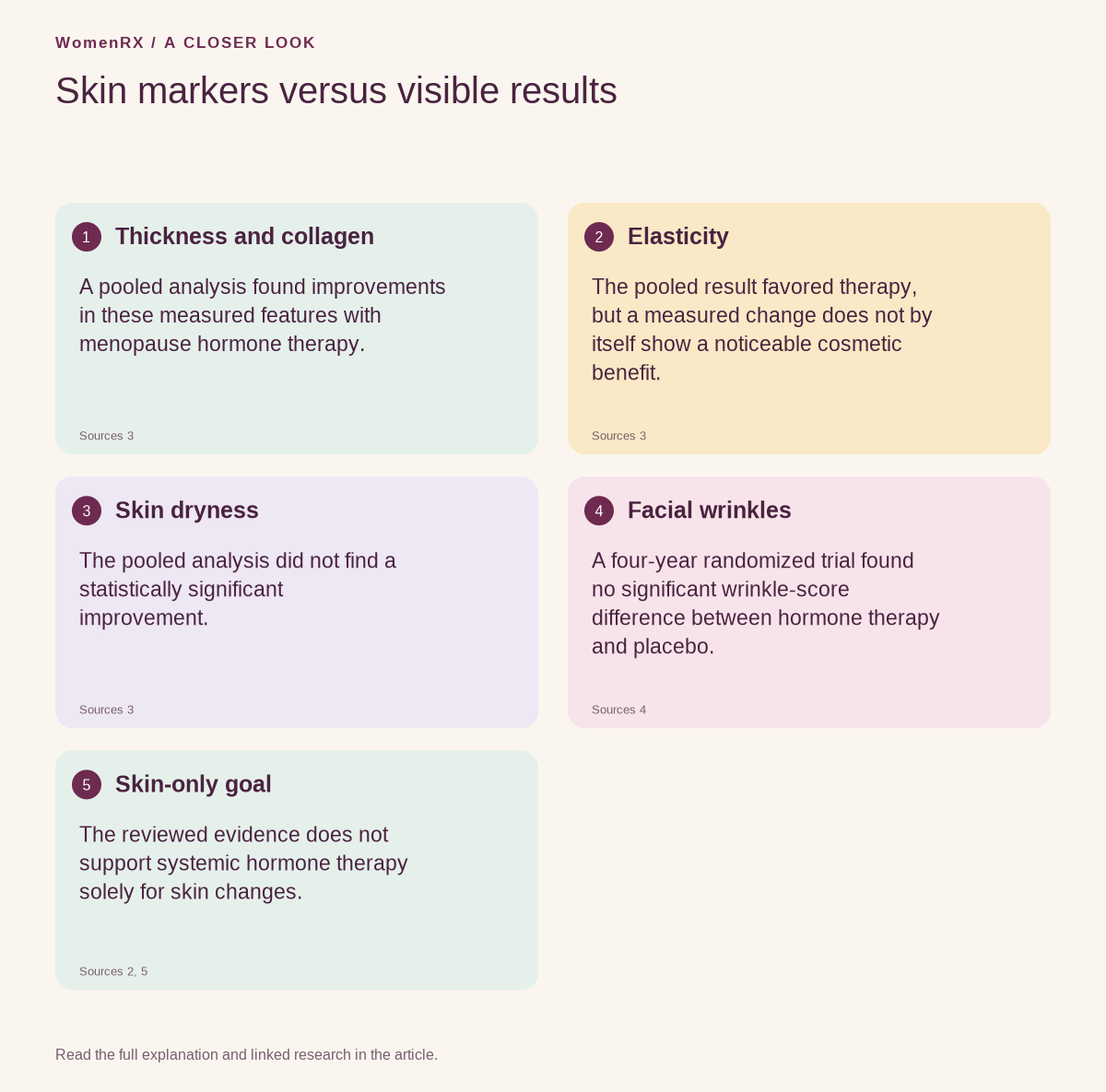
Skin markers versus visible results
Thickness and collagen: A pooled analysis found improvements in these measured features with menopause hormone therapy.3
Elasticity: The pooled result favored therapy, but a measured change does not by itself show a noticeable cosmetic benefit.3
Skin dryness: The pooled analysis did not find a statistically significant improvement.3
Facial wrinkles: A four-year randomized trial found no significant wrinkle-score difference between hormone therapy and placebo.4
Skin-only goal: The reviewed evidence does not support systemic hormone therapy solely for skin changes.25
Read the figure as text
Research has measured several kinds of skin change. Separating those outcomes helps explain why a change in a lab or device measurement doesn’t guarantee a visible cosmetic result.- Thickness and collagen: A pooled analysis found improvements in these measured features with menopause hormone therapy.3
- Elasticity: The pooled result favored therapy, but a measured change does not by itself show a noticeable cosmetic benefit.3
- Skin dryness: The pooled analysis did not find a statistically significant improvement.3
- Facial wrinkles: A four-year randomized trial found no significant wrinkle-score difference between hormone therapy and placebo.4
- Skin-only goal: The reviewed evidence does not support systemic hormone therapy solely for skin changes.25
More questions, answered
Does hormone therapy help with dry skin after menopause?
The pooled analysis did not find a statistically significant improvement in skin dryness, even though it found improvements in some other measured skin features. The evidence doesn’t establish systemic hormone therapy as a dependable treatment for dryness. 3
Does hormone therapy prevent facial wrinkles?
A four-year randomized trial found no significant difference in facial wrinkle scores between women assigned hormone therapy and those assigned placebo. That result doesn’t rule out every possible skin effect, but it does not support promising wrinkle prevention. 4
Sources you can check
- The 2022 hormone therapy position statement of The North American Menopause Society.“The 2022 Hormone Therapy Position Statement of The North American Menopause Society” Advisory Panel. · Menopause (New York, N.Y.) · 2022Return to first citation
- Managing Menopausal Skin Changes: A Narrative Review of Skin Quality Changes, Their Aesthetic Impact, and the Actual Role of Hormone Replacement Therapy in Improvement.Viscomi B, Muniz M, Sattler S. · Journal of cosmetic dermatology · 2025Return to first citation
- Skin Rejuvenation in Women using Menopausal Hormone Therapy: A Systematic Review and Meta-Analysis.Pivazyan L, Avetisyan J, Loshkareva M, Abdurakhmanova A. · Journal of menopausal medicine · 2023Return to first citation
- Effects of hormones on skin wrinkles and rigidity vary by race/ethnicity: four-year follow-up from the ancillary skin study of the Kronos Early Estrogen Prevention Study.Owen CM, Pal L, Mumford SL, Freeman R, Isaac B, McDonald L, Santoro N, Taylor HS, Wolff EF. · Fertility and sterility · 2016Return to first citation
- Skin, hair and beyond: the impact of menopause.Zouboulis CC, Blume-Peytavi U, Kosmadaki M, Roó E, Vexiau-Robert D, Kerob D, Goldstein SR. · Climacteric : the journal of the International Menopause Society · 2022Return to first citation