What Does Evidence Say About Estrogen and Skin Changes at Menopause?
Estrogen plays a role in skin structure, but skin changes alone aren’t an established reason to start menopausal hormone therapy.
Declining estrogen may contribute to changes in skin collagen, elasticity, and moisture around menopause, though it isn’t the only influence on skin aging. Studies of hormone therapy for skin have produced inconsistent results, and clinical guidance doesn’t support starting systemic hormone therapy for skin benefits alone. A patch is systemic treatment, not a local skin treatment. 4 6 1
Where estrogen fits in
If your skin feels drier or seems less firm around menopause, estrogen may be part of the explanation. Estrogen is involved in skin biology, and reviews link its decline with changes in collagen, elasticity, and moisture. Collagen helps give skin structure, while moisture and elasticity affect how it feels and responds when stretched. 4 6
That connection doesn’t tell you what caused a particular change in your skin. Skin also changes with age and external exposures. For example, dryness that becomes noticeable during the menopause transition and wrinkles that have developed over many years may not have the same explanation, even if you notice both now. Research on estrogen and skin supports a contribution, not a diagnosis based on timing. 4 6
A skin association is not a treatment result
The next question is whether replacing estrogen makes a meaningful difference to skin. A 2025 review found that studies of menopausal hormone therapy and skin often reported favorable associations, but their findings were sometimes inconsistent. It also found that robust skin-specific trials are lacking and that clinical guidelines do not support hormone therapy solely for estrogen-deficient skin. 4
That distinction matters if you’re weighing a prescription. The North American Menopause Society identifies hormone therapy as an effective treatment for hot flashes and other vasomotor symptoms and for genitourinary symptoms; it also prevents bone loss and fracture. Its benefits and risks depend on factors including treatment type, route, timing, and whether a progestogen is used. A hoped-for skin benefit doesn’t replace that broader decision. 2 4
What “on the skin” does and doesn’t mean
An estradiol patch sits on your skin, but it delivers estrogen as systemic menopausal hormone therapy. The skin is the route into the body, not the intended local treatment area. A US estradiol patch’s clinical study, for example, evaluated women with hot flashes rather than women seeking a facial skin treatment. 1
Estrogen used locally on the skin for a skin effect is a different idea. Reviews discuss possible effects of topical estrogen on skin quality, but that discussion does not establish a standard, reliably effective treatment for menopause-related facial or body skin changes. It should not be treated as interchangeable with a systemic patch. 7 4
Then there are cosmetic products described as “estrogen-like.” A study of one topical liquorice-root extract reported an improvement in a measure of dermal density after 56 days. That is a finding about a particular extract and measurement, not evidence that products using similar language reproduce the effect or reverse menopausal skin changes. The researchers called for further study of longer-term effects. 5
What about collagen supplements?
A six-month randomized study assigned menopausal women to placebo or different combinations of collagen, calcium, and vitamin D. It reported improvements in some hydration and elasticity measures in groups receiving collagen, while skin water loss did not significantly change in any group. This was a supplement study, not a test of estrogen replacement. Its findings can’t tell you whether your skin change is caused by low estrogen or whether systemic hormone therapy would help it. 3
The useful way to sort these options is by the question each one answers. Menopausal hormone therapy is a whole-body treatment with established menopause-related uses. Estrogen intended to act locally on skin and cosmetic ingredients need their own evidence for skin outcomes. A plausible estrogen connection is worth understanding, but it isn’t, by itself, a reason to start systemic treatment. 2 4 7
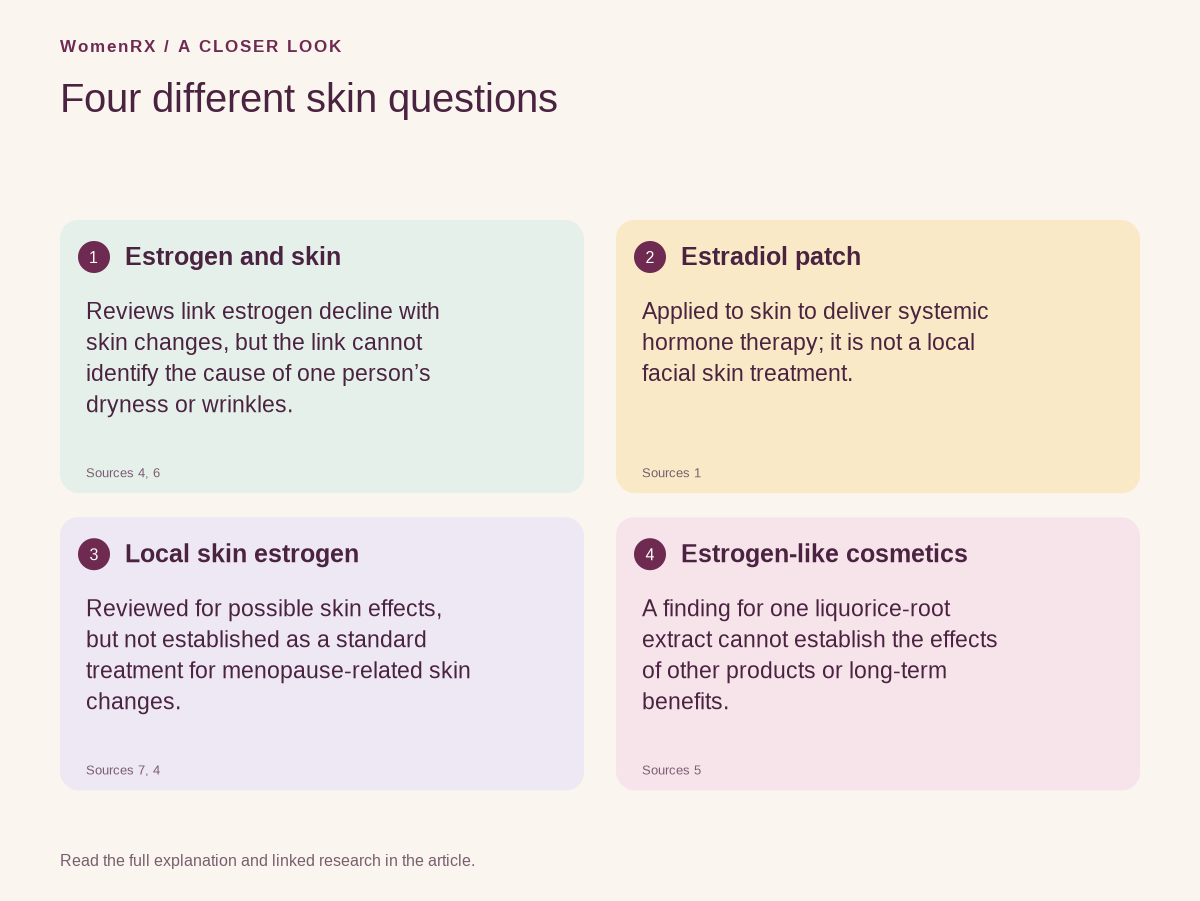
Four different skin questions
Estrogen and skin: Reviews link estrogen decline with skin changes, but the link cannot identify the cause of one person’s dryness or wrinkles.46
Estradiol patch: Applied to skin to deliver systemic hormone therapy; it is not a local facial skin treatment.1
Local skin estrogen: Reviewed for possible skin effects, but not established as a standard treatment for menopause-related skin changes.74
Estrogen-like cosmetics: A finding for one liquorice-root extract cannot establish the effects of other products or long-term benefits.5
Read the figure as text
Where a treatment is placed does not, by itself, tell you whether it acts locally or throughout the body.- Estrogen and skin: Reviews link estrogen decline with skin changes, but the link cannot identify the cause of one person’s dryness or wrinkles.46
- Estradiol patch: Applied to skin to deliver systemic hormone therapy; it is not a local facial skin treatment.1
- Local skin estrogen: Reviewed for possible skin effects, but not established as a standard treatment for menopause-related skin changes.74
- Estrogen-like cosmetics: A finding for one liquorice-root extract cannot establish the effects of other products or long-term benefits.5
More questions, answered
Is vaginal estrogen the same as an estrogen skin cream?
No. Low-dose vaginal estrogen is used for bothersome genitourinary symptoms of menopause when over-the-counter measures haven’t helped and systemic hormone therapy isn’t otherwise indicated. That recommendation does not establish vaginal estrogen as a treatment for facial or body skin changes. 2
Sources you can check
- CLIMARA (ESTRADIOL) PATCH [BAYER HEALTHCARE PHARMACEUTICALS INC.] | US prescribing information and patient instructionsAccessed 2026-09-25Return to first citation
- The 2022 hormone therapy position statement of The North American Menopause Society.“The 2022 Hormone Therapy Position Statement of The North American Menopause Society” Advisory Panel. · Menopause (New York, N.Y.) · 2022Return to first citation
- Calcium and Vitamin D Supplementation with and Without Collagen on Bone Density and Skin Elasticity in Menopausal Women-A Randomized Controlled Study.Duangjai A, Srivilai J, Nangola S, Amornlerdpison D. · Clinics and practice · 2025Return to first citation
- Managing Menopausal Skin Changes: A Narrative Review of Skin Quality Changes, Their Aesthetic Impact, and the Actual Role of Hormone Replacement Therapy in Improvement.Viscomi B, Muniz M, Sattler S. · Journal of cosmetic dermatology · 2025Return to first citation
- Phytoestrogens as Natural Anti-Aging Solutions for Enhanced Collagen Synthesis in Skin.Amini N, Osterlund C, Curpen J, Lafon-Kolb V, Richard T, Visdal-Johnsen L. · Journal of cosmetic dermatology · 2025Return to first citation
- Factors Influencing Skin Aging and the Important Role of Estrogens and Selective Estrogen Receptor Modulators (SERMs).Lephart ED, Naftolin F. · Clinical, cosmetic and investigational dermatology · 2022Return to first citation
- Menopause and the Skin: Old Favorites and New Innovations in Cosmeceuticals for Estrogen-Deficient Skin.Lephart ED, Naftolin F. · Dermatology and therapy · 2021Return to first citation