Can Menopause Hormone Therapy Improve Sexual Desire?
Hormone therapy may ease some barriers to sex, but the right option depends on whether the main change is desire, discomfort, or another menopause symptom.
Menopause hormone therapy can treat some symptoms that affect sex, but it isn’t a guaranteed way to increase desire. Local vaginal estrogen is used for menopause-related dryness and irritation, while systemic hormone therapy is the most effective treatment for hot flashes. Lower desire can have several influences, so separating it from pain, dryness, and other symptoms helps clarify which treatment discussion fits. 3 5 7
First, name what has changed
A drop in interest, less lubrication or arousal, discomfort during sex, and pain are different experiences, even when they overlap. Menopause-related sexual changes can involve several domains, including desire, arousal, orgasm, satisfaction, and pain. Biological changes may play a part, alongside emotional wellbeing and relationship factors. Medicines and chronic health conditions can also affect sexual health. 1 7
That distinction matters because a treatment aimed at vaginal symptoms isn’t necessarily a treatment for desire, and treating hot flashes doesn’t prove that desire will change.
When vaginal symptoms are getting in the way
Lower estrogen around and after menopause can contribute to vaginal dryness. Dryness may come with soreness or discomfort during sex, but not all pain has the same cause. 2
Local vaginal estrogen is used for menopause-related vaginal dryness and irritation. It acts mainly in the vagina and is different from systemic hormone therapy. It may help when these symptoms are making sex uncomfortable, but it isn’t a direct treatment for low desire or hot flashes. 3
For bothersome genitourinary symptoms of menopause that haven’t improved with over-the-counter options, the North American Menopause Society recommends considering low-dose vaginal estrogen or other treatments for those symptoms when systemic hormone therapy isn’t otherwise indicated. 5
Lubricants or vaginal moisturizers are also options to discuss for dryness. If there’s bleeding after sex or bleeding after menopause, don’t assume dryness explains it; get it assessed. 2 4
When hot flashes are part of the picture
Systemic hormone therapy is the most effective treatment for menopause-related hot flashes and night sweats. That may make it relevant if vasomotor symptoms are the main concern, but its effectiveness for hot flashes isn’t evidence that it reliably restores sexual desire. The benefits and risks of systemic therapy vary with factors such as treatment type, route, timing, and use of a progestogen, so the decision is individualized. 5
If vaginal discomfort is the main issue and you don’t have another reason to use systemic therapy, the discussion may instead focus on treatment aimed at vaginal symptoms. Local and systemic therapy aren’t interchangeable ways to address every menopause concern. 3 5
If desire itself is lower
If you’re comfortable during sex but want it less often, increasing or changing estrogen may not answer the whole question. Desire can be affected by physical health, medicines, emotional wellbeing, and relationship dynamics, as well as menopause-related changes. 1 7
Evidence from women who had preventive surgery to remove their ovaries is limited as a guide to typical perimenopause or postmenopause. In a systematic review of that specific group, only a few studies reported significant improvement in sexual function with menopause hormone therapy, and none of the included studies was rated high quality. The findings don’t establish that hormone therapy reliably improves desire for women generally. 6
A useful starting point is to describe the change in plain terms: Is interest lower, is your body less comfortable or responsive, or is pain making sex less appealing? If several things have shifted, naming them separately can help focus the conversation on what each treatment is meant to address, rather than changing systemic therapy to try to solve everything at once. 7
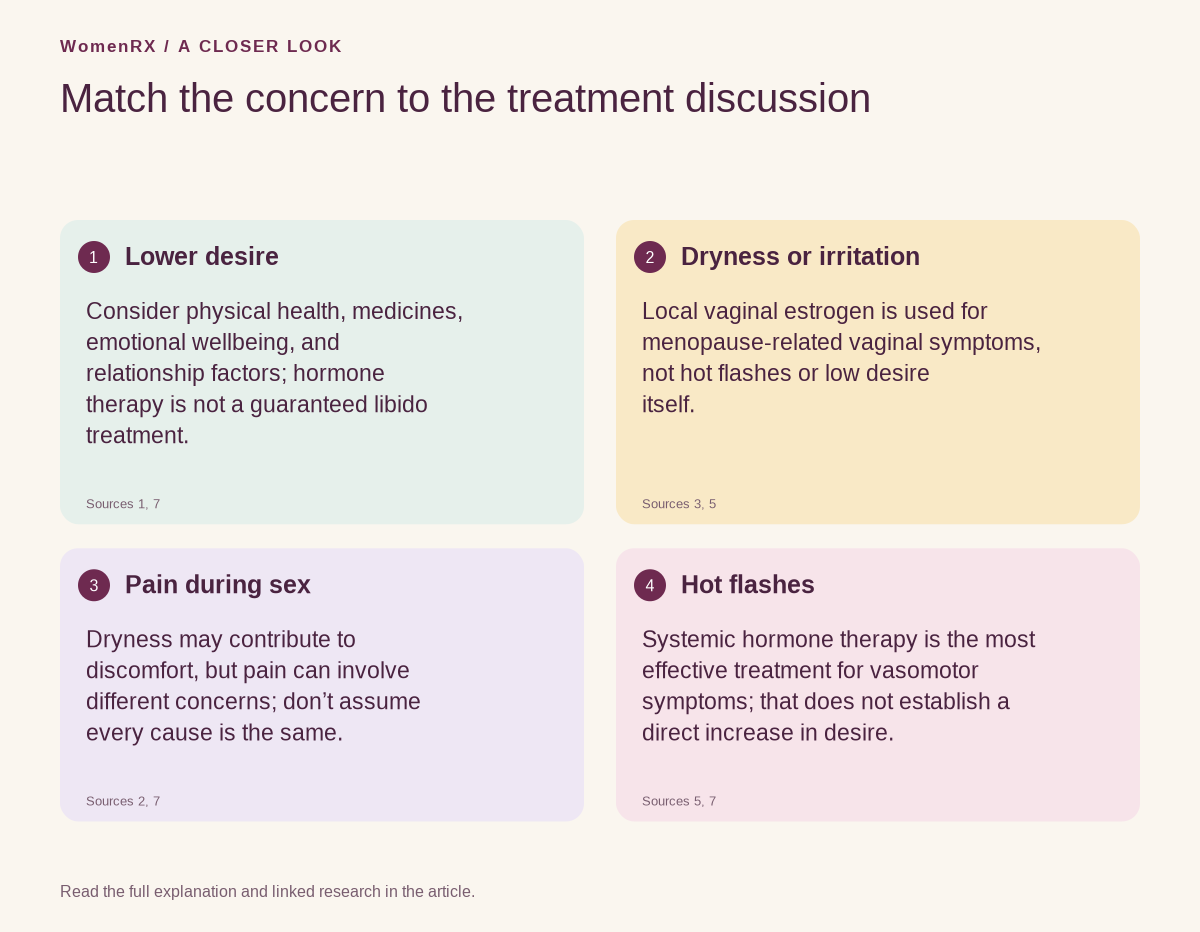
Match the concern to the treatment discussion
Lower desire: Consider physical health, medicines, emotional wellbeing, and relationship factors; hormone therapy is not a guaranteed libido treatment.17
Dryness or irritation: Local vaginal estrogen is used for menopause-related vaginal symptoms, not hot flashes or low desire itself.35
Pain during sex: Dryness may contribute to discomfort, but pain can involve different concerns; don’t assume every cause is the same.27
Hot flashes: Systemic hormone therapy is the most effective treatment for vasomotor symptoms; that does not establish a direct increase in desire.57
Read the figure as text
Different menopause-related changes call for different questions. This comparison distinguishes the concerns local or systemic hormone therapy may address from a direct desire benefit that isn’t established.- Lower desire: Consider physical health, medicines, emotional wellbeing, and relationship factors; hormone therapy is not a guaranteed libido treatment.17
- Dryness or irritation: Local vaginal estrogen is used for menopause-related vaginal symptoms, not hot flashes or low desire itself.35
- Pain during sex: Dryness may contribute to discomfort, but pain can involve different concerns; don’t assume every cause is the same.27
- Hot flashes: Systemic hormone therapy is the most effective treatment for vasomotor symptoms; that does not establish a direct increase in desire.57
More questions, answered
Does vaginal estrogen treat low desire?
It is used for menopause-related vaginal dryness and irritation, not as a direct treatment for low desire. If discomfort has made sex less appealing, easing that symptom may remove one barrier, but desire can have other influences too. 3 7
Does systemic hormone therapy help with hot flashes?
Yes. The North American Menopause Society identifies hormone therapy as the most effective treatment for vasomotor symptoms such as hot flashes. That benefit is separate from whether it changes sexual desire. 5
Sources you can check
- Sexual Health | MedlinePlusAccessed 2026-09-25Return to first citation
- Vaginal dryness - NHSAccessed 2026-09-25Return to first citation
- About vaginal oestrogen - NHSAccessed 2026-09-25Return to first citation
- Common questions about vaginal oestrogen - NHSAccessed 2026-09-25Return to first citation
- The 2022 hormone therapy position statement of The North American Menopause Society.“The 2022 Hormone Therapy Position Statement of The North American Menopause Society” Advisory Panel. · Menopause (New York, N.Y.) · 2022Return to first citation
- Prophylactic mastectomy and bilateral salpingo-oophorectomy in patients with breast cancer: a systematic review of postsurgical sexual function and menopausal hormone therapy symptom mitigation.Morgan O, Belda R, Schnur J, Montgomery G, Parmar S, Chirivella I, Cano A. · Sexual medicine reviews · 2023Return to first citation
- Sexual Function Through Menopause: A Review of Basic Evaluation and Treatment.Pope R. · BJOG : an international journal of obstetrics and gynaecology · 2025Return to first citation