How to Start Retinol Without Overdoing It
Retinol may improve some signs of sun damage, but a cautious start depends on your goal, skin sensitivity, and the products you already use.
If you’re considering retinol for visible sun damage, check your current products, introduce one formula, and follow its label while keeping the rest of your routine familiar. NHS acne guidance names tretinoin and adapalene as treatments; don’t assume cosmetic retinol serves the same role. Formula and skin sensitivity affect irritation, so there’s no universal schedule. Set it aside if discomfort persists. 2 4 7
Retinol has a reasonable place in a routine for visible sun damage, but the best first step isn’t deciding how often to apply it. It’s checking whether the product fits your goal and whether your skin has room for something that may irritate it.
Decide what you want it to do
For photoaging, there is evidence that a retinol cream can improve the appearance of wrinkles. In a 26-week study of middle-aged Japanese women, 54 participants completed treatment with 0.075% retinol cream on one side of the face and a cream without retinol on the other. Fine-wrinkle improvement was reported on the retinol side in 27 of 54 participants, compared with 13 of 54 on the other side. Three of the 57 women who began the study withdrew because of irritation. That’s a useful sign of potential benefit, not a prediction for every retinol product or every face. 7
If your main concern is acne, make a different comparison. Tretinoin and adapalene are topical retinoids used to treat acne; research on a cosmetic retinol cream for wrinkles doesn’t show that it can take their place. Acne treatment also depends on severity. Painful nodules, cysts, scarring, or acne that hasn’t responded to over-the-counter treatment are reasons to seek acne-specific care rather than keep adding skin-care products. 2 1
Give your skin a simpler starting point
Check what you already use. Look at the ingredient names on your acne treatments and other active products before adding retinol. For example, a treatment may already contain adapalene, a retinoid. 2 Adding a separate retinol would make it harder to tell which product is causing irritation. Keeping other potentially irritating additions out of the routine at first is a practical way to make your skin’s response easier to read.
Consider any skin condition you’re already managing. If your skin is currently uncomfortable or you’re treating a skin condition, ask how retinol would fit with that care before adding it. Sensitive skin was less tolerant of topical retinoids in studies of healthy volunteers, but those studies don’t establish a starting approach for a particular skin condition. 4
Choose one formula. In randomized split-face studies involving 253 healthy volunteers, lower topical-retinoid concentrations were associated with less irritation. The particular retinoid, its formulation, and whether a person had sensitive skin also affected tolerability. Those studies don’t establish a universal starting schedule for cosmetic retinol or show that every cream is gentler than every gel. 4
Introduce it without changing everything else. Start with one retinol product, following its own label directions. Keep your other routine steps familiar rather than adding or switching several active products at once. That way, if your skin becomes uncomfortable, you have fewer new products to consider. Give your skin time to show how it’s responding before changing the routine again; the research doesn’t establish a single frequency that suits every retinol product and person.
Keep comfort in the plan. Retinoid-related irritation can include dryness, stinging, burning, and redness. A moisturizer may help make a routine more comfortable, although a large observational study of people already experiencing retinoid-related dermatitis couldn’t establish how much improvement was caused by the moisturizer-and-sunscreen product they used. Chronic ultraviolet exposure contributes to photoaging. Retinol is one possible product choice, not a complete answer to sun-related skin changes. 2 3 8
Let comfort guide your choice to continue. Mild irritation and stinging are recognized side effects of topical acne retinoids, and sensitive skin was less tolerant of topical retinoids in volunteer studies. The evidence doesn’t establish a single threshold for when irritation means you must stop. If your skin feels persistently uncomfortable, you can set the product aside rather than push through; if you’re unsure whether it suits your skin, ask for advice about that specific product before restarting. 2 4
Pregnancy and breastfeeding need separate answers
NHS guidance considers topical acne retinoids such as tretinoin and adapalene unsuitable during pregnancy because of concern about birth-defect risk. That guidance doesn’t give product-specific advice for cosmetic retinol. If you’re pregnant, setting aside cosmetic retinol is a precaution, not a conclusion that your particular product has been shown to cause harm. If you’re planning a pregnancy, ask about the product you use or want to use; the guidance does not specify preconception timing. 2
If you used a topical retinoid before realizing you were pregnant, try not to read the precaution as proof that harm occurred. A 2026 review of eight studies found no statistically significant association between first-trimester topical-retinoid exposure and major congenital malformations or spontaneous abortion. Its results were driven mainly by one large registry study, so the finding doesn’t establish that every product or exposure is risk-free. Let your pregnancy care clinician know what you used. 5
Breastfeeding is a separate question. Pregnancy findings don’t settle whether a particular cosmetic retinol product is appropriate while nursing. Check the exact product with a clinician who knows your breastfeeding situation rather than assuming the pregnancy guidance answers it.
Retinol studies of photoaging have included women, but they haven’t established that benefits differ between women and men or among cycling years, perimenopause, and postmenopause. Your skin’s current sensitivity and the formula in your hand are more useful starting considerations than a life-stage promise on the label. 6 7 4
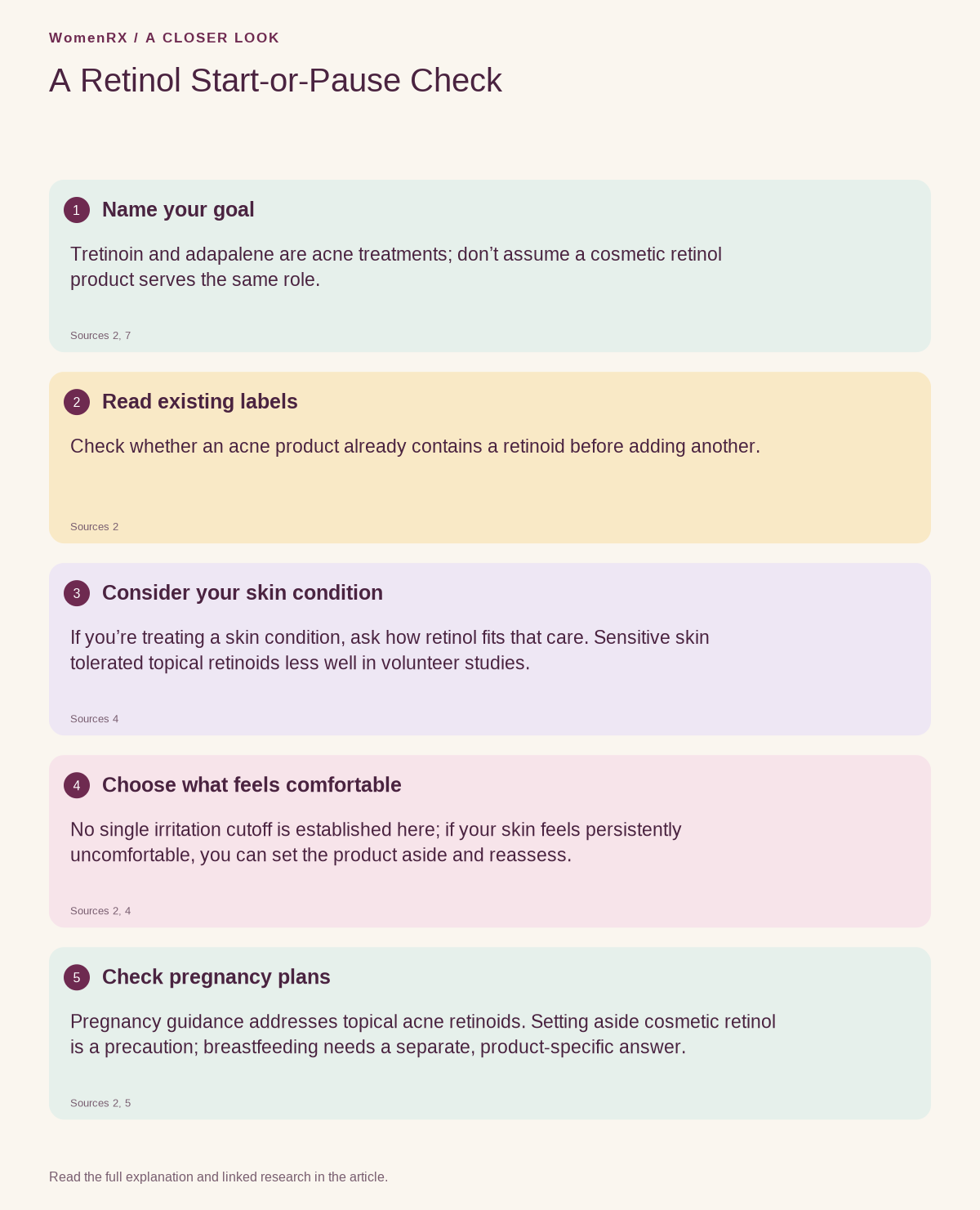
A Retinol Start-or-Pause Check
Name your goal: Tretinoin and adapalene are acne treatments; don’t assume a cosmetic retinol product serves the same role.27
Read existing labels: Check whether an acne product already contains a retinoid before adding another.2
Consider your skin condition: If you’re treating a skin condition, ask how retinol fits that care. Sensitive skin tolerated topical retinoids less well in volunteer studies.4
Choose what feels comfortable: No single irritation cutoff is established here; if your skin feels persistently uncomfortable, you can set the product aside and reassess.24
Check pregnancy plans: Pregnancy guidance addresses topical acne retinoids. Setting aside cosmetic retinol is a precaution; breastfeeding needs a separate, product-specific answer.25
Read the figure as text
Check the goal and your current routine before adding retinol, then use your skin’s response to make a comfortable choice about continuing.- Name your goal: Tretinoin and adapalene are acne treatments; don’t assume a cosmetic retinol product serves the same role.27
- Read existing labels: Check whether an acne product already contains a retinoid before adding another.2
- Consider your skin condition: If you’re treating a skin condition, ask how retinol fits that care. Sensitive skin tolerated topical retinoids less well in volunteer studies.4
- Choose what feels comfortable: No single irritation cutoff is established here; if your skin feels persistently uncomfortable, you can set the product aside and reassess.24
- Check pregnancy plans: Pregnancy guidance addresses topical acne retinoids. Setting aside cosmetic retinol is a precaution; breastfeeding needs a separate, product-specific answer.25
More questions, answered
Does stronger retinol mean better results?
Not necessarily for the product you’re choosing. Lower concentrations caused less irritation in studies of topical retinoids, while formulation and skin sensitivity also mattered. A retinol study showing wrinkle improvement tested a particular cream, not every concentration or formula. 4 7
Sources you can check
- Acne - NHSAccessed 2026-09-25Return to first citation
- Acne - Treatment - NHSAccessed 2026-09-25Return to first citation
- Real-World Evaluation of the Episoft® AC Moisturizer With Broad-Spectrum Sunscreen in the Management of Retinoid-Induced Dermatitis: A Retrospective Observational Study.Nakra G, Modi A, Hegde S, Bala S, Bhushan S, Dhoot D, Balasubramanian A, Bhosale P, Gadkari R, Patil S. · Cureus · 2026Return to first citation
- Facial tolerability of topical retinoid therapy.Leyden J, Grove G, Zerweck C. · Journal of drugs in dermatology : JDD · 2004Return to first citation
- Topical retinoids and risk of major congenital malformations and spontaneous abortion: a systematic review and meta-analysis.Alali AB, Alhammad FA, Almohammed Saleh JA, Alshaikh SB, Alshayeb ZK, Al Nujaidi AJ, Albinsaleh AA, Almutawah MR, Alhodibi MH, Albesher MA. · Frontiers in drug safety and regulation · 2026Return to first citation
- Efficacy and tolerability of a double-conjugated retinoid cream vs 1.0% retinol cream or 0.025% tretinoin cream in subjects with mild to severe photoaging.McDaniel DH, Mazur C, Wortzman MS, Nelson DB. · Journal of cosmetic dermatology · 2017Return to first citation
- Improvement of photoaged facial skin in middle-aged Japanese females by topical retinol (vitamin A alcohol): a vehicle-controlled, double-blind study.Kikuchi K, Suetake T, Kumasaka N, Tagami H. · The Journal of dermatological treatment · 2009Return to first citation
- An Innovative Serum With Retinol, Hydroxypinacolone Retinoate, Peptides, and Silybin Improves Mild Photoaged Facial Skin in Middle-Aged Chinese Women.Shen Y, Shi M, Ye Y, Xu C, Feng X, Bi T, Chen Y, Huang J, Li Y, Sun P. · Journal of cosmetic dermatology · 2026Return to first citation