Bakuchiol for Skin: How Strong Is the Evidence?
Bakuchiol has promising human research, but results from one formula don’t prove it matches retinol or predict how another product will feel on your skin.
Bakuchiol may help with some visible skin concerns, but many clinical trials test it alongside other ingredients, making the results hard to compare with retinoids. One short study reported no adverse events with a particular combination serum, but that doesn’t prove bakuchiol is gentler than retinol across products. Check the full formula and whether a claim comes from a study of that product. 12

The research is promising, but hard to compare
Bakuchiol is often marketed as a plant-based retinol alternative. That phrase can make the comparison sound settled. It isn’t: evidence that a product may improve skin doesn’t establish that bakuchiol works as well as retinol, or that every product containing it will have similar results.
A 2024 systematic review assessed 15 human clinical trials of topical bakuchiol formulations for concerns including skin aging, acne, and post-inflammatory hyperpigmentation. Twelve trials were unblinded and had no control group. Ten tested bakuchiol with other ingredients, and four did not report its concentration. Differences in study designs, formulas, and outcomes prevented the reviewers from combining the results in a meta-analysis. They also concluded that combination products made comparisons with retinoids difficult. 1
That distinction matters when you’re weighing a product claim. If several ingredients are used together, a study can assess the tested formula, but it can’t show which ingredient caused a change. Even a result from one formula doesn’t establish that a different serum or cream will work the same way.
What one sensitive-skin study can tell you
A study in 34 people with sensitive skin in China tested a serum containing supramolecular bakuchiol and Terminalia chebula extract over 28 days. Researchers reported changes in several skin measurements and no adverse events during the study. Because it tested a combination product, it can’t isolate bakuchiol’s contribution. It also didn’t compare the serum with retinol, so it can’t show that bakuchiol is generally less irritating. 2
There’s a useful but narrow takeaway: that particular serum was used for 28 days by people with sensitive skin, with no adverse events reported. The finding doesn’t predict how your skin will respond to a different formula.
Retinoids can cause redness, itching, peeling, stinging, or burning. The human bakuchiol research reviewed so far doesn’t establish that bakuchiol causes fewer of these effects across products or for any one person. 21
Read the label as a description of one formula
When a product promises “retinol-like” results, look beyond that phrase:
- Check the full ingredient list. Is bakuchiol paired with other ingredients promoted for skin benefits? A result from a combination formula can’t be credited to bakuchiol alone. 1
- Look for a stated concentration. Some trials didn’t report how much bakuchiol their formulas contained, making those results harder to compare. A percentage on a label provides useful detail, but it doesn’t prove that the product was clinically tested or performs like retinol. 1
- Ask what was actually tested. Evidence about an ingredient or a different combination formula isn’t product-specific proof. For example, results from the 28-day bakuchiol-and-Terminalia serum study don’t automatically apply to a cream with a different formula. 2
- Separate “alternative” from “equivalent.” A product can be offered as another option without having been shown to deliver equal results or cause less irritation than retinol. The review found that limitations in the human trials made comparisons with retinoids difficult. 1
The practical rule: judge the formula on the label and the study behind the claim, not just the ingredient name.
Pregnancy and breastfeeding remain open questions
The clinical findings discussed here don’t establish whether topical bakuchiol is safe during pregnancy or breastfeeding. “Plant-derived” isn’t evidence of safety in either situation. If you’re considering a bakuchiol product while pregnant or breastfeeding, bring the specific ingredient list to your obstetric clinician or dermatologist rather than relying on a retinol-alternative claim. 12
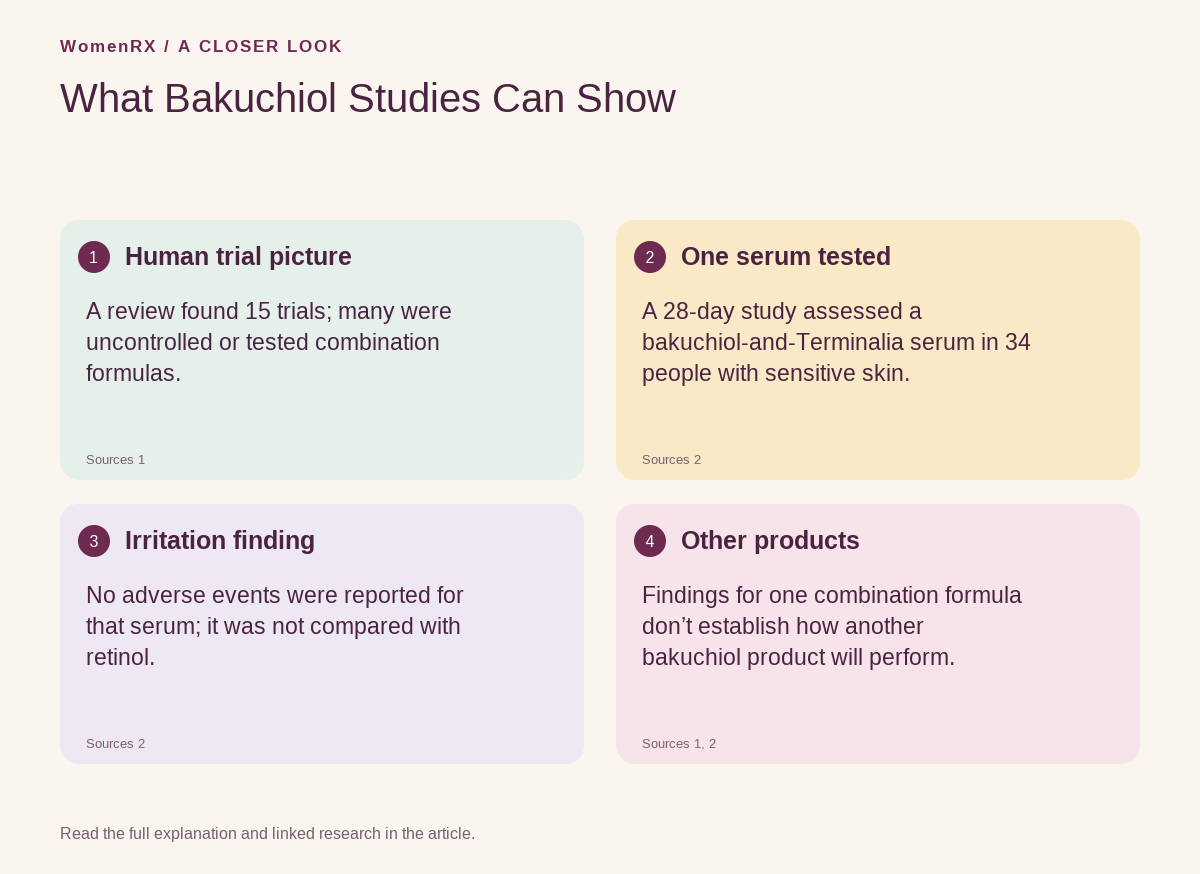
What Bakuchiol Studies Can Show
Human trial picture: A review found 15 trials; many were uncontrolled or tested combination formulas.1
One serum tested: A 28-day study assessed a bakuchiol-and-Terminalia serum in 34 people with sensitive skin.2
Irritation finding: No adverse events were reported for that serum; it was not compared with retinol.2
Other products: Findings for one combination formula don’t establish how another bakuchiol product will perform.12
Read the figure as text
An evidence map separating broader trial limitations from findings about one combination serum.- Human trial picture: A review found 15 trials; many were uncontrolled or tested combination formulas.1
- One serum tested: A 28-day study assessed a bakuchiol-and-Terminalia serum in 34 people with sensitive skin.2
- Irritation finding: No adverse events were reported for that serum; it was not compared with retinol.2
- Other products: Findings for one combination formula don’t establish how another bakuchiol product will perform.12
More questions, answered
Does bakuchiol work as well as retinol?
That hasn’t been established across products. A systematic review found that varied study designs and combination formulas limited meaningful comparisons with retinoids. 1
Does bakuchiol cause less irritation?
That hasn’t been established across products. One 28-day study reported no adverse events with a serum combining bakuchiol and Terminalia chebula, but it didn’t compare that serum with retinol or test bakuchiol alone. 2
Sources you can check
- Human Clinical Trials Using Topical Bakuchiol Formulations for the Treatment of Skin Disorders: A Systematic Review.Fanning JE, McGee SA, Ibrahim OI. · Journal of drugs in dermatology : JDD · 2024Return to first citation
- Prospective, Randomized, Double-Blind Assessment of Supramolecular Bakuchiol and Terminalia Chebula Extract for Facial Photoaging in Chinese Sensitive Skin Population.Shi X, Wang Y, Zhang H, Zhang T. · Health science reports · 2025Return to first citation