Glycolic Acid for Texture and Tone: What to Expect
Glycolic acid can help smooth the skin’s surface, but the formula and your skin’s tolerance matter more than a promise on the label.
Glycolic acid is an exfoliating ingredient worth considering for rough surface texture. A short study found better exfoliation and brightness with one specific serum, not a guaranteed result from every product or a proven fix for dark spots. If you try it, choose a home-use product, follow its directions, and pause if burning or peeling persists. 1
Start with the concern you want to address
Glycolic acid is an alpha-hydroxy acid (AHA) that exfoliates the skin’s surface. If your skin feels rough or looks dull, that’s the most direct reason to consider it. In a two-week, randomized split-face study involving 37 people, a particular glycolic acid serum improved measured exfoliation, brightness, and texture compared with conventional formulations. The result tells us something about that formula over two weeks, not what to expect from every bottle labeled “glycolic acid.” 1
Uneven tone is a broader question. Looking brighter in a short study isn’t the same as showing that a product fades a particular dark spot. For example, acanthosis nigricans causes darkened, thickened patches, often on the neck or underarms. A review of seven small randomized trials found more modest results with glycolic acid peels than with some other treatments for that condition. Those trials used peels, so their findings shouldn’t be treated as a prediction for a home-use serum or for other kinds of discoloration. 3
For wrinkles and other signs of sun damage, there’s another distinction: a product regimen isn’t an ingredient acting alone. In a 12-week clinical comparison, both a glycolic-acid-containing AHA regimen and a polyhydroxy acid (PHA) regimen improved measures of photoaging. The study doesn’t isolate how much of the AHA regimen’s effect came from glycolic acid. 2
More exfoliation isn’t always better
A formula’s strength and acidity affect the irritation tradeoff. The glycolic serum study describes irritation, disruption of the skin barrier, and greater sensitivity to sunlight as concerns with AHAs at higher concentrations or very low pH. That’s a reason not to assume a stronger product will give you a better experience. 1
The 12-week regimen comparison offers a useful alternative if your priority is tolerability: the PHA regimen produced comparable improvement on most photoaging measures, while participants using the AHA regimen reported significantly more stinging and burning at both six and 12 weeks. That doesn’t mean every PHA product will suit sensitive skin, but it does show that tolerating glycolic acid isn’t a requirement for pursuing smoother-looking skin. 2
Peels deserve their own category. A review of chemical peels in people with skin of color noted the possibility of pigmentary complications and identified a report of burns from improper use. It also found that the relevant studies were few, small, and short. A professionally administered peel isn’t interchangeable with a home-use exfoliant, and peel results aren’t a reason to improvise with a stronger product at home. 4
How to give a home-use product a fair try
There’s no single starting concentration or schedule established by these studies for every home-use glycolic acid product. Choose one intended for home skincare and follow its directions. Testing it on a small area before using it more widely, then introducing it gradually, is a cautious approach rather than a clinically validated routine. If you’re adding glycolic acid to an existing routine, changing one exfoliating product at a time makes it easier to notice what your skin tolerates.
Pay attention to the difference between using a product and pushing through a reaction. If burning, redness, or peeling continues, pause and reassess rather than increasing use. Because some AHA formulas can increase sensitivity to sunlight, take the product’s sun-exposure directions seriously. 1
If you have eczema or another ongoing skin condition, the short serum study offers less reassurance than it might appear to: people with eczema, psoriasis, and acne were excluded. People who were pregnant or breastfeeding were excluded too, so that study cannot establish whether the serum is suitable during pregnancy or breastfeeding. These are limits of the study, not findings that the ingredient is either safe or unsafe for those groups. 1
The studies don’t establish a special benefit for women. Women made up the majority of participants in the acanthosis nigricans trials, but the review did not report treatment results separately for women and men. Your particular concern, the kind of product, and how your skin responds are more useful guides than a “for women” claim. 3
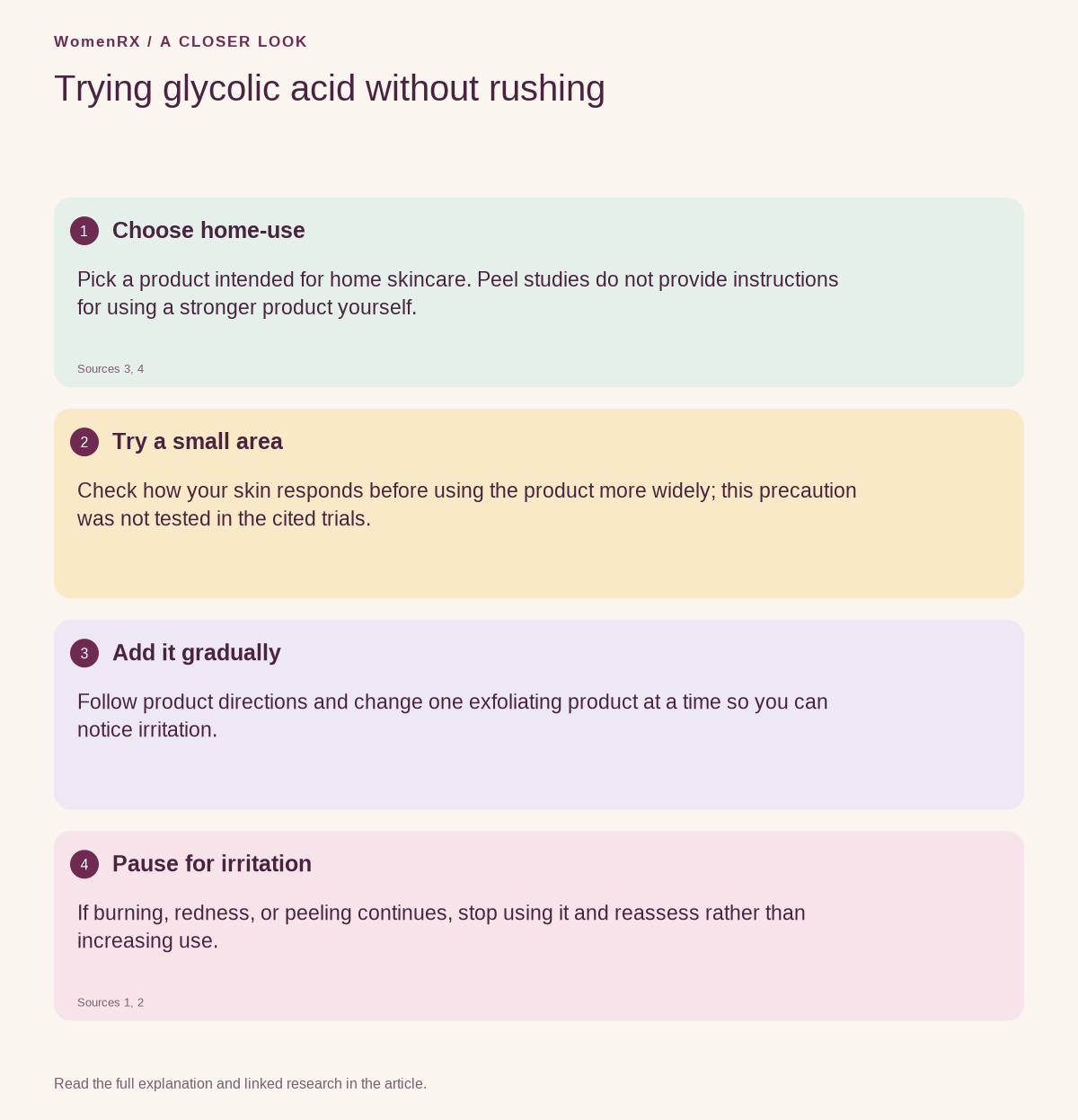
Trying glycolic acid without rushing
Choose home-use: Pick a product intended for home skincare. Peel studies do not provide instructions for using a stronger product yourself.34
Try a small area: Check how your skin responds before using the product more widely; this precaution was not tested in the cited trials.
Add it gradually: Follow product directions and change one exfoliating product at a time so you can notice irritation.
Pause for irritation: If burning, redness, or peeling continues, stop using it and reassess rather than increasing use.12
Read the figure as text
A cautious sequence for a home-use product, not a tested treatment schedule or diagnostic checklist.- Choose home-use: Pick a product intended for home skincare. Peel studies do not provide instructions for using a stronger product yourself.34
- Try a small area: Check how your skin responds before using the product more widely; this precaution was not tested in the cited trials.
- Add it gradually: Follow product directions and change one exfoliating product at a time so you can notice irritation.
- Pause for irritation: If burning, redness, or peeling continues, stop using it and reassess rather than increasing use.12
More questions, answered
Could glycolic acid make dark patches worse?
Irritation matters when discoloration is your concern. A review of chemical peels in skin of color noted pigmentary complications and a burn report linked to improper use, though those findings concern peels rather than all home-use products. If a product is persistently irritating your skin, pause instead of using more to chase a faster result. 4
Sources you can check
- Shake-Induced Temporary Ion-Pairing Between Lecithin and Glycolic Acid for Enhanced Exfoliation in a Novel Biphasic Serum: Comparative Ex Vivo and in Vivo Randomised Studies.Kwon KC, Kim MJ. · Skin research and technology : official journal of International Society for Bioengineering and the Skin (ISBS) [and] International Society for Digital Imaging of Skin (ISDIS) [and] International Society for Skin Imaging (ISSI) · 2026Return to first citation
- A polyhydroxy acid skin care regimen provides antiaging effects comparable to an alpha-hydroxyacid regimen.Edison BL, Green BA, Wildnauer RH, Sigler ML. · Cutis · 2004Return to first citation
- The efficacy of topical treatments for acanthosis nigricans: a systematic review of randomized controlled trials.Alamri A, Alraddadi RA, Alzahrani D, Abualola AH, Maaddawi HA, Alharthy RF, Alkhashan AY, Ashqan MY, Shaheen EA, Almahdi B, Althobaiti HM. · Frontiers in medicine · 2025Return to first citation
- Chemical Peels in Skin of Color: A Scoping Review of Safety, Efficacy, and Practice Patterns.Garelick E, Pohani P, Aswani A, Khan S, Chadha S, Patel T, Kebbe MB. · Cureus · 2026Return to first citation