How to Fit Azelaic Acid Into Your Routine
Start with your product’s directions, then keep cleansing and moisturizing simple while you learn how your skin responds.
Check the directions and full ingredient list on the azelaic acid product you have; strength alone won’t tell you how to use it. If you have particularly sensitive skin, NHS guidance describes once-daily use as an option, but follow your product’s directions and don’t change a prescribed routine without checking. Cleanse, pat dry, apply as directed, and follow the label if irritation develops. 1 2 4

Let your product set the frequency
Azelaic acid comes in different strengths and formulations, so don’t borrow an application schedule from someone else’s bottle. NHS acne guidance describes cream or gel as usually used twice daily, or once daily when skin is particularly sensitive. That gives you a cautious, lower-frequency starting option when it fits the product directions. Two US product labels also give morning-and-evening directions, but those instructions belong to those products. If your product’s directions don’t allow a gentler start, or it was prescribed, check with a pharmacist or prescriber before changing the schedule. 1 2 4
Read beyond the percentage on the front. For example, one 12% azelaic acid cream lists salicylic acid and fragrance; a different 10% cream lists lavender oil. If you’ve reacted to a skincare ingredient before, the full ingredient list matters. These examples don’t mean every azelaic acid product contains those extras. 1 2
Build the routine around the basics
For the products whose directions are cited here, the application order starts with cleansing and gently patting the face dry, then applying the cream as directed. If dryness is a problem, a fragrance-free, water-based moisturizer is an option in NHS acne guidance. A practical order is cleanse, dry, azelaic acid, then moisturizer. That last layering step is a simple way to organize a routine, not a tested order that’s required for every formulation. If your own label or prescription directions specify an order, use those. 1 2 3
In the daytime, choose a sunscreen or other skincare product that’s labeled noncomedogenic if acne-prone skin is a concern. Azelaic acid itself does not require avoiding sunlight because it makes skin sun-sensitive, according to NHS guidance. Remove makeup before bed rather than applying a treatment over it. 3 4
What about your other acne products? Check whether your azelaic acid formula already includes another active ingredient, such as the salicylic acid in the 12% cream example. If you also use benzoyl peroxide, a retinoid, or another prescribed treatment, don’t assume they all need to go on in the same step. Keep the existing treatment plan in view and ask the prescriber or pharmacist how the products should fit together if the directions aren’t clear. This is a practical way to avoid guessing at a routine, not evidence that a particular pairing is unsafe. 1 4
One 21-day study applied azelaic acid with nadifloxacin, a topical antibiotic, to test areas on 40 healthy volunteers and found no substantial intolerance compared with the products applied alone. It does not establish how azelaic acid works alongside every other acne treatment or in an everyday facial routine. 6
If it stings or dries you out
Local reactions can happen: in a randomized study of people with mild-to-moderate acne, 35.8% of those assigned to twice-daily 20% azelaic acid cream had an application-site reaction during treatment lasting up to 12 weeks. That finding describes that study’s product and schedule, not the odds of a reaction to yours. 5
A cautious start means choosing the lower frequency only when your product’s directions allow it. If irritation develops, check the label before deciding what to do: one cited product says to discontinue use if irritation occurs and to ask a doctor if it persists. Another says to stop and ask a doctor for significant facial swelling, a large area of red rash, intense itching, or intense burning. For a product that permits once-daily use when skin is particularly sensitive, NHS guidance supports that option; it does not override a label that says to stop when irritation occurs. 1 2 4
Give acne treatment time without increasing use beyond your directions. NHS guidance says improvement with azelaic acid usually takes about a month, and acne treatments can take several months overall. If you develop painful nodules or cysts, notice scarring, or acne is making you feel very low or anxious, seek care rather than trying to solve it by adding more products. 3 4
If you’re pregnant or breastfeeding, check how azelaic acid fits into your full acne treatment plan. One of the cited US product labels specifically advises asking a doctor before use during pregnancy or nursing; that label instruction isn’t a claim about every formulation. 2
Putting azelaic acid into a routine
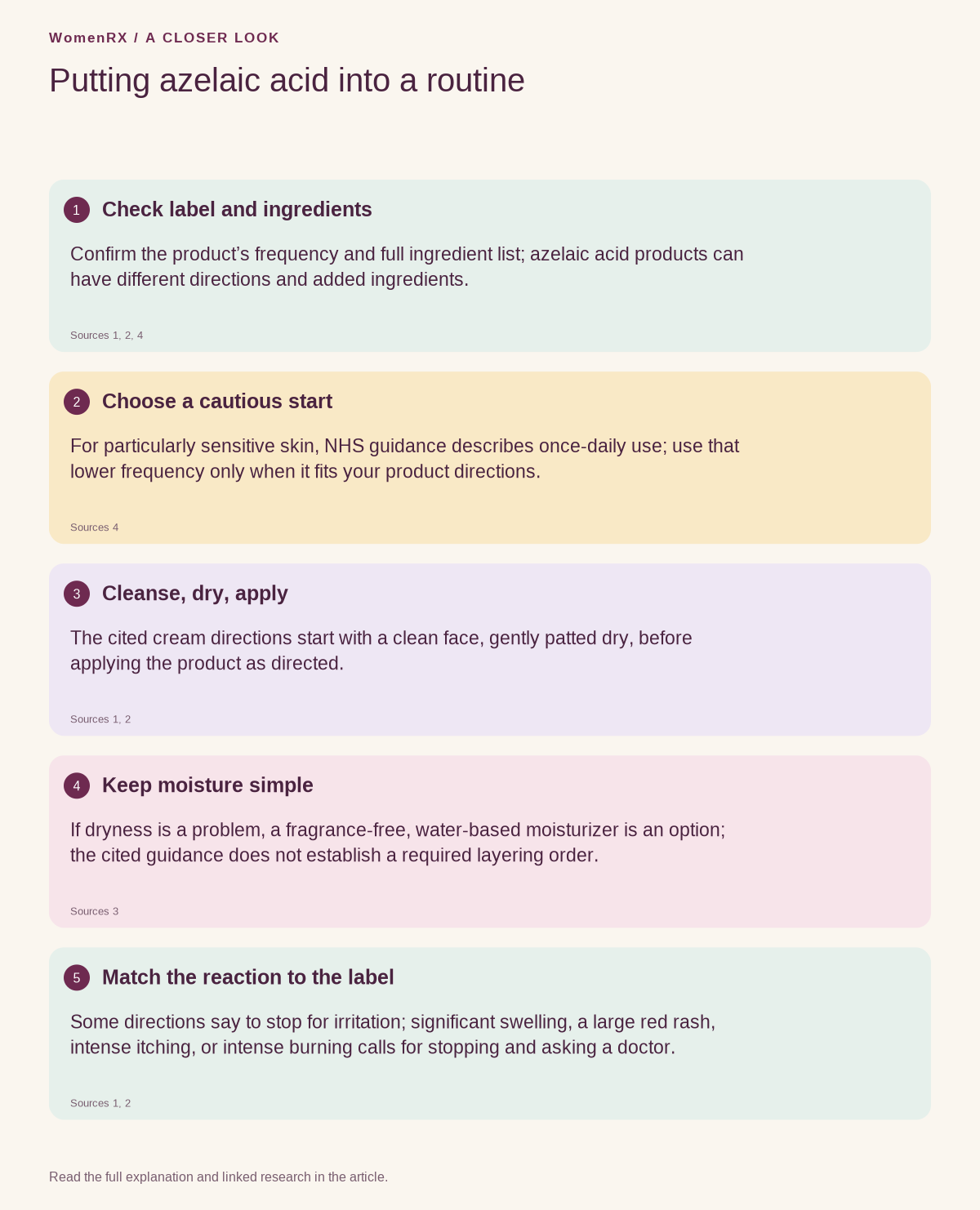
Check label and ingredients: Confirm the product’s frequency and full ingredient list; azelaic acid products can have different directions and added ingredients.124
Choose a cautious start: For particularly sensitive skin, NHS guidance describes once-daily use; use that lower frequency only when it fits your product directions.4
Cleanse, dry, apply: The cited cream directions start with a clean face, gently patted dry, before applying the product as directed.12
Keep moisture simple: If dryness is a problem, a fragrance-free, water-based moisturizer is an option; the cited guidance does not establish a required layering order.3
Match the reaction to the label: Some directions say to stop for irritation; significant swelling, a large red rash, intense itching, or intense burning calls for stopping and asking a doctor.12
Read the figure as text
A label-led sequence for introducing the product, layering basics, and responding to irritation without treating every formulation alike.- Check label and ingredients: Confirm the product’s frequency and full ingredient list; azelaic acid products can have different directions and added ingredients.124
- Choose a cautious start: For particularly sensitive skin, NHS guidance describes once-daily use; use that lower frequency only when it fits your product directions.4
- Cleanse, dry, apply: The cited cream directions start with a clean face, gently patted dry, before applying the product as directed.12
- Keep moisture simple: If dryness is a problem, a fragrance-free, water-based moisturizer is an option; the cited guidance does not establish a required layering order.3
- Match the reaction to the label: Some directions say to stop for irritation; significant swelling, a large red rash, intense itching, or intense burning calls for stopping and asking a doctor.12
Sources you can check
- BLOOMELLEE 12%GEL AZELAIC ACID ACNE (12%AZELAIC ACID) CREAM [SHENZHEN LANXI TRADING CO., LTD.] | US prescribing information and patient instructionsAccessed 2026-09-25Return to first citation
- 10% AZELAIC ACID (AZELAIC ACID CREAM) CREAM 14% AZELAIC ACID (AZELAIC ACID) CREAM [GUANGZHOU ARIEL MEDICAL TECHNOLOGY CO., LTD.] | US prescribing information and patient instructionsAccessed 2026-09-25Return to first citation
- Acne - NHSAccessed 2026-09-25Return to first citation
- Acne - Treatment - NHSAccessed 2026-09-25Return to first citation
- A multicentre, randomized, single-blind, parallel-group study comparing the efficacy and tolerability of benzoyl peroxide 3%/clindamycin 1% with azelaic acid 20% in the topical treatment of mild-to-moderate acne vulgaris.Schaller M, Sebastian M, Ress C, Seidel D, Hennig M. · Journal of the European Academy of Dermatology and Venereology : JEADV · 2016Return to first citation
- Lack of irritative potential of nadifloxacin 1% when combined with other topical anti-acne agents.Wilhelm KP, Wilhelm D, Neumeister C, Zsolt I, Schwantes U. · Clinical and experimental dermatology · 2012Return to first citation