Dark Patches on Skin: Match Treatment to the Cause
A mark left by acne calls for a different approach than recurring, symmetrical facial patches.
Dark patches can follow inflammation, develop as melasma, or have another cause. An acne mark calls for attention to the acne as well as the lingering pigment; symmetrical facial patches may call for a melasma-focused plan. Appearance alone can’t establish the cause. If patches appear during pregnancy, check whether a proposed treatment is suitable before using it. 247
Start with what happened before the patch appeared
A dark appearance alone doesn’t establish what caused it, or even whether excess pigment is responsible. The most useful first clue is the story around it: Did a mark remain where acne or eczema had been? Did broader patches develop on both sides of your face? Or is the pattern unclear? Clinicians sometimes use a close-up tool called a dermatoscope to help distinguish pigmentary conditions that are difficult to tell apart by sight alone. 24
A mark left where skin was inflamed may be post-inflammatory hyperpigmentation, or PIH. Acne is one common starting point; eczema, burns and aggressive skin treatments can also leave pigment behind. If new acne or irritation keeps appearing, treating only the old marks misses what’s creating new ones. A global expert consensus separates acne-related PIH from PIH after other inflammation when considering treatments. 4
Broad, roughly symmetrical facial patches fit the pattern described for melasma, a condition that can recur. Pregnancy is one possible trigger: changes in estrogen and progesterone are thought to play a role. But neither pregnancy timing nor symmetry confirms that an individual patch is melasma. 372
A patch that doesn’t fit either story deserves a closer look before you try to fade it. Pigmentary disorders include more than melasma and PIH, and some are clinically hard to distinguish. When the pattern is uncertain, an assessment can help distinguish the cause before you try to fade the patch. 24
What changes when the cause is PIH?
For PIH, the first treatment decision is whether the skin is still being inflamed. For example, if a facial mark follows repeated breakouts, a plan that addresses the acne has a different purpose from a product meant to fade the mark. If a patch followed an irritating peel or an eczema flare, adding another irritating treatment could work against your goal. The global consensus lists azelaic acid, topical retinoids and hydroquinone among options for acne-related PIH; it also lists hydroquinone and azelaic acid for PIH after other inflammatory conditions. These are treatment categories to match to the skin condition, not an interchangeable shopping list. 4
That distinction matters with tretinoin, a topical retinoid. Its cream label warns that it can cause substantial redness and peeling, particularly alongside drying or abrasive products, and reports temporary increases or decreases in pigment in some users. If your skin is already irritated, adding more active products is not necessarily a faster route to an even tone. 1
What changes when the pattern suggests melasma?
Melasma often needs a plan for both improvement and recurrence. Sun protection is a continuing part of management, not something to add only after a dark patch fades. Topical options discussed in clinical literature include hydroquinone, retinoids and combination formulas. Their suitability depends on the pigmentary condition and how well the skin tolerates them. That makes a targeted treatment conversation more useful than buying a strong lightener based on a photo or a product claim. 46
Procedures aren’t automatically the stronger choice. A systematic review of randomized and split-face studies found highly variable results for lasers used in melasma, with very low certainty for its overall primary outcome. The review also describes a risk of PIH from chemical peels, especially in darker skin tones. If you’re considering a peel or laser, the key question is how its potential benefit compares with irritation, further pigment change and recurrence for your skin. 6
If patches appeared during pregnancy, melasma is worth considering, but timing alone still doesn’t identify the cause. Melasma sometimes clears after birth and sometimes persists. Establish what you’re treating before choosing a product. If you’re pregnant, also check whether a proposed lightener or retinoid is suitable for use now with your prenatal care clinician or dermatologist. Don’t assume that an option discussed for melasma generally is appropriate during pregnancy. 726
Choose the next move, not just a product
If marks clearly follow breakouts or another recurring irritation, focus on stopping new inflammation and consider a PIH treatment that your skin can tolerate. If patches are broad and symmetrical, ask whether melasma fits and what an ongoing protection-and-treatment plan would involve. If the pattern is unclear, consider an assessment to distinguish the cause before escalating treatment. That pause can save you from treating the wrong condition with something that further irritates your skin. 241
Evidence also has limits that matter when choosing treatment. Expert guidance accounts for skin type, but dermatology research has broader gaps in representation across skin tones. The melasma laser review does not report treatment outcomes separately by sex in its summarized findings, so it cannot tell you whether women respond differently from men. For a treatment choice, the clearer distinctions here are the likely cause, your skin’s response to irritation and the possibility of recurrence. 456
Let the pattern guide the next step
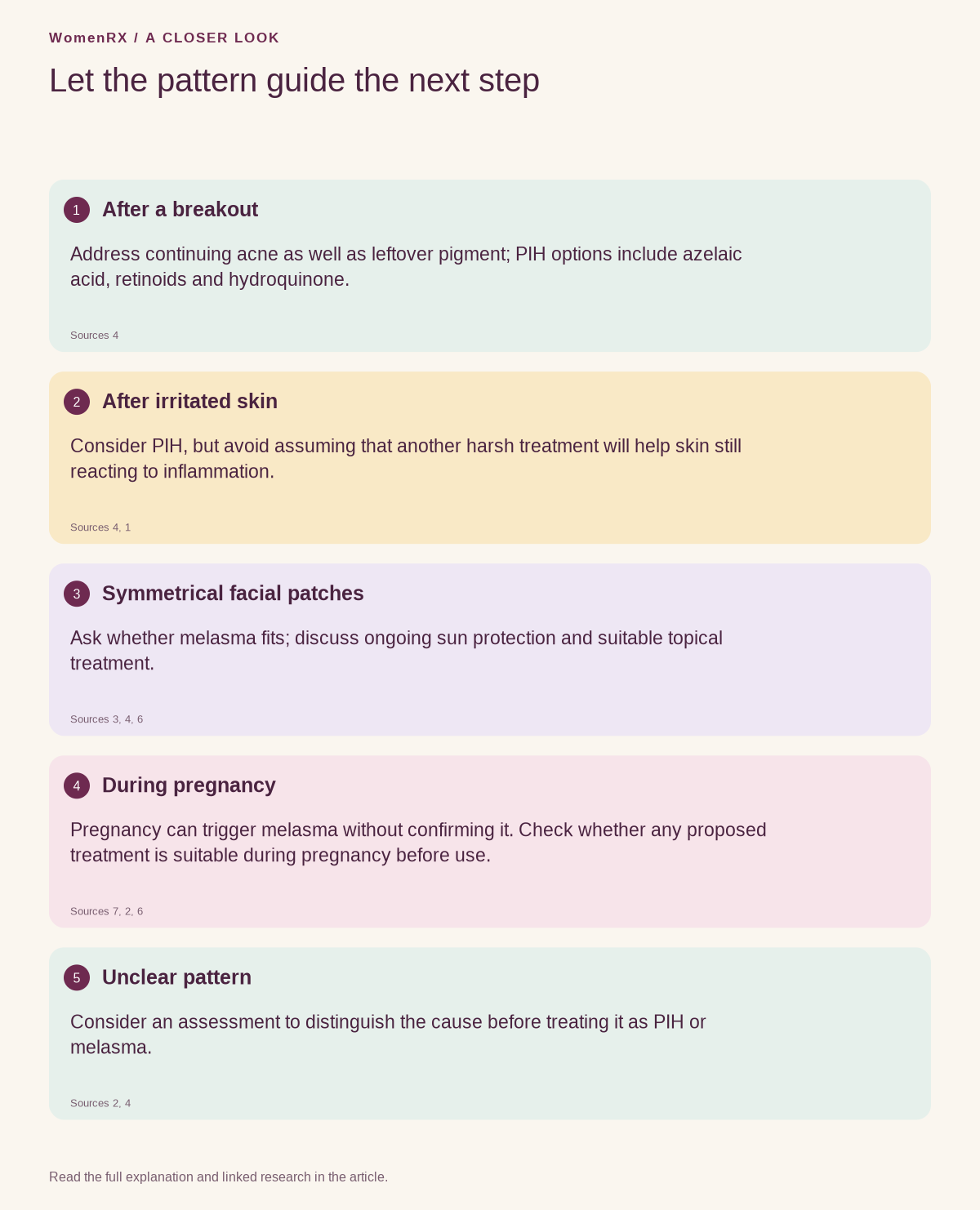
After a breakout: Address continuing acne as well as leftover pigment; PIH options include azelaic acid, retinoids and hydroquinone.4
After irritated skin: Consider PIH, but avoid assuming that another harsh treatment will help skin still reacting to inflammation.41
Symmetrical facial patches: Ask whether melasma fits; discuss ongoing sun protection and suitable topical treatment.346
During pregnancy: Pregnancy can trigger melasma without confirming it. Check whether any proposed treatment is suitable during pregnancy before use.726
Unclear pattern: Consider an assessment to distinguish the cause before treating it as PIH or melasma.24
Read the figure as text
These clues suggest different questions and treatment categories; they do not diagnose a dark area.- After a breakout: Address continuing acne as well as leftover pigment; PIH options include azelaic acid, retinoids and hydroquinone.4
- After irritated skin: Consider PIH, but avoid assuming that another harsh treatment will help skin still reacting to inflammation.41
- Symmetrical facial patches: Ask whether melasma fits; discuss ongoing sun protection and suitable topical treatment.346
- During pregnancy: Pregnancy can trigger melasma without confirming it. Check whether any proposed treatment is suitable during pregnancy before use.726
- Unclear pattern: Consider an assessment to distinguish the cause before treating it as PIH or melasma.24
More questions, answered
Could a peel make dark marks worse?
Yes. Irritation from an aggressive skin treatment can itself lead to PIH, and a review of melasma treatments describes PIH as a risk of chemical peels, particularly in darker skin tones. A peel is worth discussing in terms of both the pigment it might improve and the pigment it might trigger. 46
Sources you can check
- TRETINOIN CREAM [REDPHARM DRUG] | US prescribing information and patient instructionsAccessed 2026-09-25Return to first citation
- Dermoscopy of acquired pigmentary disorders: a comprehensive review.Krueger L, Saizan A, Stein JA, Elbuluk N. · International journal of dermatology · 2022Return to first citation
- Efficacy of natural products in the treatment of melasma: A systematic review.Morais MT, Gonçalves TLN, de Paula Soares L, Sato AFQ, Oliveira Júnior RG, Silva Almeida JRGD. · Biomedicine & pharmacotherapy = Biomedecine & pharmacotherapie · 2026Return to first citation
- Global consensus on the management of melanin hyperpigmentation disorders.Passeron T, Desai SR, Abdallah M, Al-Niaimi F, Dlova N, Grimes PE, Ocampo-Candiani J, Sarkar R, Xiang LF, Miot HA. · Journal of the European Academy of Dermatology and Venereology : JEADV · 2026Return to first citation
- International Expert Consensus on Knowledge Gaps in Care for Dermatologic Disorders in Skin of Color.Lim HW, Zhang C, Taylor M, Dlova NC, Conceição K, Jablonski N, Gupta N, Wangari-Olivero J, Alexis A. · International journal of dermatology · 2026Return to first citation
- Efficacy and Safety of Laser-Based Therapies for Melasma: A Systematic Review and Meta-Analysis.Aljoaib NN, Baltoyour A, Al-Sharif M, Salem HE, Alsharif SM, Alzahrani SJ, Alotbi TH, Maghazel RH, Alqarni OS, Alsayed SA, Alkhalagi RF, Najmi EA, Altowerki BA, Alluhaibi ST, Alreh... · Cureus · 2026Return to first citation
- Melasma: CausesAccessed 2026-09-25Return to first citation