Which Treatments Work for Melasma and Acne Marks?
Melasma and marks left by acne may look alike, but their treatment studies answer different questions.
If your patches are melasma, azelaic acid and hydroquinone have been compared in randomized trials; neither was clearly better across every measure. 6 For post-inflammatory hyperpigmentation, such as marks left by acne, a small study of a combination serum found improvement but couldn’t identify which ingredient helped. 7 Topical tretinoin can cause redness and peeling, so significant irritation is a tolerability concern, not proof that treatment irritation worsens pigmentation. 2
First, which kind of pigment is it?
Melasma commonly appears as symmetrical darker patches on sun-exposed areas of the face. Post-inflammatory hyperpigmentation, or PIH, is pigment that develops after inflammation or skin damage, such as acne. They can both leave you looking for a dark-spot treatment, but results from a melasma trial don’t automatically apply to an acne mark. 4 8
PIH follows inflammation, so avoiding unnecessary irritation is a sensible precaution. But tretinoin’s known redness and peeling don’t, by themselves, show that treatment-related irritation worsens pigmentation. Topical tretinoin, for example, can cause substantial local redness and peeling; its product information advises using it less frequently or temporarily stopping if irritation warrants it. That warning doesn’t establish whether tretinoin will improve a particular pigment pattern. 8 2
Melasma: two familiar ingredients have direct comparisons
Azelaic acid and hydroquinone are among the better-compared topical options for melasma. A review pooled six randomized trials involving 673 people with melasma. Azelaic acid showed a greater improvement than hydroquinone on the Melasma Area and Severity Index, a score combining the area and severity of patches. But the review found no significant difference on its other reported measures of response or pigment reduction, or in reported adverse events. Individual trials hadn’t all favored the same treatment. 6
So this isn’t a clean verdict that azelaic acid is better for everyone. It’s a reason to consider both the outcome being measured and how your skin tolerates a product. Another double-blind melasma trial compared cysteamine plus ectoine cream with hydroquinone plus ectoine cream. Both groups improved, without a statistically significant difference between them. Because each cream contained more than one ingredient, that trial can’t tell you what ectoine or either pigment-targeting ingredient would do alone. 5
Tranexamic acid injections have also been studied for melasma. A systematic review reports improvement in studies comparing injections with treatments including hydroquinone and lasers, but the review’s abstract doesn’t provide the study details needed to make injections a straightforward substitute for a topical option. 4 A discussion about injections is a different decision from choosing a cream.
Acne marks: promising findings, fewer clear comparisons
For PIH after acne, one 16-week study followed 30 women, half with acne-related PIH and half with melasma. They used a serum containing lotus sprout extract, tranexamic acid, and niacinamide. Both groups improved from their starting point. There was no untreated or alternative-treatment control group, though, and the formula contained three active ingredients. Improvement from baseline therefore can’t establish the serum’s effect, identify which ingredient helped, or show whether it works better than another treatment. 7
The participants included a substantial range of darker skin tones: 70% had Fitzpatrick skin types IV-VI, and 57% identified as Black or African American. That makes the findings more relevant to those groups than a study that didn’t include them, without proving the serum works equally well across all skin tones. 7
Oral tranexamic acid is a separate treatment, not a stronger version of that serum. A review describes studies of oral tranexamic acid for PIH, including PIH associated with laser and light procedures. Those findings don’t establish it as the preferred choice for an everyday acne mark. 8 Tranexamic acid taken by mouth also has considerations that a topical serum study can’t answer; guidance about its use for bleeding flags a potential increased clot risk when it is taken with a combined contraceptive pill. 3
How to use these distinctions
If you already know you have melasma, the azelaic acid-hydroquinone comparison gives you a starting point, not a guaranteed winner. If your marks followed acne, be wary of claims that a single ingredient in a combination serum is proven to erase them. And if the pigmentation doesn’t fit either pattern, don’t assume a treatment tested for melasma has been tested for yours. 6 7
Pregnancy or breastfeeding changes the safety question, too. These treatment comparisons don’t establish which pigment treatment is safest in either situation. In particular, topical tretinoin’s US product information says to speak with a physician before using it if you’re pregnant, think you might be pregnant, or are nursing. That topical-product advice shouldn’t be confused with warnings for oral tretinoin capsules, a different medicine used for leukemia. 2 1
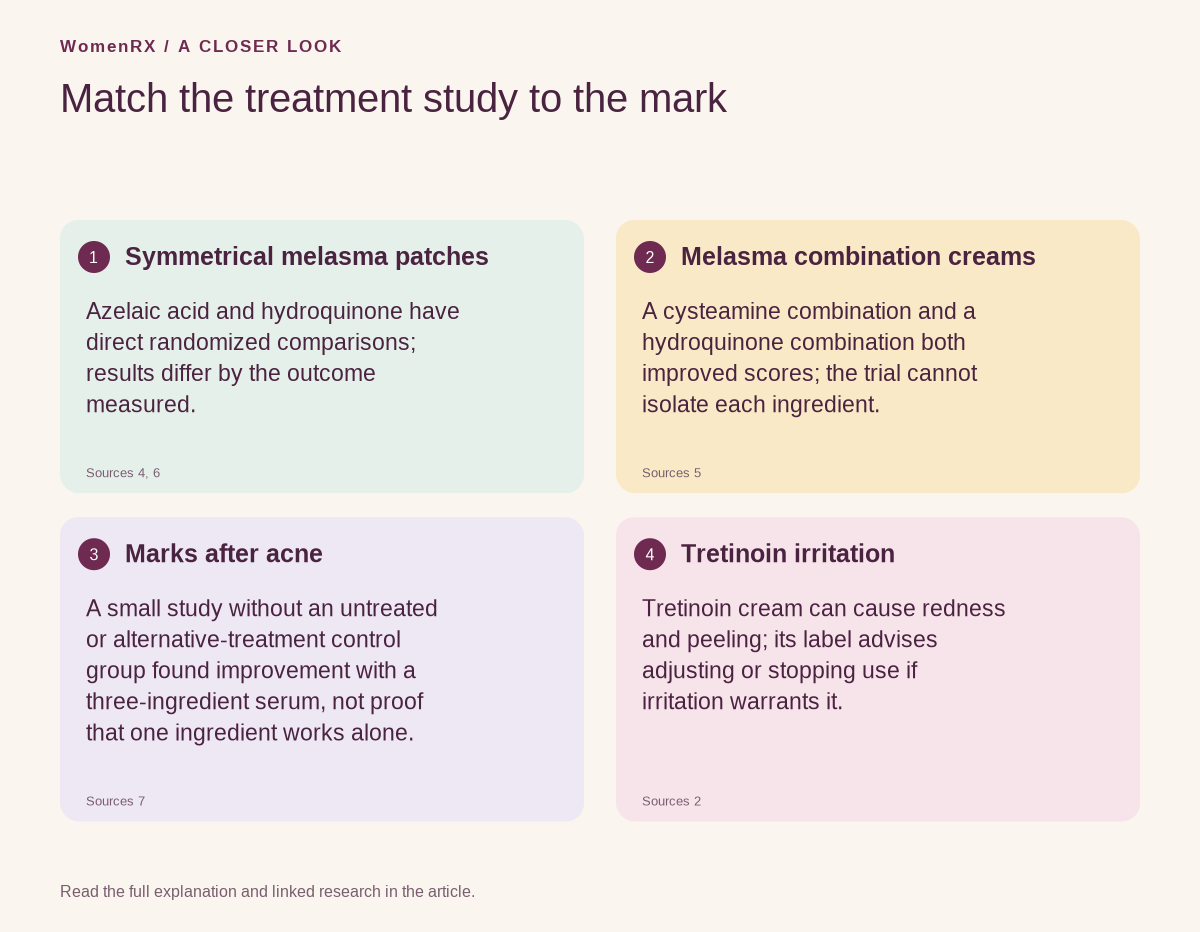
Match the treatment study to the mark
Symmetrical melasma patches: Azelaic acid and hydroquinone have direct randomized comparisons; results differ by the outcome measured.46
Melasma combination creams: A cysteamine combination and a hydroquinone combination both improved scores; the trial cannot isolate each ingredient.5
Marks after acne: A small study without an untreated or alternative-treatment control group found improvement with a three-ingredient serum, not proof that one ingredient works alone.7
Tretinoin irritation: Tretinoin cream can cause redness and peeling; its label advises adjusting or stopping use if irritation warrants it.2
Read the figure as text
Similar-looking dark areas can point to different research and different tolerability questions.- Symmetrical melasma patches: Azelaic acid and hydroquinone have direct randomized comparisons; results differ by the outcome measured.46
- Melasma combination creams: A cysteamine combination and a hydroquinone combination both improved scores; the trial cannot isolate each ingredient.5
- Marks after acne: A small study without an untreated or alternative-treatment control group found improvement with a three-ingredient serum, not proof that one ingredient works alone.7
- Tretinoin irritation: Tretinoin cream can cause redness and peeling; its label advises adjusting or stopping use if irritation warrants it.2
More questions, answered
Is tranexamic acid in a serum the same treatment as tranexamic acid tablets?
No. The PIH serum study tested a three-ingredient product applied to the skin; the oral tranexamic acid review examined medicine taken by mouth. Neither set of findings establishes the benefits or risks of the other route. 7 8
Sources you can check
- TRETINOIN CAPSULE [PAR HEALTH USA, LLC] | US prescribing information and patient instructionsAccessed 2026-09-25Return to first citation
- TRETINOIN CREAM [REDPHARM DRUG] | US prescribing information and patient instructionsAccessed 2026-09-25Return to first citation
- About tranexamic acid - NHSAccessed 2026-09-25Return to first citation
- Intradermal tranexamic acid and melasma: a systematic review and level of evidence.Piras M, Bigotto GD, Galadari H, Proietti I, DI Brizzi EV, Paganelli A, Nisticò SP, Mercuri SR, Zerbinati N, Mammucari M, Paolino G, Pellacani G, Longo C, Argenziano G, Rongioletti... · Italian journal of dermatology and venereology · 2026Return to first citation
- Efficacy of overnight leave-on sandwich therapy with 5% cysteamine and ectoine cream compared to hydroquinone 4% cream for treatment of melasma: a double-blind randomized controlled trial.Kusumawardani A, Murasmita A, Rosmarwati E, Norawati Ashadi L, Setiawan SV, Murlistyarini S, Wahyu Fitriyani N. · Acta dermatovenerologica Alpina, Pannonica, et Adriatica · 2025Return to first citation
- Azelaic Acid Versus Hydroquinone for Managing Patients With Melasma: Systematic Review and Meta-Analysis of Randomized Controlled Trials.Albzea W, AlRashidi R, Alkandari D, Sadan M, Alkandari A, Alkanderi JJ, AlHajri MT, Almutairi SN, Alenzi A, Alanazi S, Al-Qurashi S, Alhajaji R, Al Shami A. · Cureus · 2023Return to first citation
- Efficacy and Tolerability of a Topical Pigment-Correcting Serum in Melasma and Postinflammatory Hyperpigmentation.Grimes P, Dias S, Huang P, Cheng T, Makino E. · Journal of drugs in dermatology : JDD · 2026Return to first citation
- Oral Tranexamic Acid for Prevention and Treatment of Postinflammatory Hyperpigmentation.Minasyan M, Hogan S, Lal K. · Dermatologic surgery : official publication for American Society for Dermatologic Surgery [et al.] · 2024Return to first citation