Melasma: Triggers, Treatment Choices, and Recurrence
Sun exposure is a key contributor to melasma, while pregnancy, hormonal contraception, and other factors may also play a role.
Melasma often appears as symmetrical darker patches on the face. UV exposure is a key contributor; pregnancy-related hormonal changes, hormonal contraception, family history, and some medicines may also be relevant. Management usually pairs consistent UV protection with treatment chosen for your skin and circumstances. Patches can be difficult to treat, so it’s worth planning for follow-up rather than expecting a permanent fix. 2 4 5
Start with the patch, not the trigger
Melasma typically forms symmetrical patches of increased pigment on sun-exposed skin, especially the face. It can also appear on the neck and, less often, the upper limbs. It’s more common in women and people with darker skin tones, but men can have it too. 3 5
That familiar pattern is a clue, not a way to identify every dark patch yourself. If you’re unsure whether a patch fits this pattern, consider getting a clinician’s view before trying to fade it. That’s a cautious next step, not a diagnostic rule.
Why there may not be one clear cause
UV exposure is a major contributor to melasma. Pregnancy-related hormonal changes, hormonal contraception, family history, thyroid abnormalities, and some medicines, including anti-seizure medicines, may also be relevant. More than one factor can overlap, and the exact process isn’t fully understood. 2 3 4
An international survey of 324 women being treated for melasma illustrates why timing needs careful interpretation. Participants reported different times of onset: before pregnancy, during pregnancy, and after pregnancy. Some who had used hormonal contraception reported that patches first appeared after its use. Because this was a survey of women already receiving treatment and relied on their recollections, it cannot show that pregnancy or contraception caused any one person’s melasma. 2
If you noticed patches during pregnancy or after a contraception change, that timing is useful to share when discussing care. It doesn’t mean you need to identify a single culprit before you can address the patches.
Give UV protection its own job
Consistent protection against UV exposure is a prevention principle for melasma. It addresses an ongoing contributor whether you’re considering pigment treatment or already using one. 5
Think of protection and treatment as doing different jobs. Reducing UV exposure helps limit a factor that can worsen melasma; a pigment treatment aims to improve patches that are already there. Neither should be framed as a guaranteed, permanent fix. Long-term maintenance remains an area where treatment research needs improvement. 4 5
Choose a treatment path around your circumstances
Topical pigment-lightening agents are one main treatment category. A 2012 review described hydroquinone-containing topical agents as the standard treatment at that time, while noting concerns about side effects and long-term safety. Chemical peels and laser or other device-based approaches are also discussed in reviews. These are different treatment categories, but the reviews don’t provide a dependable basis for saying that procedures work better than topicals, or vice versa, for a particular person. 3 4
A useful way to narrow the discussion is to consider the kind of melasma, your skin complexion, what you’ve already tried, the season, and what improvement you’re hoping for. Also consider whether the proposed plan feels manageable to follow. These factors can guide a choice, but they don’t predict which option will work best for you. 6
If you’re unsure that a patch is melasma, clarify that before choosing a treatment. If you’re pregnant or might be, discuss a specific medicine with your prenatal care clinician before starting it; general pregnancy medicine guidance also advises discussing medicines before stopping them. 1
Reassess without expecting a one-time cure
Melasma can be difficult to treat, and a review of randomized trials identified a need for better evidence on long-term maintenance. If patches improve, keeping UV protection in place still makes sense. If they persist or return, revisit the treatment choice and any relevant changes in your circumstances rather than assuming you did something wrong. 4 5
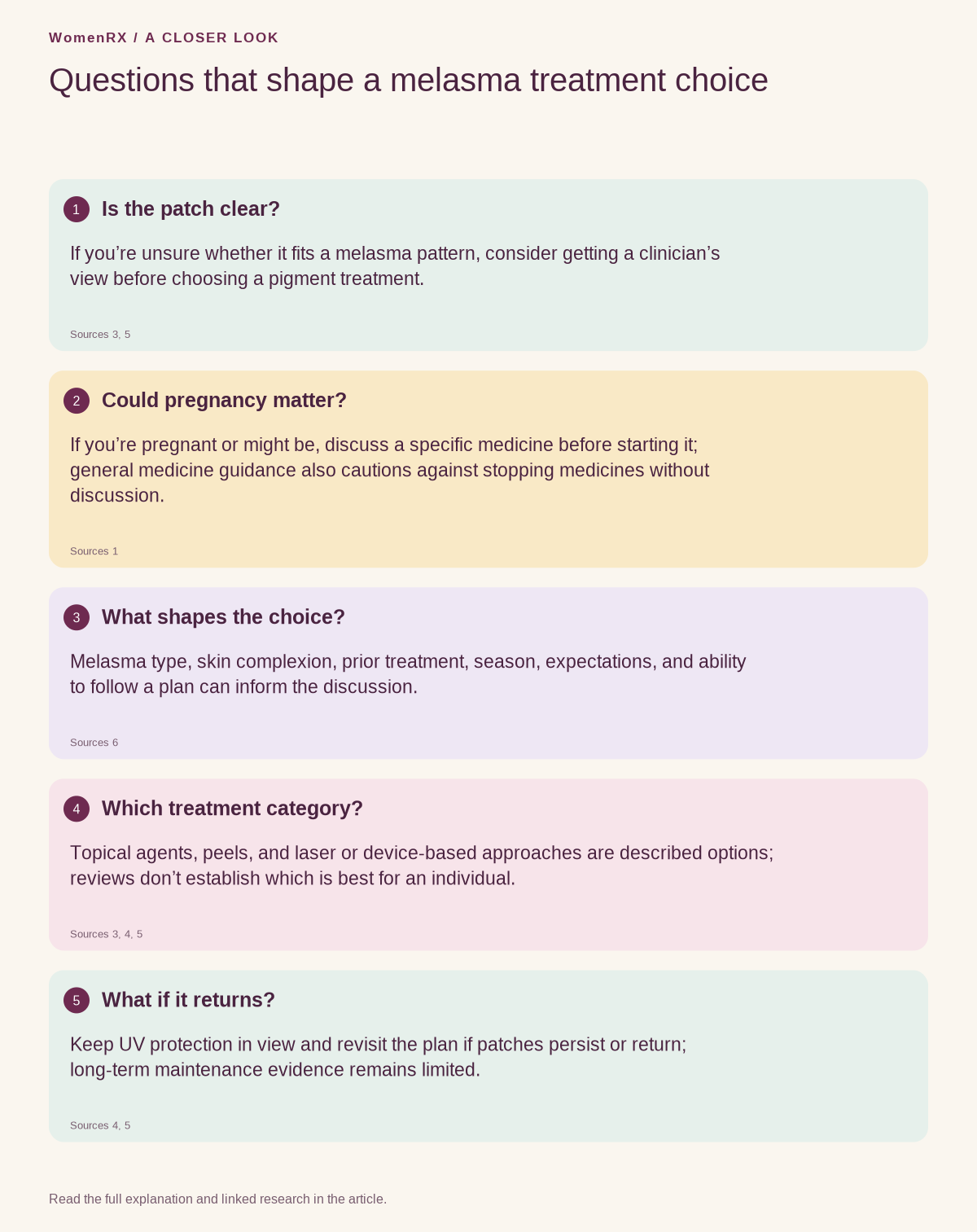
Questions that shape a melasma treatment choice
Is the patch clear?: If you’re unsure whether it fits a melasma pattern, consider getting a clinician’s view before choosing a pigment treatment.35
Could pregnancy matter?: If you’re pregnant or might be, discuss a specific medicine before starting it; general medicine guidance also cautions against stopping medicines without discussion.1
What shapes the choice?: Melasma type, skin complexion, prior treatment, season, expectations, and ability to follow a plan can inform the discussion.6
Which treatment category?: Topical agents, peels, and laser or device-based approaches are described options; reviews don’t establish which is best for an individual.345
What if it returns?: Keep UV protection in view and revisit the plan if patches persist or return; long-term maintenance evidence remains limited.45
Read the figure as text
Use these decision points to focus a treatment discussion. They help sort out which factors matter, but they don’t predict which option will work best.- Is the patch clear?: If you’re unsure whether it fits a melasma pattern, consider getting a clinician’s view before choosing a pigment treatment.35
- Could pregnancy matter?: If you’re pregnant or might be, discuss a specific medicine before starting it; general medicine guidance also cautions against stopping medicines without discussion.1
- What shapes the choice?: Melasma type, skin complexion, prior treatment, season, expectations, and ability to follow a plan can inform the discussion.6
- Which treatment category?: Topical agents, peels, and laser or device-based approaches are described options; reviews don’t establish which is best for an individual.345
- What if it returns?: Keep UV protection in view and revisit the plan if patches persist or return; long-term maintenance evidence remains limited.45
More questions, answered
Does melasma mean my birth control caused it?
No. In a survey, some women reported that patches first appeared after they used hormonal contraception, but that timing cannot prove cause or predict whether changing contraception would improve the patches. If you’re considering a change, discuss that tradeoff with the clinician who manages your contraception. 2
Sources you can check
- Pregnancy and Medicines | MedlinePlusAccessed 2026-09-25Return to first citation
- A global survey of the role of ultraviolet radiation and hormonal influences in the development of melasma.Ortonne JP, Arellano I, Berneburg M, Cestari T, Chan H, Grimes P, Hexsel D, Im S, Lim J, Lui H, Pandya A, Picardo M, Rendon M, Taylor S, Van Der Veen JP, Westerhof W. · Journal of the European Academy of Dermatology and Venereology : JEADV · 2009Return to first citation
- Melasma.Lee BW, Schwartz RA, Janniger CK. · Giornale italiano di dermatologia e venereologia : organo ufficiale, Societa italiana di dermatologia e sifilografia · 2017Return to first citation
- Advances in the treatment of melasma: a review of the recent literature.Ball Arefiev KL, Hantash BM. · Dermatologic surgery : official publication for American Society for Dermatologic Surgery [et al.] · 2012Return to first citation
- Melasma: insights and perspectives.Jadotte YT, Schwartz RA. · Acta dermatovenerologica Croatica : ADC · 2010Return to first citation
- Therapeutical approaches in melasma.Prignano F, Ortonne JP, Buggiani G, Lotti T. · Dermatologic clinics · 2007Return to first citation