Melasma Around Midlife: Hormones, Sunlight, and Treatment Choices
Brown facial patches may be melasma, but their timing alone won’t tell you whether a hormone change caused them.
Melasma can appear as brown patches on sun-exposed parts of the face and may return after treatment. Sunlight and hormones are among the factors discussed in relation to it, but patches appearing around midlife can’t, by themselves, show whether perimenopause is involved or what caused them. Sun protection and topical treatments are common approaches. If you’re considering a procedure, ask about the chance of worsening pigmentation, particularly if you have a darker skin tone. 2 3 5
Recognize the pattern without guessing the cause
Melasma often looks like irregular brown patches on the cheeks, forehead, nose, or upper lip. The patches tend to appear on sun-exposed skin. If you’ve noticed a new pattern around midlife, melasma is one possibility, but appearance alone can’t settle what the pigmentation is or why it appeared. 5
The distinction matters because melasma can fade and then return. When you weigh a treatment, ask not only whether it might lighten the patches, but also how it fits with ongoing sun protection and what happens if the color comes back. 2 3
Where hormones fit, and where they don’t
Hormones are discussed as one influence on melasma, alongside sunlight, inherited factors, and changes in the skin. That makes pregnancy history and hormonal medicines useful context when you describe when the patches first appeared or changed. But the patches themselves can’t identify a menopause transition or explain what caused them. 3 5
For example, if the patches began during pregnancy and became more noticeable again years later, both the earlier timing and your current sun exposure are worth mentioning. Neither detail, by itself, identifies the cause. You could ask the clinician who manages a hormonal medicine whether its timing is relevant to the patches and what, if anything, you should do next.
Compare treatment by benefit and risk
Sun protection is part of the plan, not an optional extra. Clinical discussions of melasma management include avoiding triggers and protecting skin from the sun. They describe sunscreens containing ingredients such as zinc oxide, titanium dioxide, and iron oxide. A dermatologist can help you fit protection into a routine you’ll actually maintain alongside treatment. 3
Topicals are a common treatment route. Hydroquinone, retinoids such as tretinoin, and azelaic acid are among the options discussed for melasma. They aren’t interchangeable recommendations: ask how a proposed treatment fits your skin and other products you use. If you’re pregnant or nursing and considering a particular azelaic acid acne cream, its US label says to ask a doctor before using that product. That label doesn’t establish safety advice for melasma treatments generally. 1 3
Procedures need a different risk conversation. Peels and light- or laser-based treatments may improve pigmentation, but they can also cause post-inflammatory hyperpigmentation, or darker color after skin irritation. That concern is particularly relevant for darker skin tones. Ask what experience a dermatologist has treating melasma in skin like yours and how they would respond if the patches darkened. 3
Small procedure studies show why a promising result isn’t a guarantee. In a retrospective study of 29 Vietnamese women with melasma and Fitzpatrick skin types III-IV, pigmentation measures improved after a particular picosecond laser treatment, but the study did not establish long-term recurrence rates. In a separate retrospective case series, 13 of 116 people treated with a different fractional laser for photorejuvenation developed new or worsening melasma. These were different lasers used in different settings, so the figures shouldn’t be compared as if they measured the same treatment’s benefits and harms. 4 6
If you’re deciding what to do next, start with two questions: “Do these patches look like melasma?” and “Which approach offers a reasonable chance of improvement without creating more pigmentation for my skin?” Your pregnancy history, hormonal medicines, skin tone, and previous response to irritating products can make that conversation more useful. The aim is a plan you understand, including what you’ll do if the patches return. 2 3 5
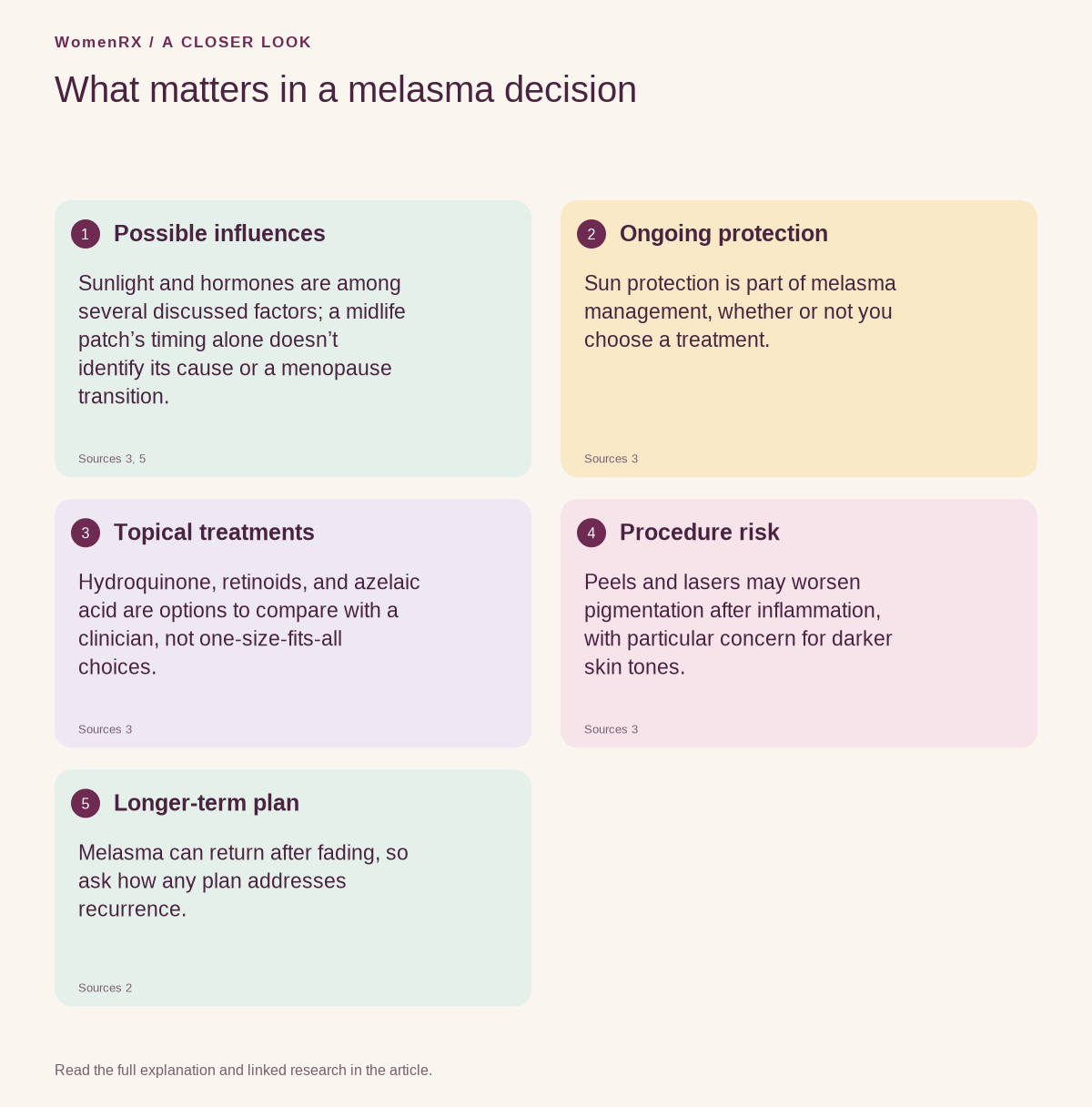
What matters in a melasma decision
Possible influences: Sunlight and hormones are among several discussed factors; a midlife patch’s timing alone doesn’t identify its cause or a menopause transition.35
Ongoing protection: Sun protection is part of melasma management, whether or not you choose a treatment.3
Topical treatments: Hydroquinone, retinoids, and azelaic acid are options to compare with a clinician, not one-size-fits-all choices.3
Procedure risk: Peels and lasers may worsen pigmentation after inflammation, with particular concern for darker skin tones.3
Longer-term plan: Melasma can return after fading, so ask how any plan addresses recurrence.2
Read the figure as text
A quick way to separate possible influences from protective measures and treatment tradeoffs.- Possible influences: Sunlight and hormones are among several discussed factors; a midlife patch’s timing alone doesn’t identify its cause or a menopause transition.35
- Ongoing protection: Sun protection is part of melasma management, whether or not you choose a treatment.3
- Topical treatments: Hydroquinone, retinoids, and azelaic acid are options to compare with a clinician, not one-size-fits-all choices.3
- Procedure risk: Peels and lasers may worsen pigmentation after inflammation, with particular concern for darker skin tones.3
- Longer-term plan: Melasma can return after fading, so ask how any plan addresses recurrence.2
More questions, answered
Does melasma mean I’m in perimenopause?
Melasma on its own can’t tell you whether you’re in perimenopause or what caused the patches. Hormones are among the influences discussed in relation to melasma, but the timing of a midlife patch doesn’t establish a cause. 3 5
Will a successful treatment keep melasma away?
Not necessarily. Melasma is described as a relapsing condition. Ask how a proposed plan addresses both fading the patches and managing their return. 2
Sources you can check
- 10% AZELAIC ACID (AZELAIC ACID CREAM) CREAM 14% AZELAIC ACID (AZELAIC ACID) CREAM [GUANGZHOU ARIEL MEDICAL TECHNOLOGY CO., LTD.] | US prescribing information and patient instructionsAccessed 2026-09-25Return to first citation
- Efficacy of natural products in the treatment of melasma: A systematic review.Morais MT, Gonçalves TLN, de Paula Soares L, Sato AFQ, Oliveira Júnior RG, Silva Almeida JRGD. · Biomedicine & pharmacotherapy = Biomedecine & pharmacotherapie · 2026Return to first citation
- Comparative effectiveness of acupuncture, fire needle, and herbal therapies for melasma: A Bayesian network meta-analysis.Dai Y, Li G, Hao P. · Medicine · 2026Return to first citation
- Efficacy of picosecond Nd:YAG 1064 nm laser in melasma treatment: a real-world retrospective analysis.Lê TT, Lê AV, Tạ HQ, Nguyễn TP, Zevini A, Martinelli D, Barini R. · Italian journal of dermatology and venereology · 2026Return to first citation
- Effectiveness of Using the AOPT-LTL Technique for the Treatment of Melasma: A Clinical Study.Jin Q, Dong R, Zhi J, Nan M, Pi L, Jin Z, Jin C. · Skin research and technology : official journal of International Society for Bioengineering and the Skin (ISBS) [and] International Society for Digital Imaging of Skin (ISDIS) [and] International Society for Skin Imaging (ISSI) · 2026Return to first citation
- Melasma Flaring and Unmasking After Treatment With a 1,927-nm Non-ablative Fractional Thulium Fiber Laser.Cancel-Artau K, Michelen-Gómez E, Gerena-Maldonado CP, Guerrero-García A, Pérez C, Martín-García R, Brau-Javier C. · Cureus · 2026Return to first citation