Dark Spots on Skin: How to Narrow Down the Cause and Choose Care
Where a mark appeared and what the skin was doing beforehand can help distinguish common causes, but some spots need an examination before any fading treatment.
A dark mark left where a rash or other inflammation healed may be post-inflammatory hyperpigmentation. Facial patches can be melasma, which is associated with sun exposure and hormonal fluctuations; separate flat marks on sun-exposed skin may have another cause. These clues aren’t a diagnosis. Protecting skin from sun matters across several types, and a new, changing, or unusual spot should be assessed before you try to fade it. 2345

Start with what happened before the mark appeared
A useful first question is whether the skin was inflamed before it darkened. Post-inflammatory hyperpigmentation (PIH) is pigment left behind after an inflammatory skin condition. If a mark appeared where a rash or another inflamed area healed, PIH is one possibility. It occurs more often and can be more pronounced in darker skin, and ongoing inflammation can keep contributing to the problem. 3
Melasma is different: it’s an acquired form of facial hyperpigmentation associated with ultraviolet exposure, hormonal fluctuations, and genetic susceptibility. It predominantly affects women, but those details don’t make every facial dark mark melasma. If you noticed pigmentation during pregnancy or another period of hormonal change, mention the timing; it can be a useful clue, not proof of the cause. 2
Some flat brown spots on sun-exposed skin may instead be solar lentigines. These are described as asymptomatic, well-defined spots on sun-exposed areas. Appearance alone can’t reliably sort every spot into a category, though: several pigment conditions can look alike, and some pigmented lesions require a different kind of assessment. 56
Use the likely cause to guide the next step
If a mark followed inflammation: Address the condition that is still irritating or inflaming the skin. For PIH, treatment centers on managing the underlying condition, sun protection, and, when appropriate, topical lightening treatments. Hydroquinone and azelaic acid are among the options discussed in the clinical literature. Irritation matters: a product that inflames the skin can worsen pigmentation, so more aggressive treatment isn’t automatically better. 3
If facial pigmentation may be melasma: Sun protection is a cornerstone of management. Treatment may include topical agents such as hydroquinone, azelaic acid, or retinoids. If you’re pregnant, don’t assume topical tretinoin is interchangeable with other options: its labeling describes reports of birth defects temporally associated with use, but says no causal link has been established and the significance of the reports is unknown. Discuss tretinoin with your prescriber before using it during pregnancy. 1 Which option makes sense depends on the diagnosis and the type of pigmentation; pigmentation closer to the skin surface tends to respond better to topical treatments than deeper pigment. 4 Melasma can be persistent 2, so don’t count on one product to produce uniform fading. 4
If the spot is isolated or doesn’t fit either pattern: Don’t assume a single brown mark is harmless sun pigmentation. A clinician can assess its history and appearance, using tools such as dermoscopy when helpful to distinguish conditions that overlap visually. If the spot is new, changing, or unusual, get it assessed rather than applying a fading treatment first. Pigmented skin conditions include lesions that need a different evaluation, and pigment treatments aren’t a substitute for diagnosis. 56
Keep sun protection simple and consistent
Photoprotection is part of care for both PIH and melasma, not just a finishing step after a lightening product. Use sunscreen and other practical sun protection, such as protective clothing, especially on the affected area. If you’re using topical tretinoin for a skin condition, its prescribing information advises minimizing sun exposure and using sunscreen and protective clothing when exposure can’t be avoided; irritation may mean the treatment needs to be paused or adjusted with the prescriber. 341
A reasonable plan is to first identify whether inflammation is ongoing, then protect the area from sun, and only then consider a treatment suited to the likely cause. If the mark’s history or appearance doesn’t fit, have it assessed before trying to fade it. Pigmentation can have overlapping causes, so the goal is a sound diagnosis and gradual improvement, not a promise that every mark will disappear. 356
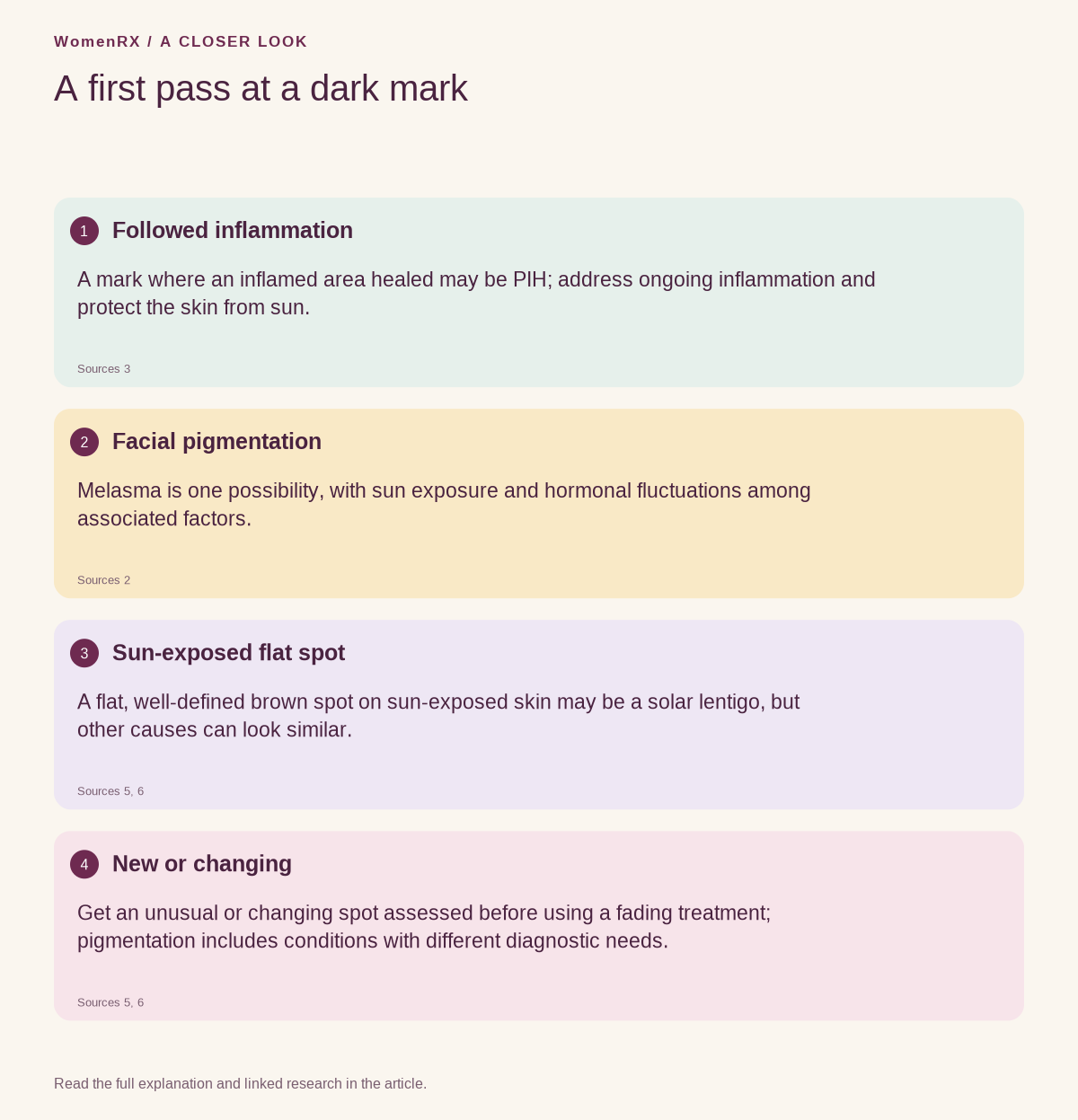
A first pass at a dark mark
Followed inflammation: A mark where an inflamed area healed may be PIH; address ongoing inflammation and protect the skin from sun.3
Facial pigmentation: Melasma is one possibility, with sun exposure and hormonal fluctuations among associated factors.2
Sun-exposed flat spot: A flat, well-defined brown spot on sun-exposed skin may be a solar lentigo, but other causes can look similar.56
New or changing: Get an unusual or changing spot assessed before using a fading treatment; pigmentation includes conditions with different diagnostic needs.56
Read the figure as text
The history behind a spot can suggest a useful next step, but appearance and timing are clues rather than a diagnosis.- Followed inflammation: A mark where an inflamed area healed may be PIH; address ongoing inflammation and protect the skin from sun.3
- Facial pigmentation: Melasma is one possibility, with sun exposure and hormonal fluctuations among associated factors.2
- Sun-exposed flat spot: A flat, well-defined brown spot on sun-exposed skin may be a solar lentigo, but other causes can look similar.56
- New or changing: Get an unusual or changing spot assessed before using a fading treatment; pigmentation includes conditions with different diagnostic needs.56
Sources you can check
- TRETINOIN CREAM [REDPHARM DRUG] | US prescribing information and patient instructionsAccessed 2026-09-25Return to first citation
- Beyond the boundaries of pigmentation and inflammation: understanding the mechanistic basis of melasma-rosacea comorbidity.Li X, Shi H, Feng Y. · Frontiers in medicine · 2026Return to first citation
- Postinflammatory hyperpigmentation: a review of the epidemiology, clinical features, and treatment options in skin of color.Davis EC, Callender VD. · The Journal of clinical and aesthetic dermatology · 2010Return to first citation
- Facial Melanosis: A Comprehensive Review of Uncommon and Common Presentations with Personal Experience.Sarkar R, Verma D. · Indian journal of dermatology · 2026Return to first citation
- Dermatoscopic Features of Hyperpigmented Dermatoses.Hua Y, Xie B, Shen Y, Song X. · Clinical, cosmetic and investigational dermatology · 2026Return to first citation
- Clinical and Dermoscopic Characteristics of Facial Hyperpigmentation Disorders in Skin of Color.Mansilla-Polo M, Díaz-Gómez CJ, Morgado-Carrasco D. · Actas dermo-sifiliograficas · 2026Return to first citation