Dark Under-Eye Circles: Match the Treatment to the Cause
Brown patches, bluish show-through, and shadows from eye bags can look similar, but they call for different approaches.
Dark circles aren’t always excess pigment. They can come from inherited or inflammation-related pigmentation, visible vessels beneath thin skin, or shadows cast by a tear trough or eye bags. These causes can overlap, so appearance is a clue, not a diagnosis. Under-eye darkness affects all genders, though it is reported more often in females and people of color. 3 Pigment-focused skin care won’t change a structural shadow, and swelling is a different question from choosing a lightening cream. 3
First, look at what makes the area appear dark
“Dark circles” describes an appearance, not one condition. A dermatologist-led consensus groups under-eye darkness into inherited or constitutional pigmentation, pigmentation following inflammation, vascular show-through, and shadows from the shape of the under-eye area. More than one may be present at once. Under-eye darkness affects all genders, though the consensus reports it more often in females and people of color. That’s why a cream that helps a brown patch may do little for a hollow that looks dark only in certain light. 3
Brown or gray-brown patches may be pigment. Constitutional pigmentation can form a curved band beneath the eyes and may involve the upper lids too. Pigmentation after inflammation may appear alongside eyelid creases, thickened skin, or nearby eczema. If the skin is irritated, addressing that irritation matters as much as considering a lightening product. 3
Blue-toned darkness may be vascular show-through. Visible capillaries or veins can show through the delicate lower-eyelid skin and become more apparent when the skin is stretched. A pigment-lightening cream isn’t designed to remove a visible vessel. 3
A dark area that changes with lighting may be a shadow. A deep tear trough or eye bags can cast darkness beneath the eye; the consensus describes this shadow as disappearing under direct light. Bags can therefore make circles look darker without the skin itself becoming more pigmented. These observations help narrow the possibilities, but they aren’t a reliable at-home diagnosis. Clinicians may use a gentle eyelid-stretch test and dermoscopy to assess what’s contributing. 3
Choose care for the likely contributor
For pigmentation, sun protection is a useful foundation. The American Academy of Dermatology recommends broad-spectrum SPF 30 or higher; a tinted sunscreen containing iron oxides also protects against visible light that can contribute to dark spots. Finding a tint that works for your skin tone can be difficult. A pigment-disorder consensus suggests a non-tinted UVA/UVB sunscreen paired with iron-oxide-containing makeup as an alternative when available tints aren’t a match. 73
Pigment-focused topical options in the consensus include azelaic acid and other lightening agents, with the choice varying by type of pigmentation. That is a treatment category, not a reason to put a strong active close to your eye on your own. The skin here is easy to irritate, and irritation can complicate pigmentation. For example, US prescribing information for topical tretinoin acne cream says to keep it away from the eyes and warns that it can cause substantial local irritation. 31
For visible vessels, the consensus lists different options, including caffeine as a topical option and laser treatment as a procedure. That list doesn’t mean either will erase every blue-toned circle. The distinction is practical: adding more pigment-lightening products may miss what you’re seeing. 3
For a tear-trough shadow, lightening agents can’t change the shape casting it. For selected shadow-effect cases, the consensus lists dermal filler; it reserves filler for this type rather than treating it as an all-purpose dark-circle solution. If eye bags are creating the shadow, identifying that shape-related contribution matters before choosing any procedure. 3
Procedures deserve a closer look than a before-and-after photo. If you’re considering a peel or laser, discuss your skin tone and any history of dark marks after irritation. The consensus recommends preparing skin before procedures for people at higher risk of post-inflammatory hyperpigmentation. 3 A systematic review of light devices found promising results for some pigmented circles but called for better-standardized measurements and further clinical trials. Another review of platelet-rich plasma and fibrin found only moderate effectiveness for periorbital hyperpigmentation amid substantial differences in how treatments were prepared. Neither finding establishes a universal treatment for every kind of under-eye darkness. 42
When the change isn’t just a dark area
A familiar, fairly stable shadow beneath both eyes is different from new swelling on one side, particularly if the eye appears to bulge or is hard to move. In a small series of people already diagnosed with orbital inflammation, one-sided involvement, swelling, bulging, and difficulty moving the eye were reported. Another small series of people diagnosed with orbital lymphoma described swelling or a visible mass as presenting findings. These studies don’t establish what a new change means for any one person. If you notice new one-sided swelling, a visible mass, bulging, or trouble moving the eye, ask a clinician to assess it rather than treating it as an ordinary dark circle. 356
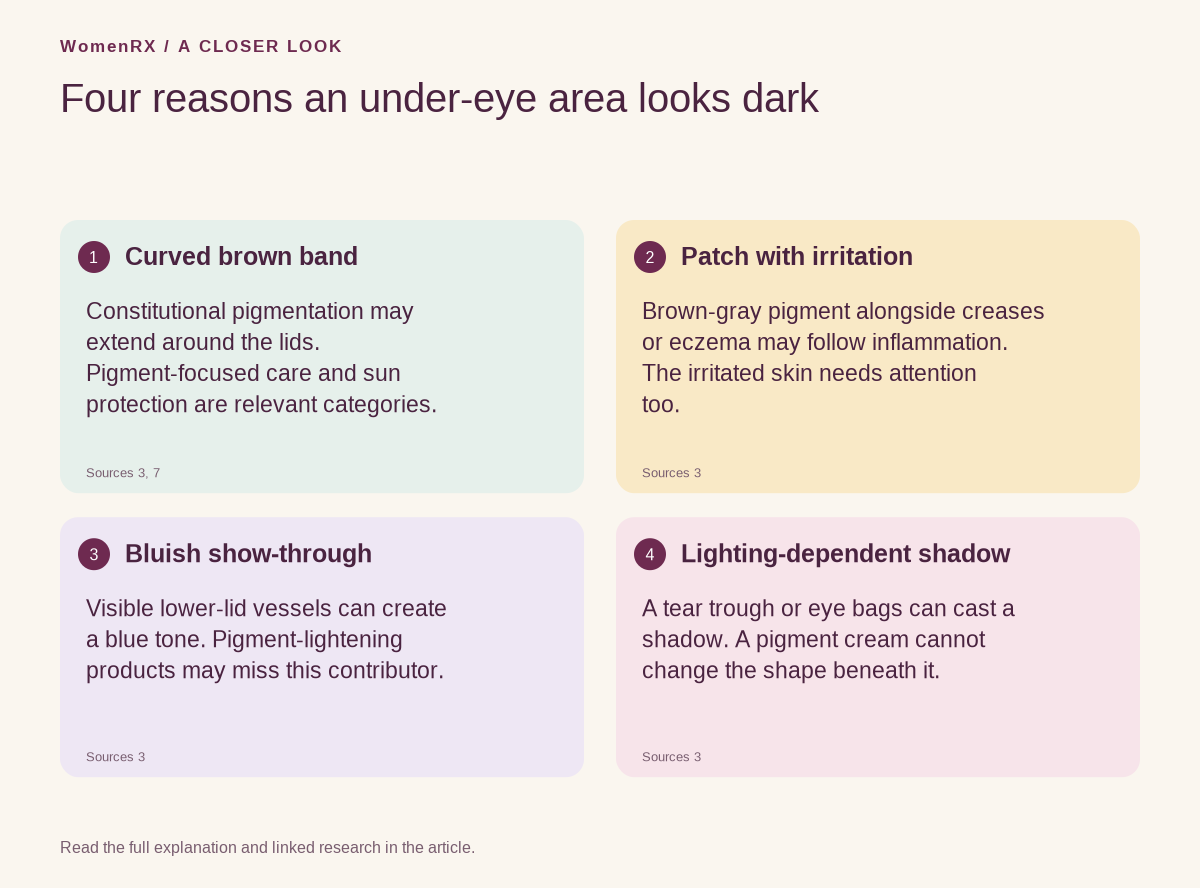
Four reasons an under-eye area looks dark
Curved brown band: Constitutional pigmentation may extend around the lids. Pigment-focused care and sun protection are relevant categories.37
Patch with irritation: Brown-gray pigment alongside creases or eczema may follow inflammation. The irritated skin needs attention too.3
Bluish show-through: Visible lower-lid vessels can create a blue tone. Pigment-lightening products may miss this contributor.3
Lighting-dependent shadow: A tear trough or eye bags can cast a shadow. A pigment cream cannot change the shape beneath it.3
Read the figure as text
The appearance offers clues to the kind of care that might fit, not a diagnosis.- Curved brown band: Constitutional pigmentation may extend around the lids. Pigment-focused care and sun protection are relevant categories.37
- Patch with irritation: Brown-gray pigment alongside creases or eczema may follow inflammation. The irritated skin needs attention too.3
- Bluish show-through: Visible lower-lid vessels can create a blue tone. Pigment-lightening products may miss this contributor.3
- Lighting-dependent shadow: A tear trough or eye bags can cast a shadow. A pigment cream cannot change the shape beneath it.3
More questions, answered
Can a cream fix hollow-looking dark circles?
A cream aimed at excess pigment won’t change a tear trough that casts a shadow. The consensus lists filler, rather than pigment-lightening agents, as a potential option for selected shadow-effect cases. 3
Sources you can check
- TRETINOIN CREAM [REDPHARM DRUG] | US prescribing information and patient instructionsAccessed 2026-09-25Return to first citation
- Platelet-Rich Plasma and Platelet-Rich Fibrin in Periorbital Esthetics: Systematic Review and Clinical Applications.Tai K, Morrissette M, Li JH, Dib M, Schechter I, Hickner A, Sclafani AP. · Facial plastic surgery clinics of North America · 2026Return to first citation
- Global consensus on the management of melanin hyperpigmentation disorders.Passeron T, Desai SR, Abdallah M, Al-Niaimi F, Dlova N, Grimes PE, Ocampo-Candiani J, Sarkar R, Xiang LF, Miot HA. · Journal of the European Academy of Dermatology and Venereology : JEADV · 2026Return to first citation
- Treatment of periorbital hyperpigmentation using light devices.Montolío-Marzo S, Montolío-Marzo E, Martínez-Gil C, Rodríguez-Iranzo G, Arias-García E, Pérez-López M. · Archivos de la Sociedad Espanola de Oftalmologia · 2024Return to first citation
- Non-specific orbital inflammation: Clinical and histopathological insights from a 6-year single-centre Malaysian cohort.Sharifah Izzati SJ, Farez Mukhriz MJ, Adlina AR, Muzaliha MN, Shahidatul Adha M. · The Medical journal of Malaysia · 2026Return to first citation
- Retrospective Evaluation of Clinical, Demographic, and Radiological Data of Orbital Lymphoma Patients: A Single Tertiary Center Experience.Ozizmirliler D, Karakaya B, Yaman A, Bajin MS, Men S, Demirkan F, Ozsan GH, Utine CA. · Beyoglu eye journal · 2025Return to first citation
- How to apply sunscreenAccessed 2026-09-25Return to first citation