Melasma: How Hormones and Sunlight Can Overlap
Facial patches can fit melasma, but their appearance alone can’t tell you whether hormones, sunlight, or both contributed.
Melasma is associated with both ultraviolet exposure and hormonal contexts such as pregnancy and hormonal contraception. These factors can overlap, and a person’s facial patches don’t reveal which one mattered most. A clinician can assess whether the pattern fits melasma and may assess pigment depth, but that is different from proving what triggered it. A focused history can add context without turning a suspected cause into certainty. 1 2 4
Why “hormonal” and “sun-related” aren’t separate boxes
Melasma commonly appears as darker patches on sun-exposed parts of the face. Ultraviolet exposure, pregnancy-related hormonal changes, hormonal contraception, and family history are all reported as possible contributors. That means the familiar patch pattern can point toward melasma, but it doesn’t sort cases into a reliably “hormonal” group and a “sun-only” group. Several influences may be involved in the same person. 1 2 3
Sun exposure may matter even when a hormonal context is part of the story. In a survey of 324 women being treated for melasma at nine clinics, more time outdoors was associated with higher odds of melasma first appearing during pregnancy. Because this was a questionnaire survey of people already being treated, the finding describes an association in that group. It doesn’t establish that outdoor time caused an individual case. 1
What pregnancy and contraception can suggest
Melasma can appear before, during, or after pregnancy. In that clinic survey, participants reported onset after a pregnancy, during pregnancy, or before pregnancy; onset after pregnancy was the most frequently reported timing. The study’s participants weren’t a representative sample of all pregnant women, so these figures shouldn’t be read as the chance that melasma will develop in pregnancy. They do show why timing can be useful history, without making pregnancy the explanation for every case. 1
Hormonal contraception can be another clue, not a verdict. In the same survey, 25% of women who had used hormonal contraception said their melasma first appeared after using it. That was their reported timing, not proof the contraception caused the patches, and it doesn’t mean a similar share of all people using contraception will develop melasma. 1
Family history may also help complete the picture. Nearly half of the surveyed women reported a family history, but a family pattern does not establish one cause or rule out other contributors. Reviews also list factors such as thyroid abnormalities and certain medications among possible associations. Those details may be worth mentioning when they apply, but they don’t identify a cause from appearance alone. 1 2 3
What a clinician can learn from appearance
Melasma often presents as fairly symmetric darker patches on the face, and it tends to involve sun-exposed skin. Those features can support recognition of a familiar pattern. They cannot show whether pregnancy, contraception, family susceptibility, ultraviolet exposure, or a combination played the leading role. The causes are not reliably written on the skin. 2 3
A clinician may also assess whether pigment appears mainly in the outer skin layer, deeper in the skin, or in a mixture of both. These are descriptions of pigment depth, not labels for hormonal versus sun-driven melasma. A review describes Wood’s light examination as one way melasma has been classified by clinical type; that classification does not establish the personal trigger. 2 4
This distinction is useful when discussing expectations: identifying a pattern or pigment depth is not the same as reconstructing why it began. Research reviews describe melasma as having multiple possible influences, and the survey evidence documents reported associations rather than a test that can assign a single cause to one person. 1 2
A focused history that adds context
If you’re discussing facial patches with a clinician, these details can help frame the question:
- Timing: Did the patches first appear before, during, or after pregnancy? When did you first notice them?
- Hormonal contraception: Did the onset seem to follow starting contraception? Share the timing, while keeping in mind that sequence alone cannot prove cause.
- Light exposure: Did you spend more time outdoors around the time the patches began, for work or other reasons?
- Family pattern: Has a close family member had similar pigmentation?
- Other relevant context: Mention relevant medications or a thyroid condition, if either applies, since reviews list these among possible associations.
These are clues for a fuller conversation, not a scoring system or a way to diagnose the cause yourself. A useful summary might be: “The patches began during pregnancy, and I was also working outdoors more then.” That preserves both parts of the story without forcing a choice between hormones and sunlight. 1 2 3
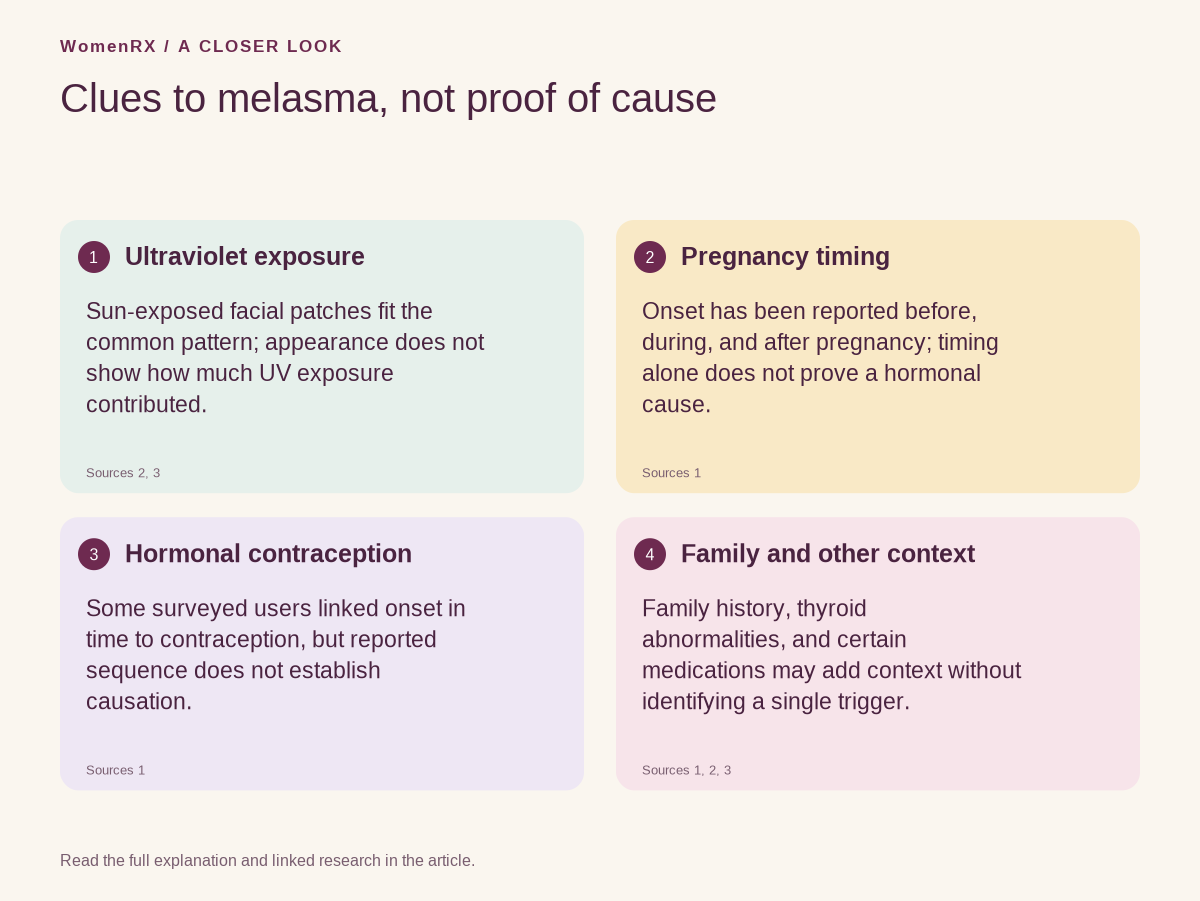
Clues to melasma, not proof of cause
Ultraviolet exposure: Sun-exposed facial patches fit the common pattern; appearance does not show how much UV exposure contributed.23
Pregnancy timing: Onset has been reported before, during, and after pregnancy; timing alone does not prove a hormonal cause.1
Hormonal contraception: Some surveyed users linked onset in time to contraception, but reported sequence does not establish causation.1
Family and other context: Family history, thyroid abnormalities, and certain medications may add context without identifying a single trigger.123
Read the figure as text
Several contexts can be relevant at once. The clue may guide the history, but it cannot independently identify why one person’s patches began.- Ultraviolet exposure: Sun-exposed facial patches fit the common pattern; appearance does not show how much UV exposure contributed.23
- Pregnancy timing: Onset has been reported before, during, and after pregnancy; timing alone does not prove a hormonal cause.1
- Hormonal contraception: Some surveyed users linked onset in time to contraception, but reported sequence does not establish causation.1
- Family and other context: Family history, thyroid abnormalities, and certain medications may add context without identifying a single trigger.123
Sources you can check
- A global survey of the role of ultraviolet radiation and hormonal influences in the development of melasma.Ortonne JP, Arellano I, Berneburg M, Cestari T, Chan H, Grimes P, Hexsel D, Im S, Lim J, Lui H, Pandya A, Picardo M, Rendon M, Taylor S, Van Der Veen JP, Westerhof W. · Journal of the European Academy of Dermatology and Venereology : JEADV · 2009Return to first citation
- Melasma.Lee BW, Schwartz RA, Janniger CK. · Giornale italiano di dermatologia e venereologia : organo ufficiale, Societa italiana di dermatologia e sifilografia · 2017Return to first citation
- Advances in the treatment of melasma: a review of the recent literature.Ball Arefiev KL, Hantash BM. · Dermatologic surgery : official publication for American Society for Dermatologic Surgery [et al.] · 2012Return to first citation
- Therapeutical approaches in melasma.Prignano F, Ortonne JP, Buggiani G, Lotti T. · Dermatologic clinics · 2007Return to first citation