Which Melasma Treatments Are Worth Discussing?
Sunscreen supports every treatment plan, while the choice of medicine or procedure depends on expected benefit, tolerability, and what you’ll do if pigment returns.
For confirmed melasma, start the treatment conversation with sun protection and a plan for maintaining results. Hydroquinone and other topicals can improve pigment over months; a clinician may also consider a combination containing hydroquinone and a topical steroid, with limits on prolonged use. Oral tranexamic acid and procedures need a closer look at added benefit and risk. Relapse is common, so no short course promises lasting clearance. 2 3 4 6 7

A useful way to compare melasma treatments is to ask two questions: What might this add to sun protection, and what happens when the initial treatment ends? Melasma can respond to treatment and still return. That makes a tolerable routine and a maintenance plan just as relevant as the first signs of fading. 2 3
Sun protection is the foundation, not the whole promise
Clinical trials of topical melasma treatments commonly included sunscreen in both comparison groups. Participants in one oral-medicine trial continued sunscreen alone during follow-up after their medicines stopped. Those designs reflect the role of sun protection in a treatment plan, but they don’t tell us that sunscreen alone will clear established melasma. 3 4 5
Tinted sunscreen is worth discussing if you’re choosing something you can use consistently. It was part of the routine in trials comparing hydroquinone with other topicals. Because both groups used it, those trials cannot tell you how much of the improvement came from the tint or whether one sunscreen is best. 3 5
Topical treatment: compare the whole plan, not one ingredient
Hydroquinone-containing topicals have long been a standard reference point in melasma research. In a 90-day randomized trial of 50 women with facial melasma, average severity scores fell by 33% with 4% hydroquinone and 43% with 0.2% Thiamidol. Both groups used tinted sunscreen, and the difference between the topical groups was not statistically significant. That supports discussing alternatives when tolerability matters, not declaring the two treatments interchangeable for everyone. 2 3
Another trial compared 4% hydroquinone with 5% cysteamine in 40 women, again with tinted sunscreen in both groups. After 120 days, average severity scores had fallen by 53% with hydroquinone and 38% with cysteamine; hydroquinone performed better on that measure. Burning and redness were notable local effects with cysteamine, though neither group had severe adverse effects reported in this small study. 5
There’s also an important difference between a single-ingredient topical and a supervised combination. A melasma maintenance study used an initial triple-combination treatment containing hydroquinone and a topical corticosteroid. Its authors described this type of combination as first-line treatment and flagged side effects with prolonged use. The study does not establish a safe long-term schedule for an individual product. If you’re offered a compounded cream, ask what every ingredient is, how the initial course will be assessed, and what replaces it for maintenance rather than assuming a combination is suitable for indefinite use. 6
Topical results are usually assessed over months in these trials, not days. If a product causes bothersome irritation, that matters to the decision: a plan you cannot comfortably continue may not be the right plan for your skin. Longer-term maintenance and safety remain less well studied than initial improvement. 2 3 5
Oral tranexamic acid: stronger add-on result, broader safety question
Oral tranexamic acid has been studied as an addition to hydroquinone and sunscreen, not as a replacement for either. In one randomized trial of 50 people with moderate-to-severe melasma, average severity scores fell by 55% after three months with the oral medicine, compared with 10.9% with placebo capsules. Both groups used hydroquinone and sunscreen. Three months after the medicines stopped, with participants using sunscreen alone, scores remained 42% below baseline in the tranexamic-acid group and 4.7% below baseline in the placebo group. That is a meaningful finding from one small trial, not proof of lasting clearance or long-term safety. 4
This is not an ingredient to self-start for a skin concern. Tranexamic acid affects blood clotting, and medicine guidance identifies a small added risk of deep-vein thrombosis when it’s taken with the combined contraceptive pill. If you take the combined pill, tell the prescriber before discussing tranexamic acid. No serious adverse events were reported among the 50 participants in the melasma trial, but a study that size cannot settle uncommon risks. 1 4
Before paying for a procedure, ask what it adds
Chemical peels and laser treatments are among the options studied for melasma, but evidence for durable benefit is limited. Worsening pigmentation after laser treatment is a particular concern raised for darker skin types. 2 6
A controlled split-face trial tested a specific low-fluence laser approach while participants also received hydroquinone and sunscreen. The laser-treated side did not show a significant improvement in melasma severity beyond the control side, and patient-reported improvement had declined by the six-month follow-up. That does not rule out every procedure. It does make “What benefit do you expect beyond my topical plan, and what if the pigment worsens?” a more useful question than assuming a procedure must work faster or better. 7
Pregnancy or breastfeeding changes the treatment conversation
Pregnancy-related hormonal changes are a recognized melasma risk factor, but pregnancy is not the cause of every case. Melasma also occurs outside pregnancy, and its underlying causes are not fully understood. 2
If you’re pregnant, planning pregnancy, or breastfeeding, say so before choosing a topical, compounded combination, or oral medicine. The melasma trials discussed here do not establish treatment safety in those circumstances. That calls for an ingredient-by-ingredient decision, not an assumption that all melasma treatments carry the same risk. 2 3 4 5 6
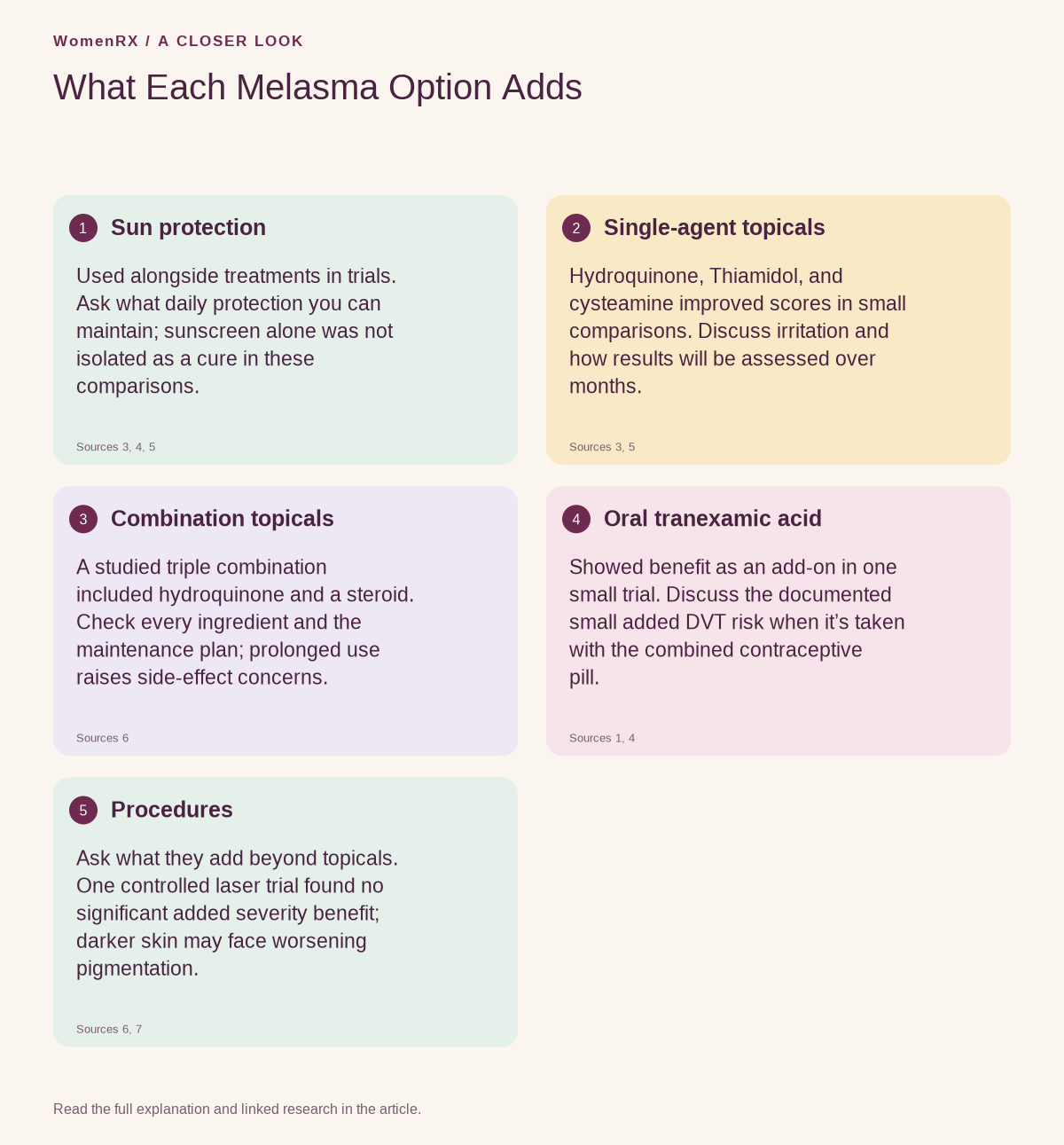
What Each Melasma Option Adds
Sun protection: Used alongside treatments in trials. Ask what daily protection you can maintain; sunscreen alone was not isolated as a cure in these comparisons.345
Single-agent topicals: Hydroquinone, Thiamidol, and cysteamine improved scores in small comparisons. Discuss irritation and how results will be assessed over months.35
Combination topicals: A studied triple combination included hydroquinone and a steroid. Check every ingredient and the maintenance plan; prolonged use raises side-effect concerns.6
Oral tranexamic acid: Showed benefit as an add-on in one small trial. Discuss the documented small added DVT risk when it’s taken with the combined contraceptive pill.14
Procedures: Ask what they add beyond topicals. One controlled laser trial found no significant added severity benefit; darker skin may face worsening pigmentation.67
Read the figure as text
Compare the role of each approach with the question most likely to change a treatment decision.- Sun protection: Used alongside treatments in trials. Ask what daily protection you can maintain; sunscreen alone was not isolated as a cure in these comparisons.345
- Single-agent topicals: Hydroquinone, Thiamidol, and cysteamine improved scores in small comparisons. Discuss irritation and how results will be assessed over months.35
- Combination topicals: A studied triple combination included hydroquinone and a steroid. Check every ingredient and the maintenance plan; prolonged use raises side-effect concerns.6
- Oral tranexamic acid: Showed benefit as an add-on in one small trial. Discuss the documented small added DVT risk when it’s taken with the combined contraceptive pill.14
- Procedures: Ask what they add beyond topicals. One controlled laser trial found no significant added severity benefit; darker skin may face worsening pigmentation.67
More questions, answered
If melasma fades, can I stop thinking about maintenance?
Probably not. Relapse is frequent, and studies have not established one reliable long-term maintenance approach for everyone. Ask what the plan is after the initial treatment rather than treating fading as a guarantee that the pigment will stay away. 2 3 6
Sources you can check
- About tranexamic acid - NHSAccessed 2026-09-25Return to first citation
- Advances in the treatment of melasma: a review of the recent literature.Ball Arefiev KL, Hantash BM. · Dermatologic surgery : official publication for American Society for Dermatologic Surgery [et al.] · 2012Return to first citation
- Efficacy and safety of topical isobutylamido thiazolyl resorcinol (Thiamidol) vs. 4% hydroquinone cream for facial melasma: an evaluator-blinded, randomized controlled trial.Lima PB, Dias JAF, Cassiano DP, Esposito ACC, Miot LDB, Bagatin E, Miot HA. · Journal of the European Academy of Dermatology and Venereology : JEADV · 2021Return to first citation
- Randomised, controlled, double-blind study of combination therapy of oral tranexamic acid and topical hydroquinone in the treatment of melasma.Shihab N, Prihartono J, Tovar-Garza A, Agustin T, Legiawati L, Pandya AG. · The Australasian journal of dermatology · 2020Return to first citation
- A comparative study of topical 5% cysteamine versus 4% hydroquinone in the treatment of facial melasma in women.Lima PB, Dias JAF, Cassiano D, Esposito ACC, Bagatin E, Miot LDB, Miot HA. · International journal of dermatology · 2020Return to first citation
- A randomized controlled pilot study of a proprietary combination versus sunscreen in melasma maintenance.Chatterjee M, Neema S, Rajput GR. · Indian journal of dermatology, venereology and leprology · 2021Return to first citation
- Treatment of Melasma Using Low-Fluence QS Nd: YAG (1064 nm) Laser: A Blind, Randomized, Placebo-Controlled Trial.Sadeghpour M, Laughter M, Rizzo SI, Depina J, Petrell K, Arndt KA, Dover JS. · Dermatologic surgery : official publication for American Society for Dermatologic Surgery [et al.] · 2026Return to first citation