Can Kettlebells Fit a Menopause-Era Strength Routine?
Kettlebells can be a strength-training option, but the choice depends more on the movements you want to learn than on a proven menopause-specific benefit.
Yes, kettlebells can fit if they suit your goals and you have a way to learn the movements you want to do. A postmenopausal trial found benefits from a supervised program that mixed resistance exercise with other activities, not from kettlebells alone. It doesn’t establish that kettlebells produce more fat loss than other resistance options. 3
What the research can tell you
Kettlebells are one possible way to do resistance exercise. Research on resistance training and mixed exercise programs can help explain what exercise may contribute, but it doesn’t compare kettlebells with other resistance equipment.
For example, a trial in 54 women who were one to five years past menopause and had osteopenia or osteoporosis tested a supervised program combining resistance exercise with aerobic dance and jumping. At the study’s 13-month endpoint, the exercise group had a greater reduction in total body fat than the low-intensity comparison group. Because the program combined several types of exercise, those results can’t be attributed to resistance training alone, let alone kettlebells. Participants also received calcium and vitamin D. 3
A review of exercise and other non-drug interventions in women aged 60 and older with sarcopenic obesity found improvements in some body-composition and strength measures. The interventions varied, and the review’s description doesn’t establish the participants’ menopause status. Its findings support exercise broadly, not a particular piece of equipment. 2
So, if weight loss is your main goal, these studies don’t show that kettlebells produce greater fat loss than other resistance options. They also don’t tell us what a kettlebell-only routine would do.
What changes when you pick up a kettlebell
A kettlebell can be used for a controlled lift, such as standing up from a squat while holding the bell near your chest. It can also be used for a swing, where the bell moves in an arc. Those are different learning tasks: holding a weight through a squat is not the same as controlling a moving weight through repeated swings. If swings appeal to you but you’re new to them, access to someone who can teach and observe the movement is a meaningful part of the choice.
Machines offer a different starting point: the equipment sets much of the path of movement. Dumbbells give you separate weights to hold, while a kettlebell has a handle above the weight. Bands offer resistance without a weight to lift. These descriptions tell you what using each option involves, not which delivers a better result. A review of progressive exercise covered varied training approaches but did not establish whether kettlebells, machines, bands, or other free weights are more effective than one another. 1
Choose the option that fits the job
If you want to build a strength routine and like learning free-weight movements, kettlebells may be a good fit. You don’t have to make swings the price of entry: consider whether the controlled lifts you want to learn appeal to you, and whether you have space and access to instruction for them. In the postmenopausal trial, the supervised program began with time devoted to learning movements and lifting technique. That supports taking the learning step seriously, though the trial didn’t test a kettlebell teaching method. 3
If you’d rather use a machine’s set movement path, already own dumbbells, or have easier access to bands, those are reasonable factors to weigh. The studies here don’t establish an effectiveness ranking among those tools. 1 For body-composition goals in particular, keep the distinction clear: the postmenopausal fat-loss result came from a supervised program with several kinds of exercise, not a test of what happens when someone picks up a kettlebell. 3
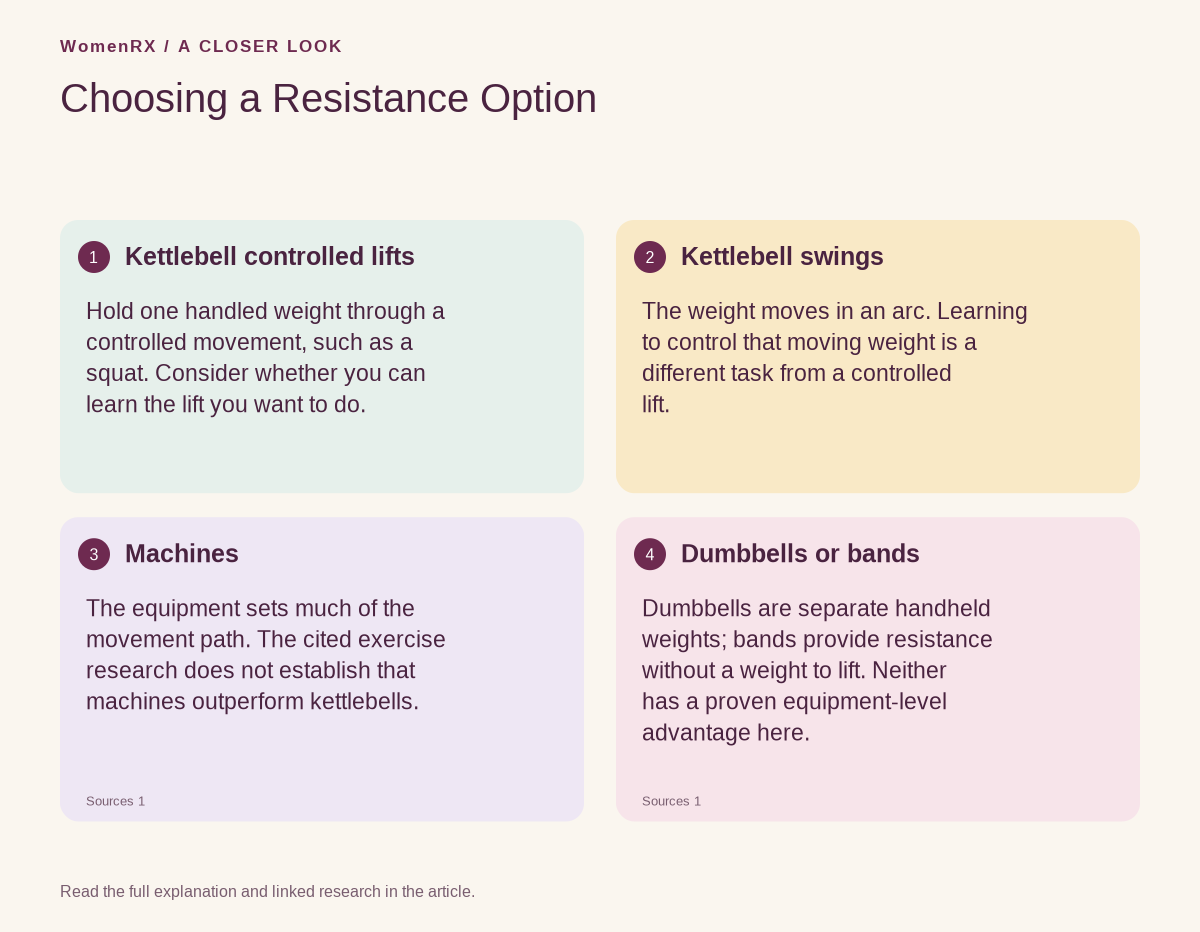
Choosing a Resistance Option
Kettlebell controlled lifts: Hold one handled weight through a controlled movement, such as a squat. Consider whether you can learn the lift you want to do.
Kettlebell swings: The weight moves in an arc. Learning to control that moving weight is a different task from a controlled lift.
Machines: The equipment sets much of the movement path. The cited exercise research does not establish that machines outperform kettlebells.1
Dumbbells or bands: Dumbbells are separate handheld weights; bands provide resistance without a weight to lift. Neither has a proven equipment-level advantage here.1
Read the figure as text
Compare what you would handle and learn; the cited studies do not rank these tools by results.- Kettlebell controlled lifts: Hold one handled weight through a controlled movement, such as a squat. Consider whether you can learn the lift you want to do.
- Kettlebell swings: The weight moves in an arc. Learning to control that moving weight is a different task from a controlled lift.
- Machines: The equipment sets much of the movement path. The cited exercise research does not establish that machines outperform kettlebells.1
- Dumbbells or bands: Dumbbells are separate handheld weights; bands provide resistance without a weight to lift. Neither has a proven equipment-level advantage here.1
Sources you can check
- Effectiveness of Exercise Loading on Bone Mineral Density and Quality of Life Among People Diagnosed with Osteoporosis, Osteopenia, and at Risk of Osteoporosis-A Systematic Review and Meta-Analysis.Alnasser SM, Babakair RA, Al Mukhlid AF, Al Hassan SSS, Nuhmani S, Muaidi Q. · Journal of clinical medicine · 2025Return to first citation
- Effects of non-pharmacological interventions on body composition and physical function in older women with sarcopenic obesity: a meta-analysis.Zeng C, Du H, Zheng J, Wang Y, Liu K, Chen Z. · Frontiers in public health · 2025Return to first citation
- Changes in Menopausal Risk Factors in Early Postmenopausal Osteopenic Women After 13 Months of High-Intensity Exercise: The Randomized Controlled ACTLIFE-RCT.Hettchen M, von Stengel S, Kohl M, Murphy MH, Shojaa M, Ghasemikaram M, Bragonzoni L, Benvenuti F, Ripamonti C, Benedetti MG, Julin M, Risto T, Kemmler W. · Clinical interventions in aging · 2021Return to first citation